
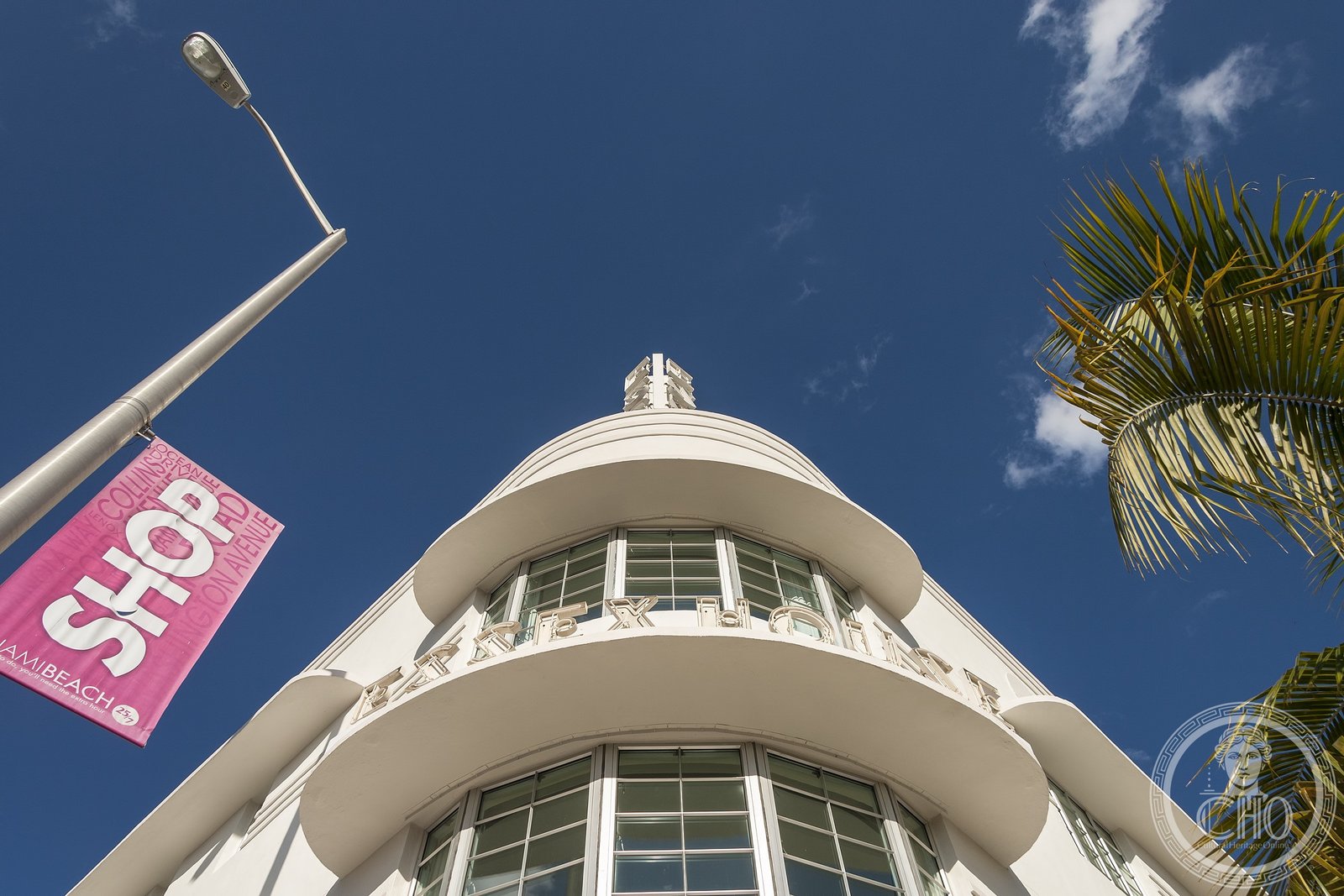
On Collins Avenue at the heart of South Beach’s Art Deco Historic District, the Essex House Hotel is one of Henry Hohauser’s most accomplished Streamline Moderne designs — a 1938 building whose rounded towers, speed-line ornament, and nautical references embody the optimistic geometric vocabulary that made Miami Beach the largest collection of Art Deco architecture in the United States.
At a glance
The Essex House Hotel at 1001 Collins Avenue is one of the defining buildings of Miami Beach’s Art Deco Historic District — the largest concentration of Art Deco and Streamline Moderne architecture in the world, listed on the National Register of Historic Places in 1979 as the first historic district of twentieth-century buildings recognized by the National Register. Designed in 1938 by Henry Hohauser, the most prolific and influential architect of the Miami Beach Deco movement, the Essex House exemplifies the Streamline Moderne variant of Art Deco: a horizontal emphasis, rounded corners, porthole windows, and the aerodynamic ornamental vocabulary borrowed from ocean liners and aircraft design that gave Miami Beach’s best buildings their distinctive nautical character. The building’s white stucco facade, eyebrow sun shades, and its Collins Avenue corner presence make it one of the neighborhood’s most photographed landmarks.
Key facts
- Address: 1001 Collins Avenue, Miami Beach, FL 33139
- Opened: 1938
- Architect: Henry Hohauser (1895–1963)
- Style: Streamline Moderne / Tropical Art Deco
- Designation: Contributing structure, Miami Beach Architectural District (NRHP since 1979)
- GPS: 25.7792° N, 80.1311° W
History
Miami Beach in 1938 was completing the most sustained period of architectural production in its history. The decade between 1930 and 1940 had transformed what had been a barrier island of beach hotels and seasonal entertainment into a dense urban neighborhood of hotels, apartment buildings, and commercial structures, almost all built in the emerging styles of the decade: Art Deco, Streamline Moderne, and the Tropical Deco variant developed specifically for the Florida climate, which combined the geometric and aerodynamic vocabulary of the national styles with an openness to light, breeze, and color suited to the subtropical environment.
Henry Hohauser had arrived in Miami Beach from New York in 1932 and quickly became the dominant figure in the local architectural scene. Working with remarkable speed and consistent quality, he designed dozens of the district’s most significant hotels, apartment buildings, and commercial structures throughout the 1930s and into the 1940s. His work for the Essex House represented a mature expression of his Streamline Moderne approach: the horizontal banding that the style inherited from international modernism, combined with the nautical references — rounded corners, porthole windows, eyebrow sun shades — that gave South Beach its distinctive character.
The Miami Beach Architectural District was designated a National Register Historic District in 1979, the first twentieth-century district in the country to receive that recognition. The designation came after years of advocacy by the Miami Design Preservation League, founded in 1976 by Barbara Baer Capitman, which had fought the widespread demolition of the Deco buildings that was occurring as the neighborhood declined from its mid-century peak. The Essex House, as one of Hohauser’s major works, was central to the argument for the district’s historic significance.
What you see
The Essex House presents Streamline Moderne at its most characteristic: a white stucco facade whose horizontal emphasis is achieved through the continuous banding of the building’s floors, the eyebrow sun shades projecting over the windows, and the rounded towers at the building’s corners that give it its aerodynamic profile. The nautical references — porthole windows, the smooth curves that recall the prow of an ocean liner, the overall suggestion of a vessel in motion — were deliberate evocations of the ocean-going culture that gave Miami Beach its character and its clientele.
The Collins Avenue facade is the building’s primary face: a composition that balances the dynamic Streamline elements against the formal requirements of a hotel entrance, with the marquee and the rhythm of the ground-floor windows providing the transitional scale between the building and the street. The Essex House sits within a block of Collins Avenue that preserves a remarkably intact sequence of 1930s-1940s hotel facades, giving the visitor a sense of the neighborhood’s original character that is increasingly difficult to find in other American cities of comparable ambition.
Practical information
- Hotel: Currently operating as a hotel; check current management for reservations and amenities
- Walking the District: The Miami Beach Architectural District is best experienced on foot; the Art Deco Welcome Center at Ocean Drive and 10th Street offers walking tours and maps of the historic buildings
- Best time: The South Beach neighborhood is most pleasant in the early morning or late afternoon; Collins Avenue sees significant foot traffic throughout the day
- Ocean Drive: One block east on Ocean Drive is the heart of the historic district, with the greatest concentration of oceanfront Art Deco hotels
Getting there
Miami Beach is connected to the mainland by causeway. Miami International Airport (MIA) is approximately 12 miles from South Beach via the MacArthur Causeway or Julia Tuttle Causeway. Fort Lauderdale-Hollywood International Airport (FLL) is 30 miles north and serves as an alternative hub. The South Beach area is walkable from the Collins Avenue hotels, with the Art Deco Historic District compact enough to explore entirely on foot. Public buses connect South Beach to mainland Miami; water taxis operate between Miami and Miami Beach. The Essex House is on Collins Avenue at 10th Street, two blocks from Ocean Drive and three blocks from the beach.
Nearby
- Colony Hotel (1935) — one of the most iconic buildings of the Art Deco Historic District, on Ocean Drive at 7th Street, with its neon Colony sign that has become the symbol of South Beach; designed by Henry Hohauser, it represents the earlier, more ornamental phase of his Miami Beach work
- Art Deco Welcome Center — the visitor center of the Miami Design Preservation League at Ocean Drive and 10th Street, which organizes walking tours of the historic district, maintains an exhibition on the history of Art Deco in Miami Beach, and operates the gift shop of the preservation organization whose advocacy saved these buildings
- Bass Museum of Art — Miami Beach’s principal art museum, in a 1930 Deco building on Collins Avenue at 21st Street designed by Russell Pancoast, with collections of European old masters, contemporary art, and temporary exhibitions; the building itself is a significant Art Deco structure within the broader Miami Beach architectural landscape
- Wolfsonian-FIU Museum — the museum of design and propaganda history at Washington Avenue and 10th Street, housed in a 1927 Deco storage facility whose restoration won the National Trust for Historic Preservation’s highest award; the collections focus on design, architecture, and visual culture from 1885 to 1945, making it the ideal companion to a walking tour of the Deco district
Sources
- National Register of Historic Places, Miami Beach Architectural District nomination
- Miami Design Preservation League documentation and archives
- Capitman, Barbara Baer. Deco Delights: Preserving the Beauty and Joy of Miami Beach Architecture. E.P. Dutton, 1988.
- Capitman, Kinerk, and Wilhelm. Rediscovering Art Deco USA. Viking Studio, 1994.
- Florida Division of Historical Resources architectural surveys
Find it on the map
See this place and what’s around it →📷 Become a Cultural Heritage Online photographer
Share your photos of places: they stay published under your name as the author. The more they're seen, the more you get noticed — and soon a contest will reward the most appreciated photos.
Log in or sign up free to add a photoIs this page about you?
This page is read by travellers and heritage enthusiasts who find it on Google. Tell us how you are connected to this place and we will take it from there.