
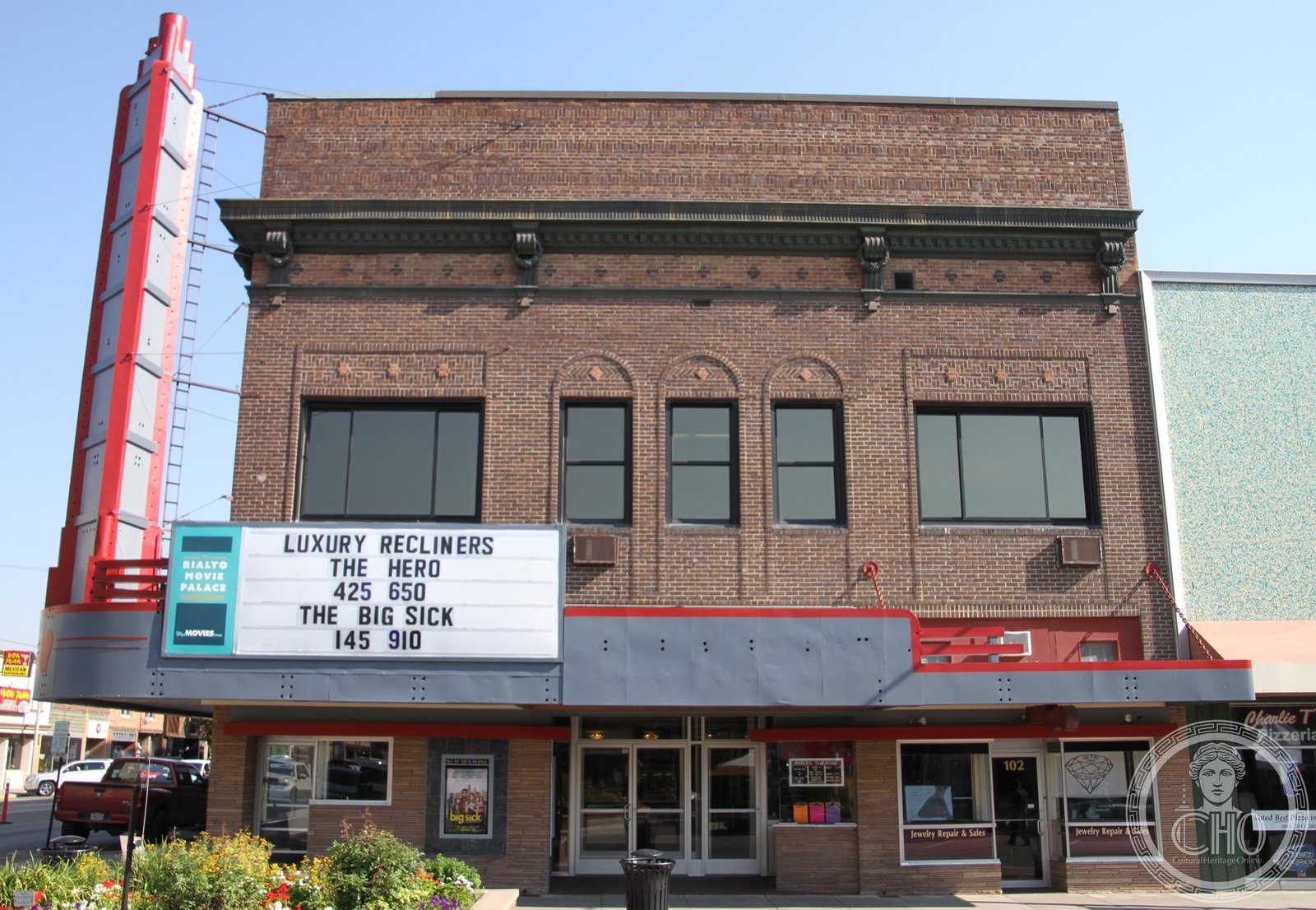
On East Second Street in the heart of Casper, the Rialto Theater has stood as Wyoming’s most significant historic cinema since it opened in 1921 — a classic Art Deco movie palace built at the height of the silent film era whose facade and auditorium brought the full ambition of the national theatrical design vocabulary to the commercial capital of Wyoming’s energy-producing heartland.
At a glance
The Rialto Theater on East Second Street is one of the most significant historic commercial buildings in Casper and the most architecturally significant theater in Wyoming. Opened in 1921 as the New Lyric Theater, it reflected Casper’s growing ambitions as the commercial hub of the Wyoming oil country — a city that had grown rapidly on the strength of the petroleum industry and whose downtown buildings measured up to those of much larger American cities. The theater served Casper audiences through the silent and sound film eras, the golden age of Hollywood, and into the postwar decades, and its historic design — the ornamental facade, the letterforms of the marquee, the appointed auditorium — gave the city a cultural landmark commensurate with its economic importance.
Key facts
- Address: 102 East Second Street, Casper, WY 82601
- Opened: 1921 (as New Lyric Theater)
- Style: Art Deco
- Designation: National Register of Historic Places
- GPS: 42.8667° N, 106.3126° W
History
Casper in the early 1920s sat at the center of Wyoming’s petroleum industry: a city that had transformed from a cattle-shipping point on the Oregon Trail into an oil-refining hub after the discovery of the Salt Creek oil field to the north — one of the most productive oil fields in the history of the American West — and the subsequent development of refining and petrochemical facilities that made Casper the industrial capital of Wyoming. The city’s population and economy in the early 1920s supported downtown investment of a scale and quality that reflected its importance to the surrounding region.
The motion picture industry in 1921 was entering its most ambitious era, with purpose-built theaters replacing converted halls across the country. The New Lyric Theater opened in this context, designed for the cinematic experience of the early silent era and serving Casper audiences as the industry transitioned first to sound and then through the full arc of Hollywood’s golden age. Its historic design — an ornamental facade and the formal lobby and auditorium sequence that gave the movie palace experience its theatrical quality — was of its moment and of its commercial context: a building that announced the ambitions of a Wyoming city that took its role in the national economy seriously.
The theater served Casper through the oil booms and contractions of the mid-twentieth century and into the era when the economics of single-screen downtown cinemas became untenable. Its importance to the city’s architectural heritage has been recognized through its listing on the National Register of Historic Places, and its survival as a commercial building is itself remarkable given the redevelopment pressures that have transformed most Wyoming downtowns in the postwar era.
What you see
The East Second Street facade presents the Rialto Theater’s historic character: a prominent marquee projecting over the sidewalk and the signage that identifies the building from a distance in downtown Casper. The facade’s composition gives the theater its presence on a downtown that retains significant historic fabric from the oil-boom decades of the early twentieth century.
The auditorium provided audiences with the elaborately appointed interior that the movie palace tradition demanded: a room designed to make the experience of attending a film feel like an event, with decorative plasterwork, atmospheric lighting, and the spatial configuration of orchestra, balcony, and boxes that gave the audience a sense of occasion and community. The building’s design reflects the confidence of early-1920s Casper in its own commercial importance and its aspiration to provide a cultural amenity of national quality.
Practical information
- Current status: Check local Casper arts organizations and preservation groups for current use and access information
- Downtown Casper: East Second Street and the surrounding blocks preserve significant historic commercial architecture from the early twentieth-century oil boom era; the National Historic District designation covers much of Casper’s downtown core
Getting there
Casper is Wyoming’s largest city by population, at the center of the state on the North Platte River, at the junction of Interstate 25 and US Highway 20/26. Natrona County International Airport (CPR) serves Casper with connections to Denver and other western hubs. The city is approximately 180 miles north of Cheyenne, Wyoming’s state capital, via Interstate 25. Amtrak does not serve Casper. The Rialto Theater is at 102 East Second Street in downtown Casper.
Nearby
- National Historic Trails Interpretive Center — the federal museum at the edge of downtown Casper documenting the Oregon, California, Mormon Pioneer, and Pony Express Trails, all of which passed through the Casper area crossing the North Platte River; the museum gives essential context for understanding why Casper occupies its position in Wyoming geography
- Casper Mountain — the forested ridge rising to over 8,000 feet immediately south of the city, with skiing, hiking, and mountain biking accessible within minutes of downtown; the abrupt transition from the high-desert cityscape of Casper to the pine forests and meadows of the mountain is one of the defining experiences of the city
- Fort Caspar Museum — the reconstructed 1865 military outpost at the historic North Platte River crossing, now a museum of Wyoming’s frontier history; the site preserves the physical context of the river crossing that made Casper’s location strategically important for generations before the oil industry
- Salt Creek Oil Field — the oil field north of Casper whose discovery in the early twentieth century transformed Wyoming’s economy and created the commercial prosperity that supported buildings like the Rialto Theater; the field is still active and its pump jacks are visible from the highway north of the city, a persistent reminder of the industry that built modern Wyoming
Sources
- National Register of Historic Places, Rialto Theater / New Lyric Theater nomination
- Wyoming State Historic Preservation Office architectural documentation
- Natrona County Historical Society records
- Casper Star-Tribune archives — Rialto Theater / New Lyric Theater history
- Wyoming Cultural Trust Fund documentation
Find it on the map
See this place and what’s around it →Record researched and written by Luigi De Marchi for Cultural Heritage Online, 2026.
📷 Become a Cultural Heritage Online photographer
Share your photos of places: they stay published under your name as the author. The more they're seen, the more you get noticed — and soon a contest will reward the most appreciated photos.
Log in or sign up free to add a photoIs this page about you?
This page is read by travellers and heritage enthusiasts who find it on Google. Tell us how you are connected to this place and we will take it from there.