
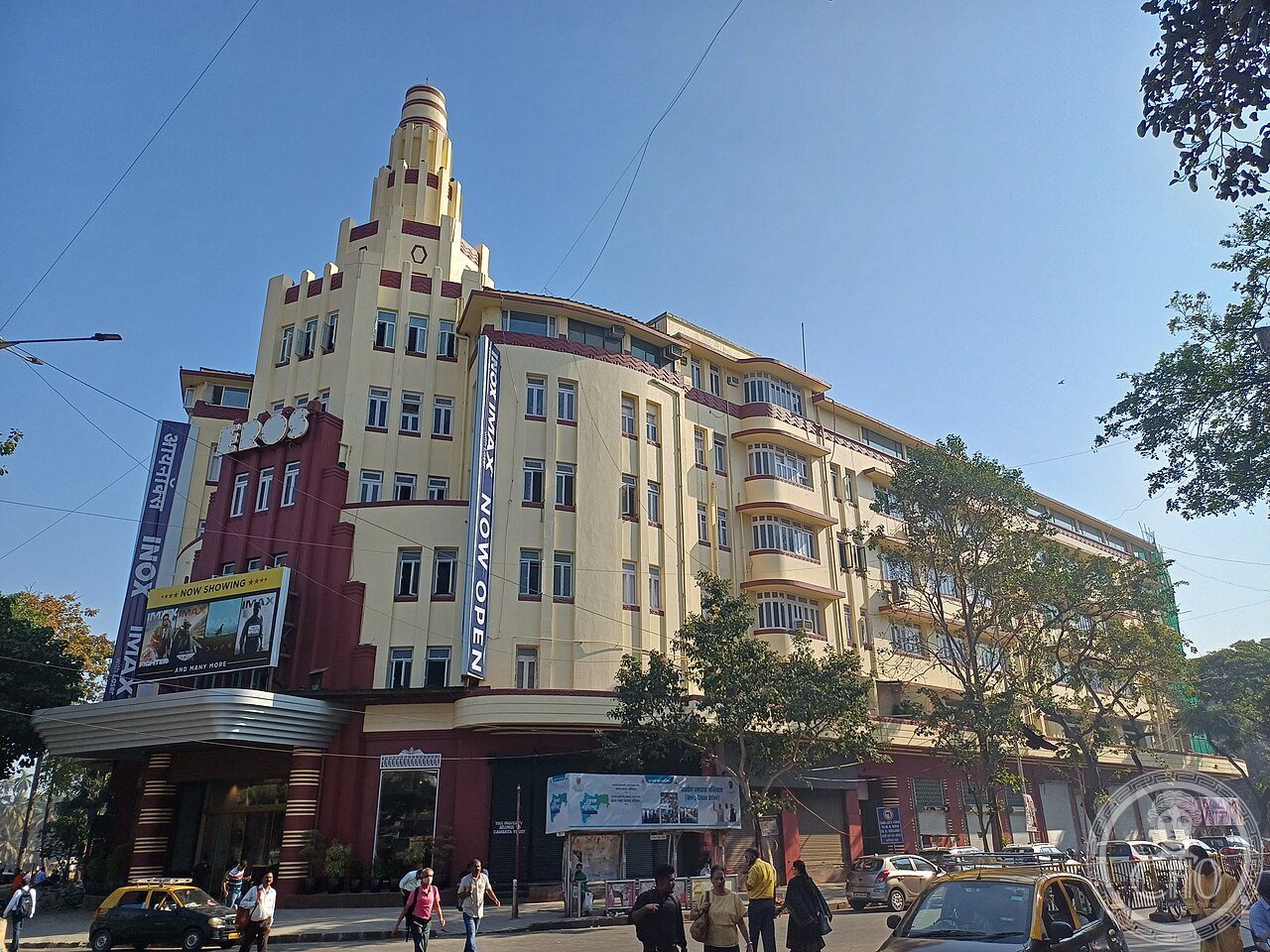
When the Eros Cinema opened on 10 February 1938 at the junction of Maharshi Karve Road and Churchgate Street, it was immediately recognised as one of the finest Art Deco buildings in Asia. Designed by Shorabji Bhedwar in the Streamline Moderne mode, the Cambata Building — as it is formally known — anchors the northern edge of the Back Bay Reclamation area, the vast land-making project that gave Mumbai its Art Deco seafront. The facade of red Agra sandstone reads boldly against the cream render of the upper floors; inside, a foyer of white and black marble with chromium-railed staircases and gold accents leads to an auditorium whose proscenium arch carries relief sculptures of Indian performance and music. The cinema closed in 2017 after decades of decline and reopened in February 2024 as a 305-seat IMAX venue, its interior restored by conservation architect Kirtida Unwalla. Since 2018 it has been part of the UNESCO World Heritage Victorian Gothic and Art Deco Ensembles of Mumbai.
At a glance
- Type
- Cinema / Art Deco heritage building
- Period
- 1938
- Style
- Art Deco / Streamline Moderne
- Location
- Maharshi Karve Rd, Churchgate, Mumbai, India
- Coordinates
- 18.9321° N, 72.8279° E
- Architect(s)
- Shorabji Bhedwar
Overview
Eros Cinema occupies a corner site at Churchgate with the commanding presence that Deco architects reserved for civic landmarks. The Cambata Building rises in a series of stepped horizontal bands, the curved corner tower asserting the building’s identity at the street junction. The facade’s two-tone treatment — red sandstone at the base, cream render above — is a signature move of Mumbai’s Deco practitioners, who were adapting international styles to local materials and tropical light. The original seating capacity was 1,204; the renovated 2024 venue holds 305 in a cinema that now combines the original Art Deco shell with state-of-the-art IMAX projection.
History
The Eros opened in 1938 during the peak of Mumbai’s Art Deco building boom. The Back Bay Reclamation scheme, begun in the 1920s, created an entirely new urban district between Marine Drive and Churchgate, and developers filled it almost entirely with Art Deco and Moderne buildings. Eros was among the grandest of these. Through the following decades it screened Bollywood and Hollywood releases, becoming a cultural institution for generations of Mumbaikars. Neglect, changing audience habits, and the rise of multiplex cinemas led to its closure in 2017. In 2018 the Victorian Gothic and Art Deco Ensembles of Mumbai, which includes Eros and approximately 94 other buildings, was inscribed as a UNESCO World Heritage Site. The 2024 reopening, executed with careful conservation methodology, returned the building to active use while preserving its original character.
Architecture & Design
Bhedwar’s design exemplifies the Indian adaptation of international Art Deco. The curved corner — a favourite Streamline Moderne motif — anchors the building to its pivotal site. Horizontal banding, speed lines, and geometric ornament in the spandrels are executed in local materials: the distinctive red of Agra sandstone, a material also deployed at India Gate and other New Delhi monuments, gives the ground floor a warm solidity that the cream upper floors visually lighten. Inside, the foyer’s chromium railings, black and white marble floor, and gold-accented ceiling represent the luxury interior Deco favoured for entertainment venues. The auditorium relief sculptures — depicting Indian musical instruments, performance, and mythological subjects — show the localisation of Deco ornament that distinguishes Mumbai’s ensemble from its European and American counterparts.
Cultural significance
Eros Cinema is one of the anchors of the UNESCO-inscribed Art Deco Ensembles of Mumbai, a site recognised for demonstrating the transfer and adaptation of international architectural movements in a colonial port city. Mumbai’s Art Deco district — the second largest concentration of Art Deco buildings in the world after Miami Beach — is the collective creation of a generation of Indian architects who absorbed European modernism and remade it in Indian materials, for Indian audiences, in a tropical climate. Eros is its most celebrated cinema and one of its most prominent individual buildings. Its 2024 restoration demonstrates that heritage conservation and active cultural use are compatible even in one of the world’s most commercially pressured real estate markets.
Visiting today
Eros Cinema is again operational as an IMAX cinema (reopened February 2024). Tickets can be purchased online or at the box office. The restored lobby is open to the public before screenings and worth visiting for the Art Deco interior alone. The surrounding Churchgate neighbourhood contains dozens of additional Art Deco buildings; the Art Deco Mumbai walking tours, run by several heritage organisations, typically include Eros as a centrepiece stop. The Marine Drive seafront, a 10-minute walk, is lined with a continuous Art Deco terrace best appreciated at sunset.
Getting there
Churchgate railway station (Western Railway terminus) is directly adjacent, served by suburban trains from Mumbai Central, Dadar, and Bandra. The nearest Metro station is Marine Lines (Aqua Line 3). Taxis and auto-rickshaws are available throughout the area; Uber and Ola operate in central Mumbai. The building is a 5-minute walk from Churchgate station along Maharshi Karve Road.
Sources & resources
Find it on the map
See this place and what’s around it →📷 Become a Cultural Heritage Online photographer
Share your photos of places: they stay published under your name as the author. The more they're seen, the more you get noticed — and soon a contest will reward the most appreciated photos.
Log in or sign up free to add a photoIs this page about you?
This page is read by travellers and heritage enthusiasts who find it on Google. Tell us how you are connected to this place and we will take it from there.