
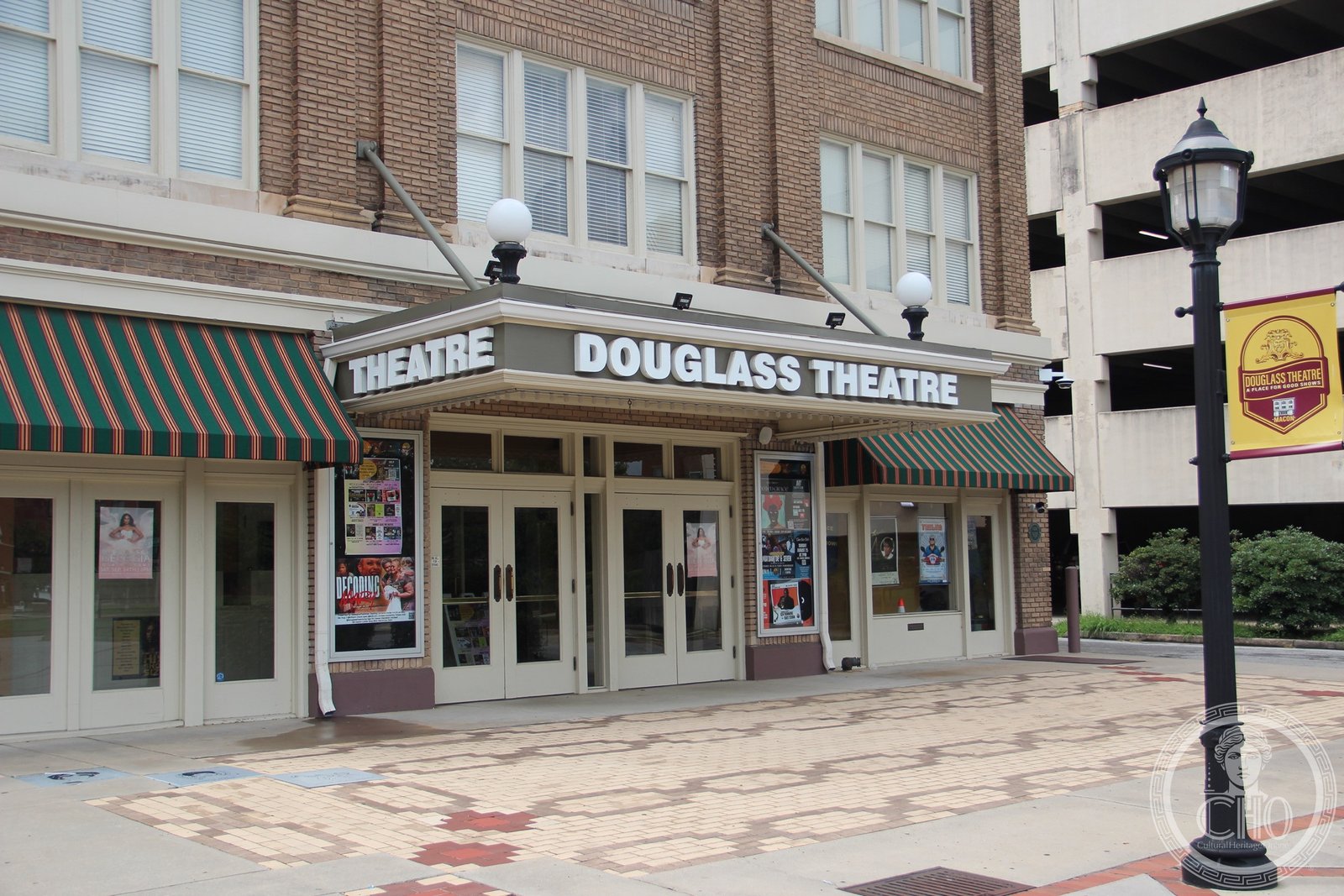
Macon’s “Black Broadway” since 1921, the Douglass Theatre launched the careers of Otis Redding and Little Richard on the same Chitlin’ Circuit stage — making this modest house on what is now Martin Luther King Jr. Boulevard one of the founding sites of soul and rock-and-roll.
At a glance
Founded in 1921 by Charles Henry Douglass — one of the earliest African American theater developers in the Southeast — the Douglass Theatre served as the anchor of Macon’s Fourth Street (now Martin Luther King Jr. Boulevard) entertainment corridor during the Jim Crow era. It was a Chitlin’ Circuit venue: a stop on the segregated Southern touring circuit where Black audiences heard live performances by regional and nationally touring musicians. Restored in the 1990s and now active as a performing arts venue and cultural education center, the theater is today recognized as a site of national significance to African American cultural heritage and American popular music.
Key facts
- Address: 355 Martin Luther King Jr. Boulevard, Macon, GA 31201
- Founded: 1921 by Charles Henry Douglass
- Circuit: Chitlin’ Circuit (Southern Black entertainment touring network, Jim Crow era)
- Style: Art Deco facade (mid-century renovation of original 1921 structure)
- Associated artists: Otis Redding, Little Richard (both Macon-area natives)
- Historic status: National Register of Historic Places
- Current use: Active performing arts venue and cultural center
- GPS: 32.8371° N, 83.6321° W
History
Charles Henry Douglass was already established in the entertainment business when he opened his Macon house in 1921 — an uncommon achievement for a Black entrepreneur in the Jim Crow South, where legal segregation confined African Americans to separate facilities in every public space. The theater sat at the center of Macon’s African American commercial district, close to the barbershops, insurance offices, and professional services of Fourth Street. Douglass built a venue that offered not only films and vaudeville but a dignity of experience unavailable to Black Maconites at white-owned theaters, where they were confined to upper balconies.
The theater’s role in American music history became clear in the 1950s, when two Macon-area natives began their careers on stages like the Douglass. Little Richard — born Richard Wayne Penniman in Macon in 1932 — performed in local revues here early in his career, absorbing the gospel-inflected piano style he would later fuse with rhythm-and-blues. Otis Redding, who grew up in Macon after his family moved from Dawson, Georgia, soaked in the same tradition on the same corridor before his recording breakthrough. The two musicians together created a disproportionate share of the founding vocabulary of soul music.
After desegregation and the suburban multiplex era eroded the theater’s business through the 1960s and 1970s, the building fell into decay. A restoration campaign in the 1990s, supported by city and federal preservation funding, returned it to active use. Today the theater operates as a venue for live performances and as a center for music education programs, housing Georgia Music Hall of Fame inductee recognition and serving as the primary anchor of Macon’s Otis Redding and Little Richard heritage trail.
What you see
The current facade reflects a mid-century renovation: characteristic Art Deco signage and a bold vertical marquee replace whatever original 1921 detailing may have existed. The result is a streamlined commercial face — flat brick with decorative horizontal banding, and a prominent vertical sign tower projecting the theater’s name in large block letters toward the boulevard. The marquee canopy shelters the entry in the pattern typical of American movie houses of the 1940s and 1950s.
The Macon Music Trail plaque program has placed markers at key sites associated with Little Richard, Otis Redding, and the Allman Brothers Band throughout downtown Macon, making the Douglass one node in a self-guided walking route through American popular music history. The theater’s modest external scale belies its historical weight: few buildings this size have contributed as much to the recorded sound of the twentieth century.
Practical information
- Performance and event schedule varies; check the theater’s current calendar for public events
- The MLK Jr. Boulevard corridor connects to Cherry Street, Macon’s main dining and nightlife strip, one block east
- Street parking and pay lots available in the downtown grid
- Macon’s compact downtown is walkable — Hay House, City Auditorium, Mercer University neighborhood, and the Allman Brothers Museum are all within a 20-minute walk
- Allow time to walk the Macon Music Trail plaques before or after a visit
Getting there
Hartsfield-Jackson Atlanta International Airport (ATL), 80 miles northwest via I-75 South (approximately 90 minutes), is the practical gateway for most visitors — Macon-Middle Georgia Regional Airport (MCN) has limited connections. Greyhound bus service connects Macon to Atlanta and Savannah. The theater is in the walkable core of downtown Macon, ten minutes on foot from the Macon Terminal Station bus hub on Cherry Street. From Atlanta by car, take I-75 South toward Macon and exit for downtown Forsyth Street / Martin Luther King Jr. Boulevard.
Nearby
- Hay House (1860) — 934 Georgia Avenue; one of the most elaborate Italianate mansions in the Southeast, 15 minutes’ walk from the Douglass
- Ocmulgee Mounds National Historical Park — 1207 Emery Highway, 3 miles east; ancient earthwork complex occupied for approximately 17,000 years, including a reconstructed 1,000-year-old council chamber earthlodge
- Rose Hill Cemetery — 1091 Riverside Drive; burial site of Duane Allman and Berry Oakley of the Allman Brothers Band
- Big House Museum — 2321 Vineville Avenue; former home shared by members of the Allman Brothers Band, now a museum of band memorabilia
Sources
- Wikipedia: Douglass Theatre (Macon, Georgia)
- National Register of Historic Places — Douglass Theatre nomination
- Visit Macon — Macon Music Trail (visitmacon.org)
- New Georgia Encyclopedia — “Douglass Theatre” entry
Find it on the map
See this place and what’s around it →📷 Become a Cultural Heritage Online photographer
Share your photos of places: they stay published under your name as the author. The more they're seen, the more you get noticed — and soon a contest will reward the most appreciated photos.
Log in or sign up free to add a photoIs this page about you?
This page is read by travellers and heritage enthusiasts who find it on Google. Tell us how you are connected to this place and we will take it from there.