
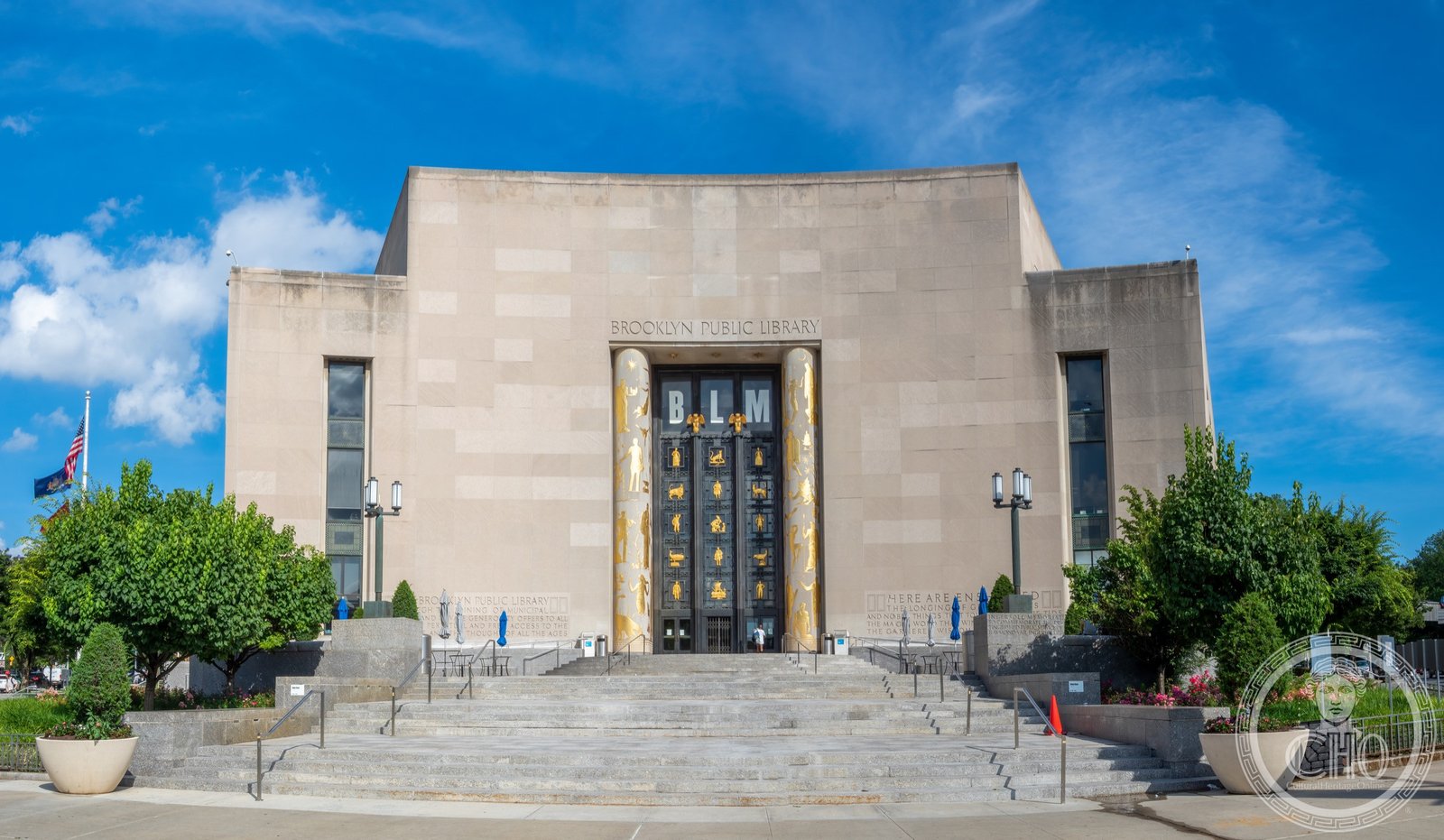
The flagship of the Brooklyn Public Library system, built during the New Deal in a curvilinear Art Deco style, its gilded bronze entrance panels depicting Brooklyn’s literary and intellectual heritage.
At a glance
The Central Library anchors Grand Army Plaza at the meeting of Flatbush Avenue and Eastern Parkway in Prospect Heights, Brooklyn. Designed by Alfred Morton Githens and Francis Keally, the building took six years to complete under Works Progress Administration (WPA) funding. When it opened in 1941, it was hailed as one of the finest public library buildings in the United States — a civic monument shaped like an open book, its facade sheathed in limestone with Art Deco ornament carved in place. The entrance vestibule alone contains eleven gilded bronze panels representing the fields of Brooklyn cultural life: science, medicine, literature, music, architecture, and more.
Key facts
- Address: 10 Grand Army Plaza, Brooklyn, NY 11238
- Architects: Alfred Morton Githens and Francis Keally
- Style: Art Deco / WPA Moderne
- Construction: 1935–1941 (WPA funding)
- Floor area: Large multi-story central reference and lending library
- NYC Landmark: Designated (NYC LPC)
- NRHP: Listed on the National Register of Historic Places
History
Brooklyn’s library leadership first proposed a central headquarters in the early twentieth century, commissioning a Beaux-Arts design that was shelved when World War I disrupted funding. The project sat dormant for over two decades. In 1935, with unemployment high and public building programs in full swing under President Roosevelt, the WPA allocated funds to revive the project. Githens and Keally replaced the classical proposal with a design entirely of their own: a curved, book-shaped volume whose main entrance faces the plaza’s central arch.
Construction proceeded steadily through the late 1930s. The building opened in 1941, just as the WPA was being wound down. It was one of the last major WPA library projects to reach completion. Githens had worked on the New York Public Library system previously; Keally would later design the Planetarium addition at the American Museum of Natural History. Together they produced a building whose Art Deco vocabulary — geometric panels, stylized foliation, bold limestone reveals — still reads as emphatically modern eighty years on.
A major renovation in the early 2020s restored the original terrazzo floors, bronze doors, and mural panels without altering the building’s essential character. The library now holds a collection of over a million items and serves as one of Brooklyn’s most visited public institutions.
What you see
The Central Library’s most distinctive exterior feature is its curved southwest corner, which sweeps around the semicircular approach at Grand Army Plaza like the spine of an open book. The limestone cladding is scored with shallow horizontal reveals that emphasize the building’s horizontal mass while thin vertical pilasters provide rhythm. At the main entrance, eleven gilded bronze panels depict figures representing Brooklyn’s intellectual and cultural life: a schoolteacher, a scientist, a physician, a musician, a poet. The gilding has been renewed in recent restorations and catches afternoon light dramatically.
The main reading room inside is long and barrel-vaulted, with terrazzo floors and tall clerestory windows delivering natural light deep into the stacks. Art Deco bronze grillework covers the ventilation registers, and carved limestone cartouches bearing the names of writers — Walt Whitman, Marianne Moore, Henry Miller — line the entrance lobby. The building’s geometry is precise and unadorned: every curve and setback serves a structural purpose, with decoration reserved for the surfaces where visitors linger longest.
Practical information
- Open to all: Free to enter; a Brooklyn Public Library card is not required to visit exhibits or use reading rooms
- Hours: Monday–Friday 9 am–8 pm, Saturday 10 am–6 pm, Sunday 12–5 pm (verify current schedule at bklynlibrary.org)
- Tours: Guided architectural tours available, check the library website for scheduling
- Photography: Permitted for personal use throughout the building
- Accessibility: Fully accessible; elevator to all floors
Getting there
From Manhattan, take the 2 or 3 subway train to Grand Army Plaza station (7–12 minutes from Fulton Street). Alternatively, the B or Q express train stops at 7th Avenue, a short walk across Prospect Park West. By car, Eastern Parkway leads directly to Grand Army Plaza from Atlantic Avenue and downtown Brooklyn; street parking is limited but metered parking is available on Flatbush Avenue. Citi Bike docking stations are at Grand Army Plaza and at the library’s eastern entrance.
Nearby
- Prospect Park — the 585-acre Olmsted and Vaux landscape begins at the library’s southeast corner
- Brooklyn Museum — the Beaux-Arts museum is a ten-minute walk east along Eastern Parkway
- Brooklyn Botanic Garden — adjacent to the museum; 52 acres of gardens
- Grand Army Plaza Arch — the granite triumphal arch (1892) honoring Civil War soldiers stands at the plaza’s north end
Sources
- Brooklyn Public Library, Central Library History, bklynlibrary.org
- New York City Landmarks Preservation Commission, Landmark Designation Report: Central Library, Brooklyn Public Library, 1997
- Wikipedia, “Central Library (Brooklyn Public Library)”
- Historic American Buildings Survey (HABS), Library of Congress
Find it on the map
See this place and what’s around it →Record researched and written by Luigi De Marchi for Cultural Heritage Online, 2026.
📷 Become a Cultural Heritage Online photographer
Share your photos of places: they stay published under your name as the author. The more they're seen, the more you get noticed — and soon a contest will reward the most appreciated photos.
Log in or sign up free to add a photoIs this page about you?
This page is read by travellers and heritage enthusiasts who find it on Google. Tell us how you are connected to this place and we will take it from there.