
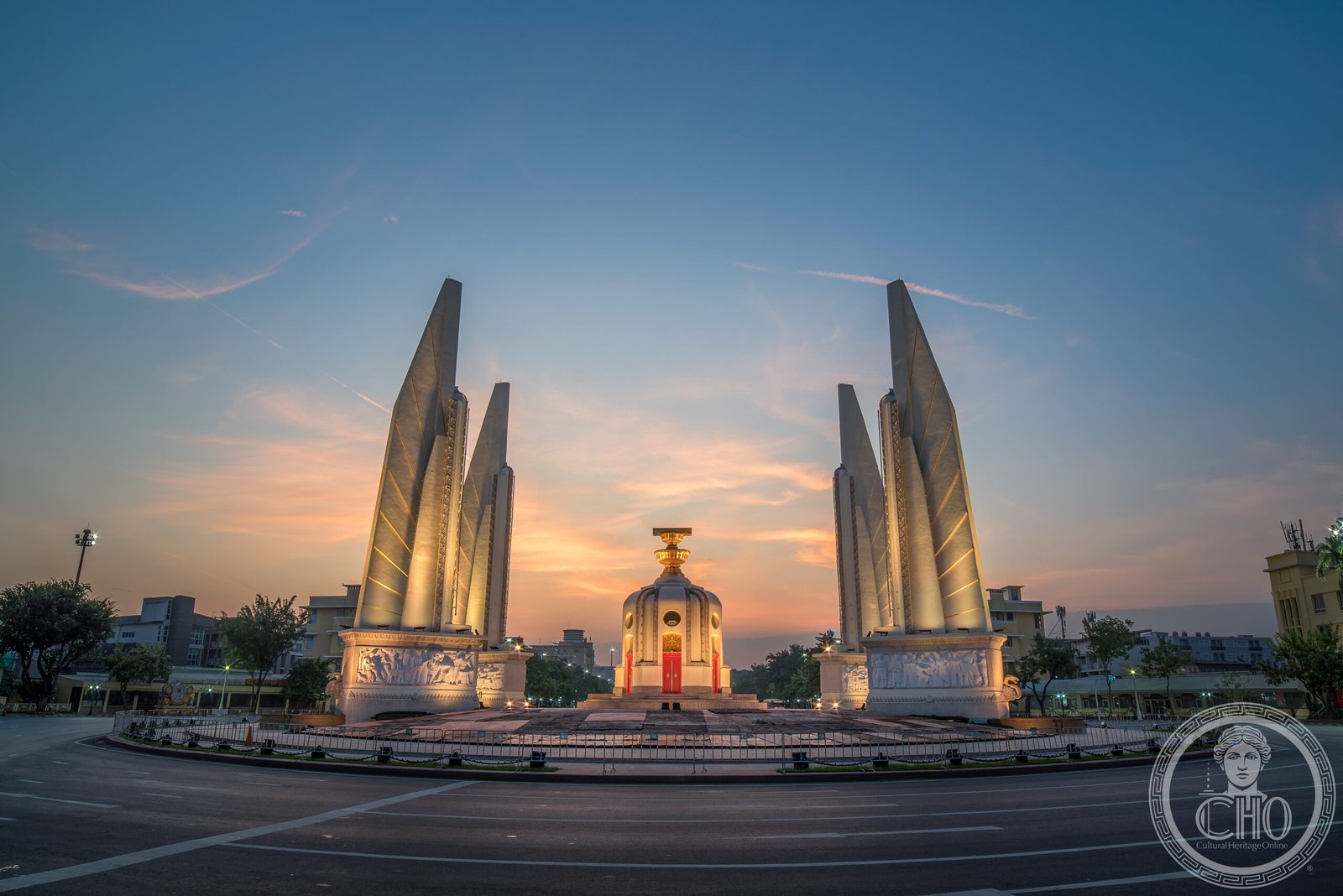
Rising from the grand ceremonial axis of Ratchadamnoen Avenue, the Democracy Monument is the symbolic heart of modern Thailand — a statement in stone and bronze of the nation's 1932 Siamese Revolution, which ended six centuries of absolute monarchy. Designed by Corrado Feroci, an Italian sculptor who became so embedded in Thai cultural life that he took the name Silpa Bhirasri and is revered as the father of modern Thai art, the monument fuses the bold geometries of Art Deco with the formal vocabulary of classical Thai temple architecture. Completed in 1940, it marks the spot where Bangkok's ceremonial boulevard meets the axis of democratic aspiration. Decades later the monument became something it was never designed for: a stage for real democratic struggle, the physical epicentre of the 1973 student uprising, the 1992 Black May protests, and the 2010 red-shirt demonstrations. It is simultaneously a monument to an ideal and a record of the distance Thai democracy has yet to travel.
At a glance
- Type
- Public monument / memorial
- Period
- 1939–1940
- Style
- Thai Modernism / Art Deco with classical Thai elements
- Location
- Ratchadamnoen Klang Avenue, Phra Nakhon, Bangkok, Thailand
- Coordinates
- 13.7567° N, 100.5017° E
- Architect(s)
- Corrado Feroci (Silpa Bhirasri), Italian-Thai sculptor and artist
Overview
The Democracy Monument occupies a traffic roundabout on Ratchadamnoen Avenue — Bangkok's Champs-Elysees — midway between the Grand Palace and the Royal Plaza. Its central element is a large gilded bronze representation of the Thai Constitution of 1932, elevated on a pedestal 3 metres high. Four elongated wing-towers surround the central pedestal, each rising 24 metres; their horizontal fins echo the finials of traditional Thai temple rooflines while their vertical shafts are unmistakably Art Deco in proportion and detail. Seventy-five cannon surround the base, symbolising the year 2475 of the Buddhist Era (1932 CE), the year of the revolution. The whole composition is axially symmetrical and designed to be read from the avenue's long approaches — a monument scaled for ceremony and procession, not intimacy.
History
The 1932 Siamese Revolution was a bloodless coup by the Khana Ratsadon (People's Party), a group of Western-educated military and civilian officials who forced King Prajadhipok to grant a constitutional monarchy. The new government commissioned a permanent monument to the event, selecting the Italian sculptor Corrado Feroci, who had arrived in Thailand in 1923 on royal invitation and spent his career teaching and practising art in Bangkok. Construction took place from 1939 to 1940. The monument stood as a largely ceremonial landmark through the mid-century; it was only during the student uprising of October 1973 — when hundreds of thousands gathered on Ratchadamnoen to demand the end of the Thanom Kittikachorn military dictatorship — that it became a living symbol of democratic aspiration. The pattern repeated in 1992 and again in 2010, each crisis adding a layer of meaning to the stone and bronze.
Architecture & Design
Feroci achieved a synthesis rare in early 20th-century public architecture: a building that reads simultaneously as rigorously modern and unmistakably Thai. The four wing-towers are the structural and visual key. Their massing — broad at the base, tapering through setbacks to a narrow finial — mirrors the profile of a Thai chedi or prang, while their surface treatment, with shallow bas-reliefs of human figures in heroic poses, belongs entirely to the international Art Deco idiom of the 1930s. The central constitutional pedestal is circular in plan, surrounded by a shallow moat and approached via four causeways aligned with the cardinal directions — a spatial arrangement that echoes the sacred geography of Khmer temple complexes. The gilded Constitution atop the pedestal catches Bangkok's afternoon sun and functions as a vertical accent visible from a considerable distance along the avenue.
Cultural significance
No monument in Thailand carries the political charge of the Democracy Monument. Its image appears on protest banners, in political cartoons, and in the imagery of every major Thai political movement of the past fifty years. For those who have gathered there in hope — students in 1973, citizens in 1992, red shirts in 2010 — it is both a rallying point and a rebuke: a monument to democracy built by a government that, within a decade of its construction, had itself become authoritarian. Corrado Feroci's own story adds resonance: an Italian artist who fled fascist Italy to build a monument to popular sovereignty in a country he had adopted as his own, becoming Thai by naturalisation in 1944. The monument is listed as a significant heritage site by the Fine Arts Department of Thailand.
Visiting today
The Democracy Monument is freely accessible at all hours; the surrounding roundabout and pavements allow close inspection of the bas-reliefs and the constitutional pedestal. The site is best appreciated at dawn or dusk when the gilded Constitution catches the light and pedestrian traffic is light enough to allow contemplative viewing. The nearby Ratchadamnoen Contemporary Art Centre and Sanam Luang are worthwhile extensions to the visit. Avoid large public holidays when road closures may affect access.
Getting there
The Democracy Monument is on Ratchadamnoen Klang Avenue in Phra Nakhon district. The nearest MRT station is Sam Yot (Blue Line), approximately 1.2 km south; from there it is a pleasant walk through the historic district. Bus lines 2, 15, 39, 44, 47, 511 stop on Ratchadamnoen Avenue. Tuk-tuks and Grab cars reach the roundabout directly. From Khao San Road the monument is an easy 10-minute walk east along Ratchadamnoen Avenue.
Sources & resources
Find it on the map
See this place and what’s around it →Record researched and written by Luigi De Marchi for Cultural Heritage Online, 2026.
📷 Become a Cultural Heritage Online photographer
Share your photos of places: they stay published under your name as the author. The more they're seen, the more you get noticed — and soon a contest will reward the most appreciated photos.
Log in or sign up free to add a photoIs this page about you?
This page is read by travellers and heritage enthusiasts who find it on Google. Tell us how you are connected to this place and we will take it from there.