

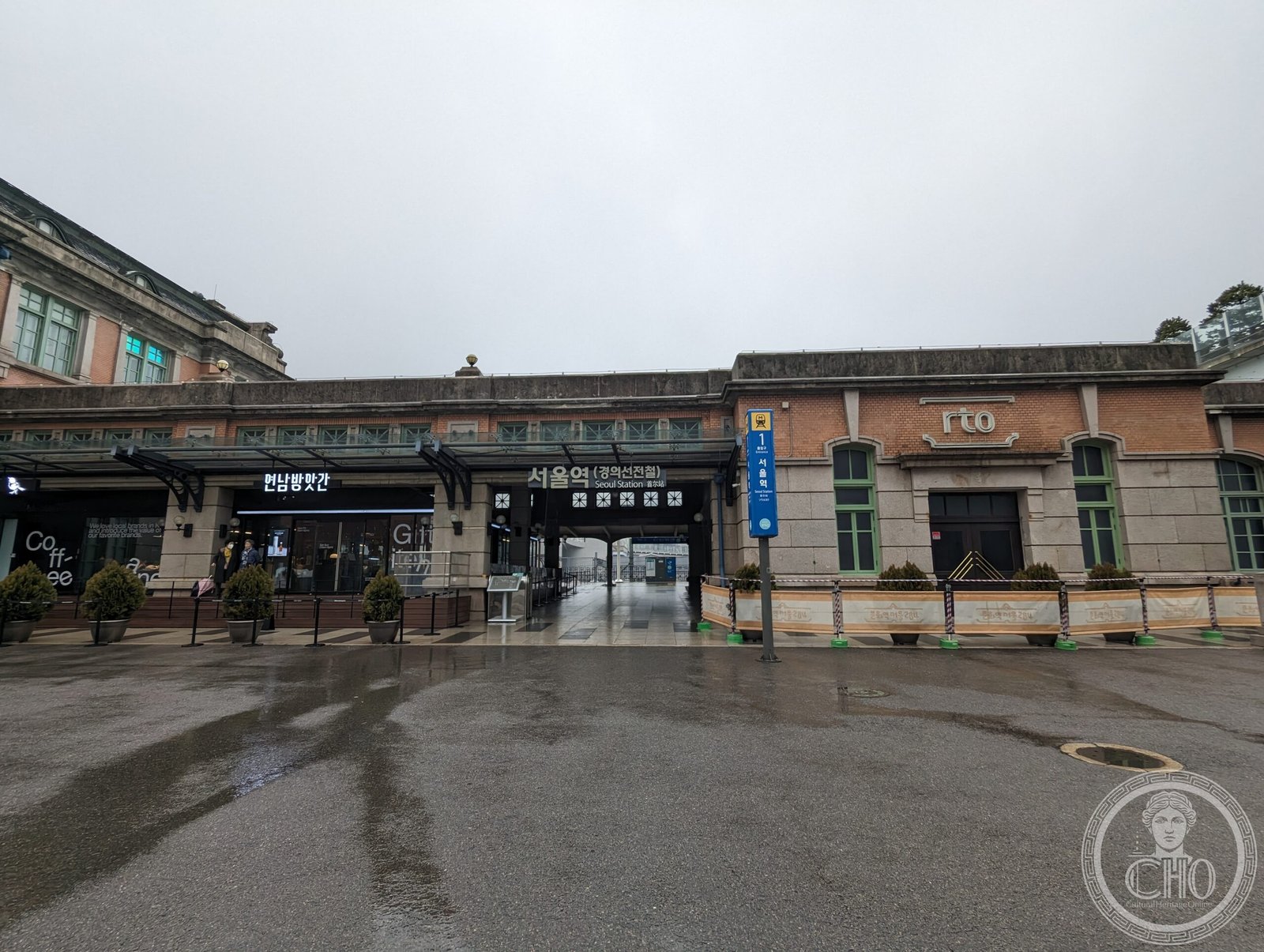
Rising from Jung-gu with its distinctive red-brick facade and Byzantine-inflected dome, Culture Station Seoul 284 is the most evocative monument to Korea’s colonial era still standing. Built between 1922 and 1925 as Keijō Station and designed by Tsukamoto Yasushi of Tokyo Imperial University, the structure served as the nation’s principal rail gateway for over six decades. Designated Historic Site 284 in 1981, the station closed to train traffic in 1988. After a painstaking two-year restoration by the Ministry of Culture, Sports and Tourism, it reopened in August 2011 as a multidisciplinary cultural complex whose name fuses the words “culture station” with its heritage site number. Today it hosts avant-garde exhibitions, performances, and public art installations inside the very concourse where generations of Koreans said farewell and welcome.
At a glance
- Type
- Historic railway station & cultural complex
- Period
- 1922–1925 (construction); reopened as cultural venue 2011
- Style
- Japanese Colonial Eclectic; Byzantine central dome, Renaissance Revival facade
- Location
- 1 Tongil-ro, Bongnaedong 2-ga, Jung-gu, Seoul, South Korea
- Coordinates
- 37.5559° N, 126.9716° E
- Architect(s)
- Tsukamoto Yasushi (Tokyo Imperial University)
Overview
Culture Station Seoul 284 occupies a symbolic position at the literal and historical heart of Seoul. The eclectic building combines a symmetrical plan, a broad central dome that echoes Byzantine and Renaissance precedents, and Baroque-inflected corner towers rendered in warm red brick. Its 9,202-square-metre interior once processed millions of passengers; today it provides a stage for Korea’s most adventurous contemporary artists. The juxtaposition of colonial-era grandeur with cutting-edge creativity makes it one of Asia’s most compelling adaptive-reuse projects.
History
The first Seoul Station opened in 1900 as a modest wooden structure on the Gyeongbu Line. By 1922, rapid urban growth under Japanese colonial rule demanded a monumental replacement. Construction of the current building began on 1 June 1922 and was completed on 30 September 1925. Known as Keijō (Gyeongseong) Station, it served as the colonial capital’s grandest public building, its VIP Lounge floored in birch and its Central Hall paved in granite. After Korea’s liberation in 1945 it was renamed Seoul Station. Designated Historic Site 284 in 1981, the old building was handed to the Ministry of Culture in 2007 and restored for cultural use by 2011.
Architecture & Design
Tsukamoto Yasushi drew on the Eclectic vocabulary fashionable in Meiji and Taishō-era Japan. The result is a symmetrical composition anchored by a broad copper-clad dome above the central concourse. Flanking towers carry Baroque lanterns, while the red-brick skin is relieved by stone dressings at windows and cornices. The Central Hall features a granite-paved floor; the former VIP Lounge preserves its original birch-wood flooring. The 2011 restoration returned the exterior to its 1925 appearance while sensitively adapting the interiors for contemporary art.
Cultural significance
For Koreans, the old Seoul Station is inseparable from collective memory: the departure point for labourers shipped to wartime Japan, and the arrival hall for families reuniting after liberation. Its conversion into a cultural venue in 2011 transformed a symbol of colonial control into a platform for Korean creative expression. Designated Historic Site 284, it stands alongside Gyeongbokgung Palace as one of Seoul’s most protected landmarks and a rare surviving example of Japanese colonial civic architecture.
Visiting today
Culture Station Seoul 284 is open Tuesday through Sunday, typically 10:00–19:00 (hours vary by exhibition). Admission prices depend on the current programme; many events are free. The main hall, dome interior, and rotating gallery spaces are accessible to visitors. Photography is generally permitted in public areas. Check the official website or local listings for the current schedule of exhibitions and performances before visiting.
Getting there
The building stands immediately adjacent to Seoul Station, one of the city’s main transport hubs. Take Seoul Metro Line 1 or Line 4 to Seoul Station (exit 2 or 3); the old station building is visible directly from the exit. Korail intercity and KTX trains also stop at the adjacent modern terminal. The AREX Airport Express connects Incheon International Airport to Seoul Station in approximately 43 minutes.
Sources & resources
Find it on the map
See this place and what’s around it →Record researched and written by Luigi De Marchi for Cultural Heritage Online, 2026.
📷 Become a Cultural Heritage Online photographer
Share your photos of places: they stay published under your name as the author. The more they're seen, the more you get noticed — and soon a contest will reward the most appreciated photos.
Log in or sign up free to add a photoIs this page about you?
This page is read by travellers and heritage enthusiasts who find it on Google. Tell us how you are connected to this place and we will take it from there.