
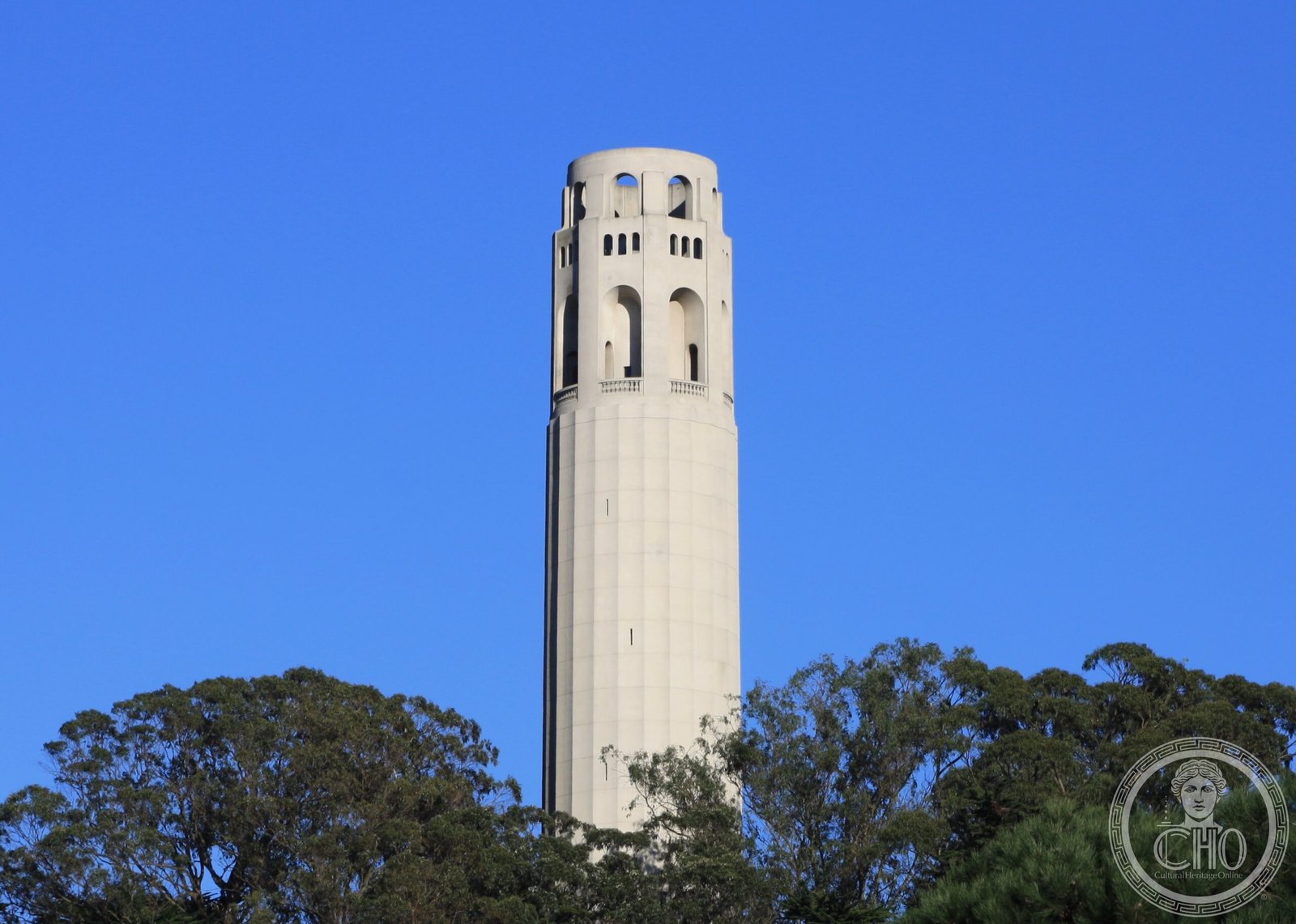
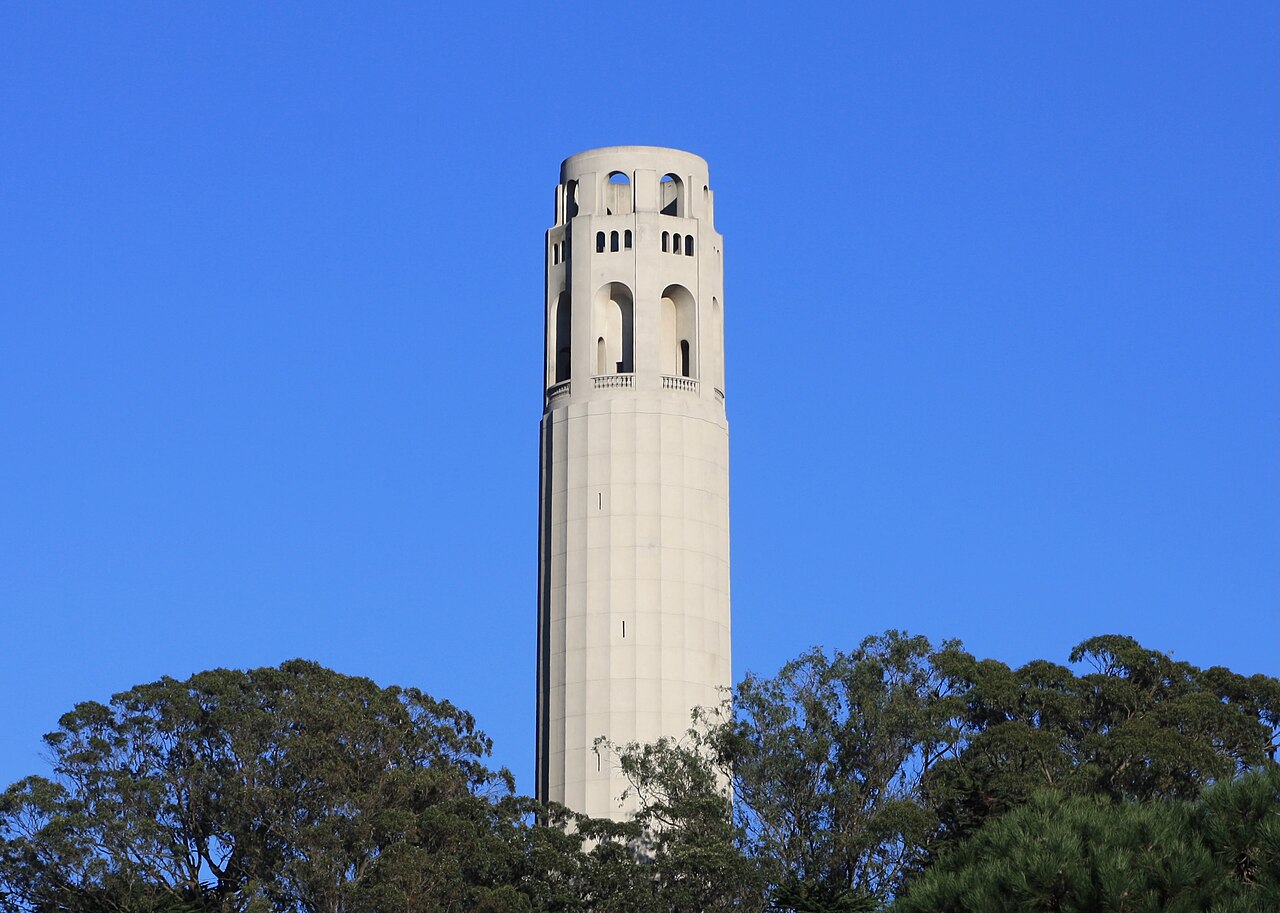
Rising 210 feet above San Francisco Bay from the crest of Telegraph Hill, Coit Tower stands as one of the most recognisable landmarks on the West Coast of the United States. Formally known as Coit Memorial Tower, it was funded by a bequest from Lillie Hitchcock Coit, an eccentric socialite and honorary member of Knickerbocker Engine Company No. 5, who left one third of her estate to the city she loved. Designed by Arthur Brown Jr. — the same architect who drew City Hall — and his associate Henry Temple Howard, the fluted concrete column was dedicated on 8 October 1933. Despite persistent popular legend, the tower was not built to resemble a fire-hose nozzle; the cylindrical silhouette is purely Art Deco abstraction. The structure is equally celebrated for the remarkable WPA fresco murals inside its base: twenty-two artists painted 3,691 square feet of wall surface depicting California labourers, stevedores, and Depression-era daily life in vivid American Social Realist style. From the open-air observation platform at the summit, visitors command a sweeping panorama of the Bay, the Golden Gate, Alcatraz, and the city grid below.
At a glance
- Type
- Observation tower / public monument
- Period
- 1932–1933
- Style
- Art Deco / WPA Social Realism (murals)
- Location
- 1 Telegraph Hill Boulevard, San Francisco, California, USA
- Coordinates
- 37.8025° N, 122.4058° W
- Architect(s)
- Arthur Brown Jr. and Henry Temple Howard
Overview
Coit Tower occupies the summit of Pioneer Park on Telegraph Hill, a rocky promontory that has dominated San Francisco Harbour since the Gold Rush era. The tower itself is a monolithic shaft of unpainted reinforced concrete, its surface left deliberately raw to contrast with the ornate civic architecture of the Beaux-Arts city below. The observation deck offers 360-degree views that include the Bay Bridge, Marin Headlands, and the densely packed Victorian neighbourhoods spreading toward Twin Peaks. The base of the tower houses the celebrated WPA murals, and a lobby phoenix relief by sculptor Robert Boardman Howard greets visitors at the entrance.
History
Lillie Hitchcock Coit died in 1929 leaving 18,000 to embellish the city of San Francisco. The Board of Supervisors commissioned Arthur Brown Jr. to design a monument befitting Telegraph Hill, the site from which semaphore signals once announced ships entering the Golden Gate. Construction ran from 1932 to 1933 under the New Deal Public Works Administration. The murals inside, painted by artists including Diego Rivera protégés and Social Realist painters, sparked controversy before the tower even opened: conservative critics objected to Communist imagery, and the dedication was delayed while the city debated whether certain panels should be painted over. They were not. The tower was added to the National Register of Historic Places in 2008 and is a San Francisco Designated Landmark since 1984.
Architecture & Design
Brown and Howard conceived the tower as a pure geometric statement: a smooth concrete cylinder rising from a flared base, unornamented except for the vertical fluting that emphasises its height. At 210 feet it dominates the Telegraph Hill silhouette without competing with it. Inside, the ground-floor lobby is entirely covered in fresco murals painted in the buon fresco technique, each panel anchored to a continuous narrative of California working life. Subjects include a library, a filling station, a farm, a California street, and the San Francisco waterfront. The colour palette is warm, earthy, and deliberately populist — quite unlike the gilded civic murals of the same era found in the City Hall rotunda six blocks to the west.
Cultural significance
Coit Tower encapsulates two distinct but intertwined legacies of the 1930s: the Art Deco drive for monumental abstraction and the New Deal conviction that public art should speak to working people. The WPA murals are among the largest intact examples of Social Realist fresco painting in the United States. The tower also marks the endpoint of the Filbert Street Steps, a beloved urban trail through cottage gardens that is itself a San Francisco cultural institution. Together, tower and steps define the character of Telegraph Hill as a neighbourhood of artists, radicals, and parrots — a reputation the area has maintained for nearly a century.
Visiting today
The tower and its ground-floor murals are open to visitors every day. There is no charge to view the lobby frescoes. A fee applies for elevator access to the observation deck. Special guided tours of the second-floor murals, normally closed to the public, are available on selected dates. Pioneer Park surrounding the tower is always open and offers shaded picnic areas with views of the Bay. Photography is permitted throughout. The wild parrots of Telegraph Hill, a flock of cherry-headed conures whose origins have been the subject of a documentary film, often roost in the cypresses nearby.
Getting there
Coit Tower sits at 1 Telegraph Hill Boulevard, San Francisco. The 39 Coit Muni bus runs directly to the tower from Washington Square Park in North Beach. Walkers can ascend via the Filbert Street Steps or the Greenwich Street Steps from the Embarcadero. Parking on Telegraph Hill is extremely limited; arriving by public transit or on foot is strongly recommended. The nearest BART station is Embarcadero, approximately a 20-minute walk.
Sources & resources
Gallery
Find it on the map
See this place and what’s around it →
Record researched and written by Luigi De Marchi for Cultural Heritage Online, 2026.
📷 Become a Cultural Heritage Online photographer
Share your photos of places: they stay published under your name as the author. The more they're seen, the more you get noticed — and soon a contest will reward the most appreciated photos.
Log in or sign up free to add a photoIs this page about you?
This page is read by travellers and heritage enthusiasts who find it on Google. Tell us how you are connected to this place and we will take it from there.