
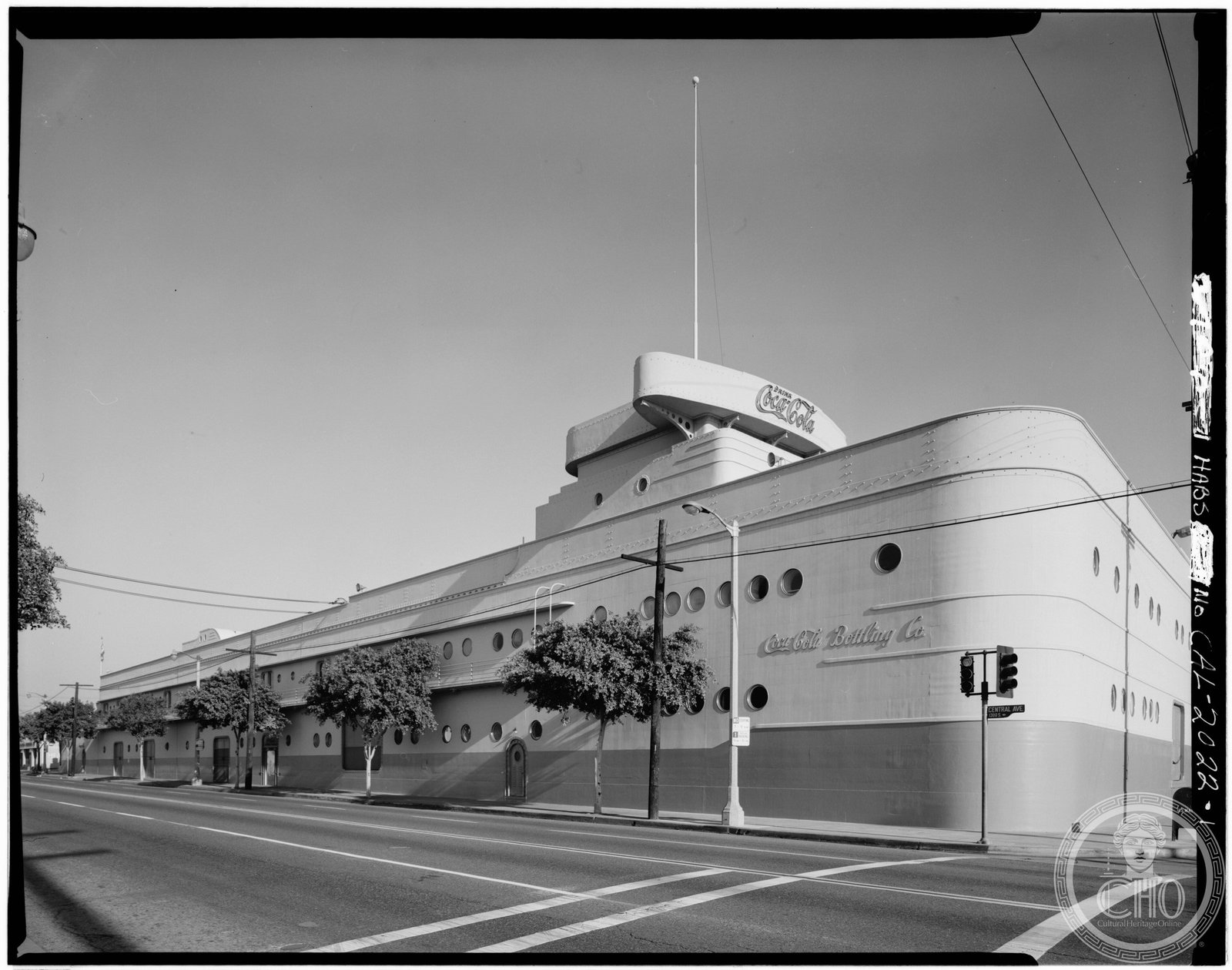
Robert Derrah designed a Coca-Cola factory as a ship running aground on South Central Avenue — and somehow made it work. The 1939 Streamline Moderne bottling plant remains one of American industrial architecture’s most exuberant gestures.
At a glance
Architect Robert V. Derrah clad three existing warehouse structures in a continuous ocean liner facade, turning a functional bottling plant into a floating metaphor for industrial modernity. The building’s curved prow points at the corner intersection, porthole windows run the length of the upper deck, a ship’s bridge projects above the roofline, and a gangway staircase descends from the midsection to the street. It is both a piece of serious Streamline Moderne architecture and an outright piece of stagecraft — which, in Los Angeles in 1939, was exactly the point. The building was designated a Los Angeles Historic-Cultural Monument and remains one of the city’s most photographed industrial landmarks.
Key facts
- Built: 1939
- Architect: Robert V. Derrah
- Address: 1334 South Central Avenue, Los Angeles, CA 90021
- Style: Streamline Moderne (ocean liner theme)
- Status: City of Los Angeles Historic-Cultural Monument
- Original use: Coca-Cola bottling and distribution plant
- GPS: 34.0293°N, 118.2574°W
History
By 1939 the Streamline Moderne vocabulary had spread from luxury transportation design — locomotives, ocean liners, automobiles — into every category of American commerce. Factories, post offices, bus stations, and supermarkets adopted the horizontal banding, curved corners, and industrial-smooth surfaces that promised efficiency, speed, and hygiene. Derrah took the metaphor one step further: not just borrowing the aesthetic language of the ship but designing an entire facade that legibly read as a vessel.
The brief was industrial: Coca-Cola needed expanded bottling capacity on the South Side of Los Angeles. Derrah’s solution was to unify three existing warehouse structures behind a new continuous white stucco skin that wrapped the entire block-front in nautical detail. The commission required him to invent specifics — the placement of portholes, the angle of the “bridge” projection, the location of the gangway stairs — that would maintain the ship illusion at street scale while accommodating the real functional requirements behind.
The plant operated as a bottling facility for decades. After Coca-Cola vacated it was converted for use by other tenants, and the Historic-Cultural Monument designation protected the building from demolition. The exterior remains largely intact, its white stucco and porthole windows a fixed landmark in a neighborhood otherwise transformed by industrial redevelopment.
What you see
From the corner the building presents its “prow” — a curved wall that rounds the intersection as a ship’s bow rounds the water. The second-floor “deck” carries a continuous run of circular porthole windows at regular intervals, each one a fixed visual unit that reinforces the horizontal rhythm of the entire composition. Above them, the “bridge” structure — a glass-fronted projection that reads as the navigator’s cabin — provides the vertical accent that keeps the facade from flattening into pure band ornament.
The gangway staircase, projecting from the midsection at a slight angle, is the building’s most theatrical element: it implies arrival, a ship moored at dock, rather than a stationary building along a Los Angeles street. Derrah calibrated the depth of these projections carefully — enough relief to read convincingly from across the street, not so much as to shade the building or create maintenance problems. The result is a study in controlled illusionism that holds up at close range.
Practical information
- Access: The exterior is visible from the street at all times; the building is privately operated and not open for interior tours
- Photography: The corner (prow) offers the most dramatic view; early morning and overcast light prevent harsh shadows on the white stucco
- Location: South Central Avenue south of downtown LA; accessible by Metro bus; limited street parking
- Time needed: 15–20 minutes for a full exterior circuit
Getting there
The Coca-Cola Bottling Plant is on South Central Avenue about 1.5 miles south of downtown Los Angeles. The nearest Metro station is Grand/LATTC on the E Line (Expo), about 0.8 miles west on foot. By car, the building is 10 minutes from the 10 freeway (Central Avenue exit). There is limited street parking on Central Avenue and the adjacent side streets.
Nearby
- Los Angeles Trade-Technical College (0.5 miles northwest)
- Broadway Historic Theater District, Downtown Los Angeles (1.5 miles north)
- Exposition Park and Natural History Museum (1.8 miles southwest)
- USC University Park campus (1.2 miles west)
Sources
- City of Los Angeles Office of Historic Resources, Historic-Cultural Monument designation file
- Gebhard, David, and Robert Winter, An Architectural Guidebook to Los Angeles (5th ed., 2003)
- Hess, Alan, Googie Redux: Ultramodern Roadside Architecture (reference for LA Streamline context)
Find it on the map
See this place and what’s around it →Record researched and written by Luigi De Marchi for Cultural Heritage Online, 2026.
📷 Become a Cultural Heritage Online photographer
Share your photos of places: they stay published under your name as the author. The more they're seen, the more you get noticed — and soon a contest will reward the most appreciated photos.
Log in or sign up free to add a photoIs this page about you?
This page is read by travellers and heritage enthusiasts who find it on Google. Tell us how you are connected to this place and we will take it from there.