
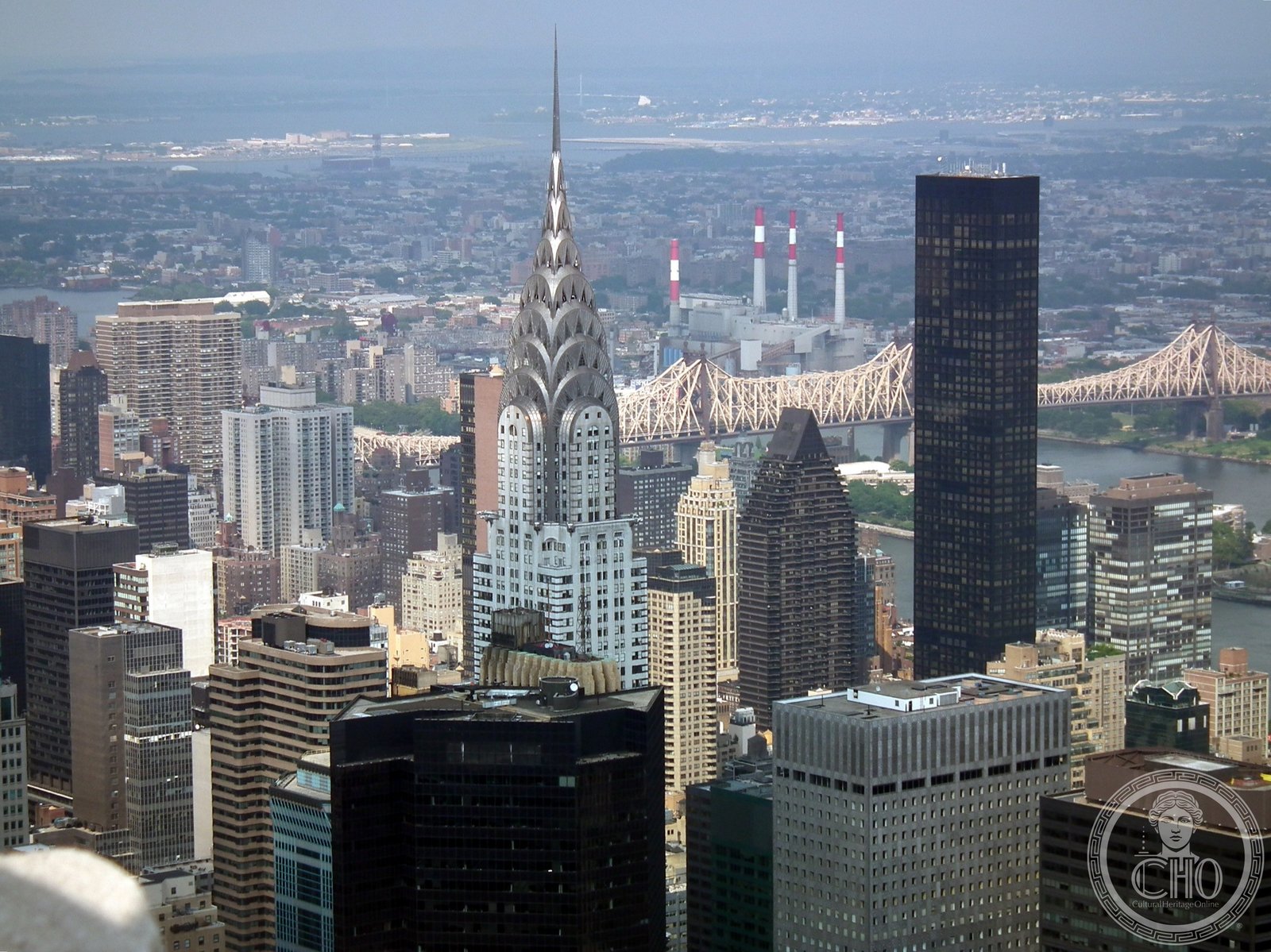

For eleven months in 1930 and 1931 the tallest building in the world — a stainless steel crown of eagle gargoyles and sunburst arches that remains the most photographed Art Deco tower in America and the clearest single image of what the style chose to say.
At a glance
The Chrysler Building at 405 Lexington Avenue in Midtown Manhattan is the defining image of American Art Deco architecture. Completed in 1930 to designs by William Van Alen for automobile manufacturer Walter P. Chrysler, it held the title of the world’s tallest building from its completion until the Empire State Building surpassed it eleven months later. Its stainless steel crown — a series of arched sunburst tiers topped by a spire, ornamented with stylized eagle hood ornaments taken from Chrysler automobiles of the period — remains the most recognizable architectural silhouette in New York City and among the most photographed buildings in the world.
Key facts
- Address: 405 Lexington Avenue, Midtown Manhattan, New York City
- Completed: 1930
- Architect: William Van Alen
- Client: Walter P. Chrysler
- Height: 1,046 feet (77 floors)
- Crown material: Nirosta stainless steel
- Designation: National Historic Landmark
- GPS: 40.7516°N, 73.9755°W
History
Walter P. Chrysler had become one of the wealthiest men in the United States through the automobile company he founded in 1925, and the commission for a Manhattan skyscraper was both a business investment and a personal monument. The architect William Van Alen had a reputation for theatrical design, and the commission was the largest of his career. Construction on the 40th Street and Lexington Avenue site began in 1928, and from the outset there was a competition — more acknowledged in retrospect than at the time — between Van Alen’s tower and H. Craig Severance’s Bank of Manhattan Trust Building at 40 Wall Street, both of which had claims to the title of world’s tallest building depending on how height was measured.
Van Alen’s resolution of this competition was the building’s most celebrated architectural moment. The stainless steel crown had been assembled in secret inside the building’s shaft during construction; in the final weeks before completion, it was raised through the top of the building and bolted in place in a process that took ninety minutes, adding one hundred and eighty-five feet to the building’s height and definitively establishing it as the world’s tallest. The eagle gargoyles at the 61st floor — replicated from the hood ornament of the 1929 Chrysler automobile — announced the building’s corporate sponsor in the most visible possible way. The stainless steel crown, chosen for its resistance to weather and its reflective properties, has never been replaced or significantly altered and remains essentially as it appeared on the day of opening.
The Empire State Building, completed eleven months later in 1931, surpassed the Chrysler Building in height. Walter Chrysler had personally financed the building rather than using corporate funds, and ownership passed through his estate and various commercial hands in the decades following his death in 1940. The building’s National Historic Landmark designation and its enduring status as the most beloved Art Deco skyscraper in the world reflect a consensus that extends beyond architectural criticism to public affection.
What you see
The building’s shaft rises from Lexington Avenue as a conventional office tower for its lower floors, gaining in decorative intensity as it ascends. The major ornamental program begins at the upper stories, where a series of brick setbacks introduces the eagle-head gargoyles — identical to the hood ornament of the 1929 Chrysler automobile — projecting from the corners of the 61st floor. Above them, the building transitions to its stainless steel crown: a sequence of seven radiating arches, each perforated by triangular windows and sheathed in Nirosta steel that catches sunlight across the day, tapering upward to the spire that terminates the composition at 1,046 feet.
The lobby interior — open to the public during business hours — is a separate and equally celebrated architectural experience. The walls are lined with African red marble and amber onyx; the ceiling is a large-scale mural by Edward Trumbull depicting the Chrysler Building under construction, surrounded by transportation and industry imagery; the elevator doors are inlaid with wood veneers in geometric Deco patterns. The lobby represents the moment when Art Deco interior design reached its fullest commercial expression in America — a room whose every surface is an argument for the aesthetic possibilities of industrial production.
Practical information
- Lobby: Open to the public Monday–Friday, approximately 8 AM–6 PM; closed weekends
- Upper floors: Private office space; no public observation deck
- Best exterior view: From 42nd Street looking east, or from the High Line looking toward Midtown
- Night lighting: The stainless steel crown is best seen in late afternoon sunlight or after dark when adjacent buildings illuminate it
- Time needed: 20–30 minutes for lobby visit; exterior viewing from street-level
Getting there
The Chrysler Building stands at the corner of 42nd Street and Lexington Avenue in Midtown Manhattan, adjacent to Grand Central Terminal. By subway, the 4, 5, 6, 7, and S trains stop at Grand Central–42nd Street, one block west on 42nd Street; the Lexington Avenue/51st Street station (6 train) is five blocks north. By commuter rail, all Metro-North lines terminate at Grand Central Terminal across the street. The building is within walking distance of the New York Public Library on 42nd and Fifth Avenue, the United Nations headquarters on the East River, and the Empire State Building on 34th Street.
Nearby
- Grand Central Terminal (1913) — one block west at Park Avenue and 42nd Street; Beaux-Arts masterpiece
- Empire State Building (1931) — eight blocks south on Fifth Avenue; the Chrysler’s Art Deco rival and successor
- New York Public Library (1911) — three blocks west at 42nd and Fifth; Carrère and Hastings Beaux-Arts
- United Nations Headquarters — eight blocks east on First Avenue; International Style (1952)
Sources
- National Historic Landmark nomination form, Chrysler Building (National Park Service)
- New York City Landmarks Preservation Commission — designation report, Chrysler Building
- New York Times, coverage of building completion and crown ceremony, 1930 (ProQuest Historical Newspapers)
- Chrysler Corporation — documentation of the building commission and Walter P. Chrysler’s personal investment
- Museum of the City of New York — construction photographs and architectural drawings
Find it on the map
See this place and what’s around it →Record researched and written by Luigi De Marchi for Cultural Heritage Online, 2026.
📷 Become a Cultural Heritage Online photographer
Share your photos of places: they stay published under your name as the author. The more they're seen, the more you get noticed — and soon a contest will reward the most appreciated photos.
Log in or sign up free to add a photoIs this page about you?
This page is read by travellers and heritage enthusiasts who find it on Google. Tell us how you are connected to this place and we will take it from there.