

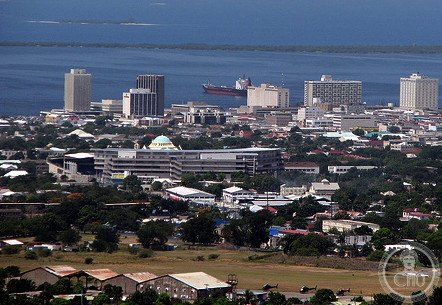
Standing at Crossroads — the commercial and cultural crossroads of Kingston — the Carib Cinema is the most storied picture house in Jamaica and one of the finest surviving Art Deco cinema buildings in the English-speaking Caribbean. Opened in 1937 with 1,350 seats, the Carib brought the glamour of Hollywood to Kingston in a purpose-built Streamline Moderne shell: horizontal banding, bold neon signage, and shaded arcades adapted to the Caribbean climate with wide louvred openings that let the trade winds through. For over three-quarters of a century the Carib has been a shared space for Jamaican life — the place where generations came to see their first film, where Independence Week celebrations were held in 1962, and where figures from Bob Marley to Jimmy Cliff absorbed the images of a wider world. Still operating as a cinema and live-event venue today, it anchors a tradition of Caribbean urban culture that the Jamaica National Heritage Trust has recognized as architecturally and socially significant.
At a glance
- Type
- Cinema / live-event venue
- Period
- 1937
- Style
- Art Deco / Caribbean Streamline Moderne
- Location
- Crossroads, Kingston, Jamaica
- Coordinates
- 17.9959° N, 76.7986° W
- Architect(s)
- Evon Blake (with British firm consultants)
Overview
The Carib Cinema sits at the junction of Half Way Tree Road and Maxfield Avenue in Crossroads, the commercial hub that links downtown Kingston to the wealthier uptown districts. The building is a three-storey reinforced concrete structure with a strong horizontal emphasis — the Streamline Moderne aesthetic stripped of ornamental excess and adapted to the Jamaican climate. A cantilevered marquee shades the main entrance; the original neon signage — restored in the 1990s — makes the building visible for blocks in every direction at night. Inside, the raked auditorium retains much of its original configuration, though the single-screen format was converted to a multiplex of smaller screens. The Jamaica National Heritage Trust lists the Carib as a heritage structure.
History
The Carib was built in 1937 by a private consortium during the late colonial period, when Kingston was growing rapidly as a commercial capital. Architect Evon Blake, one of Jamaica earliest professionally trained local architects, designed the cinema with British technical advisors, producing a building that was thoroughly modern by Caribbean standards. The Carib opened to great fanfare — Kingston had never had a purpose-built picture palace of this scale. Through World War II, the cinema continued operating, showing newsreels alongside features. At Independence in August 1962, the Carib hosted special national celebrations. Through the 1960s and 1970s, as reggae and ska transformed Jamaican culture, the cinema was part of the landscape that formed the musicians and artists of that era. A major refurbishment in the 1990s updated the technical infrastructure while preserving the Art Deco exterior.
Architecture & Design
The Carib is a textbook example of Caribbean Streamline Moderne — the regional variant of Art Deco that emerged in the 1930s across the English, French, and Dutch Caribbean colonies. The key adaptations for climate: deep horizontal projections that shade the facade from direct sun; wide louvred panels replacing solid walls on upper floors to admit air movement; the heavy cantilevered marquee at ground level creating a shaded pedestrian zone. The color palette — cream and terracotta on the original, subsequently refreshed — echoes the Jamaican landscape. Inside, the original ceiling plasterwork featured stylized tropical motifs, some of which survive under later paint layers. The vertical neon sign tower on the corner is the building landmark element, visible from half a mile in either direction along Crossroads.
Cultural significance
The Carib is embedded in the cultural memory of Kingston. As one of the few large-capacity public gathering spaces in twentieth-century Jamaica, it has hosted films, political rallies, Independence celebrations, and concerts. The cinema represented access to global culture for Jamaicans of all backgrounds during the colonial and early independence eras. Its continued operation connects present-day Kingston to a century of urban cultural life. The Jamaica National Heritage Trust designation acknowledges both the architectural rarity — very few Caribbean Art Deco cinemas survive intact — and the social history the building embodies.
Visiting today
The Carib operates as an active multiplex cinema and occasional live-event venue in Crossroads, Kingston. Showtimes and ticket pricing are available through local listings; the cinema screens both Jamaican and international releases. The best time to appreciate the Art Deco exterior is at night, when the restored neon signage is illuminated. The surrounding Crossroads area has an active street life; standard urban precautions apply. The cinema is easily accessible by route taxi from both downtown Kingston and Half Way Tree.
Getting there
The Carib Cinema is at Crossroads, on the Half Way Tree Road / Maxfield Avenue junction in central Kingston. Norman Manley International Airport (KIN) is approximately 20 km southeast; journey time by taxi is 30–45 minutes depending on traffic. From downtown Kingston the cinema is a 15-minute route taxi ride north on Orange Street to Half Way Tree Road. Multiple JUTC bus routes serve Crossroads. Parking is available on surrounding streets and in nearby lots.
Sources & resources
Find it on the map
See this place and what’s around it →Record researched and written by Luigi De Marchi for Cultural Heritage Online, 2026.
📷 Become a Cultural Heritage Online photographer
Share your photos of places: they stay published under your name as the author. The more they're seen, the more you get noticed — and soon a contest will reward the most appreciated photos.
Log in or sign up free to add a photoIs this page about you?
This page is read by travellers and heritage enthusiasts who find it on Google. Tell us how you are connected to this place and we will take it from there.