
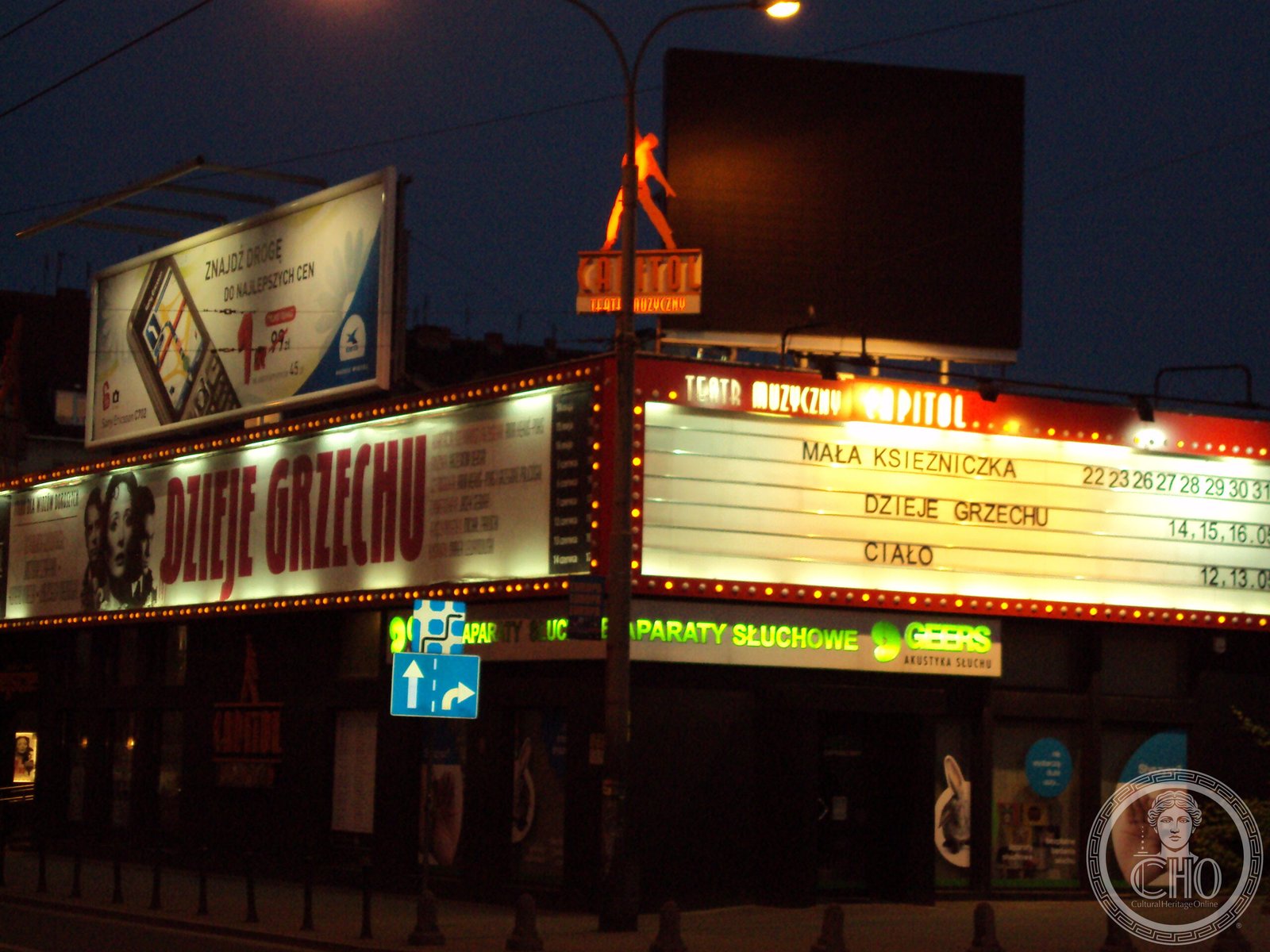
The Capitol Musical Theatre on Piłsudskiego Street is one of the most layered cultural buildings in Central Europe — a 1929 Art Deco cinema that has survived two nationalisms, a world war, and a complete change of national identity, emerging as one of Poland’s most celebrated musical theatre venues. Built in what was then Breslau, capital of German Silesia, it opened as the Capitol Kino with one of the most lavish interiors in the Weimar Republic: atmospheric lighting, Baroque plasterwork fused with geometric Deco ornament, and a 2,000-seat auditorium designed for total immersion. When Breslau became Wrocław in 1945, the building survived intact and was reconverted as a Polish theatre. Over the following decades it became a focal point of Polish alternative and independent culture, before a comprehensive restoration in 2010 returned it to its original splendour. It now stages major international musicals and concerts, making it both an architectural monument and a living venue.
At a glance
- Type
- Musical theatre / concert hall
- Period
- 1929
- Style
- Art Deco / Expressionist
- Location
- ul. Piłsudskiego 67, Wrocław, Poland
- Coordinates
- 51.1070° N, 17.0297° E
- Architect(s)
- Richard Konwiarz
Overview
The Capitol stands as one of the finest surviving examples of 1920s Central European cinema architecture. Architect Richard Konwiarz created a building whose bold street facade — with its oversized lettering, geometric mouldings, and confident mass — announced a new era of public entertainment. The interior amplified this ambition: an atmospheric auditorium where Baroque-derived plasterwork curves met angular Deco profiles in a deliberate historical dialogue. The building’s history since 1929 mirrors the turbulent fate of Wrocław itself: German, then Polish, reinvented by successive cultures while the walls remained constant. Today the Capitol operates under the City of Wrocław as a major municipal theatre, hosting Polish premieres of international musicals alongside concerts and special programmes.
History
The Capitol Kino opened in 1929 in Breslau, then a major German city and the cultural capital of Silesia. Under the Weimar Republic it operated as a prestige cinema and entertainment venue. With the Nazi seizure of power in 1933, the building became a vehicle for state cultural programming — the same auditorium that had shown international films began screening propaganda alongside entertainment. Breslau was besieged in 1945; unlike much of the city, the Capitol survived largely intact. When the city was transferred to Poland and renamed Wrocław, the building was reconverted first as a variety theatre, then as the Teatr Muzyczny. In the 1970s and 1980s, under communist Poland, the Capitol became associated with independent cultural voices and alternative programming. The 2010 restoration, carried out to a high standard, preserved and revealed original decorative layers.
Architecture & Design
Konwiarz designed the Capitol in the transitional mode of the late 1920s, where Expressionist boldness was being domesticated by Deco clarity. The street facade is characterised by a strong horizontal band at cornice level, bold sculptural lettering, and a symmetrical entrance bay with geometric reliefs. The interior was the real set-piece: the main auditorium featured a vaulted ceiling with atmospheric indirect lighting, Baroque-inspired plasterwork cartouches and swags reinterpreted in a flattened Deco idiom, and a stage large enough for full theatrical productions. The seating capacity of approximately 2,000 made it one of the largest venues in the region. The 2010 restoration recovered original paint schemes and decorative programmes, some of which had been obscured by postwar repainting.
Cultural significance
The Capitol embodies the extraordinary historical density of Wrocław — a city that changed hands, language, and cultural identity in 1945 and rebuilt itself from near-total destruction. The building’s survival makes it a physical bridge between German Breslau and Polish Wrocław, carrying layers of meaning that no purpose-built postwar venue could replicate. Its role in Polish alternative culture during the 1970s–80s adds a further dimension: a place where, within a German shell, Polish artists found a space for genuine expression. This layered identity — German architecture, Polish culture, European city — makes the Capitol a uniquely resonant monument to Central European complexity.
Visiting today
The Capitol is a working theatre and is most fully experienced by attending a performance. The programme — available on the theatre’s official website — includes Polish-language musicals, concerts, and special events. The lobby and public areas of the restored building may be accessible before performances. The exterior facade on Piłsudskiego Street is always visible and is best appreciated in the evening when the theatre signage is illuminated. The building is located in the heart of Wrocław, near the Old Town, making it easy to combine with other visits.
Getting there
The Capitol is on ul. Piłsudskiego in central Wrocław, approximately 10 minutes’ walk from the Main Market Square. Tram lines 1, 2, 4, and 10 stop nearby at the pl. Jana Pawła II stop. From Wrocław Główny railway station, the theatre is reachable by tram (lines 2 or 10 towards Rynek, then walk) or on foot in approximately 20 minutes through the city centre.
Sources & resources
Find it on the map
See this place and what’s around it →Record researched and written by Luigi De Marchi for Cultural Heritage Online, 2026.
📷 Become a Cultural Heritage Online photographer
Share your photos of places: they stay published under your name as the author. The more they're seen, the more you get noticed — and soon a contest will reward the most appreciated photos.
Log in or sign up free to add a photoIs this page about you?
This page is read by travellers and heritage enthusiasts who find it on Google. Tell us how you are connected to this place and we will take it from there.