

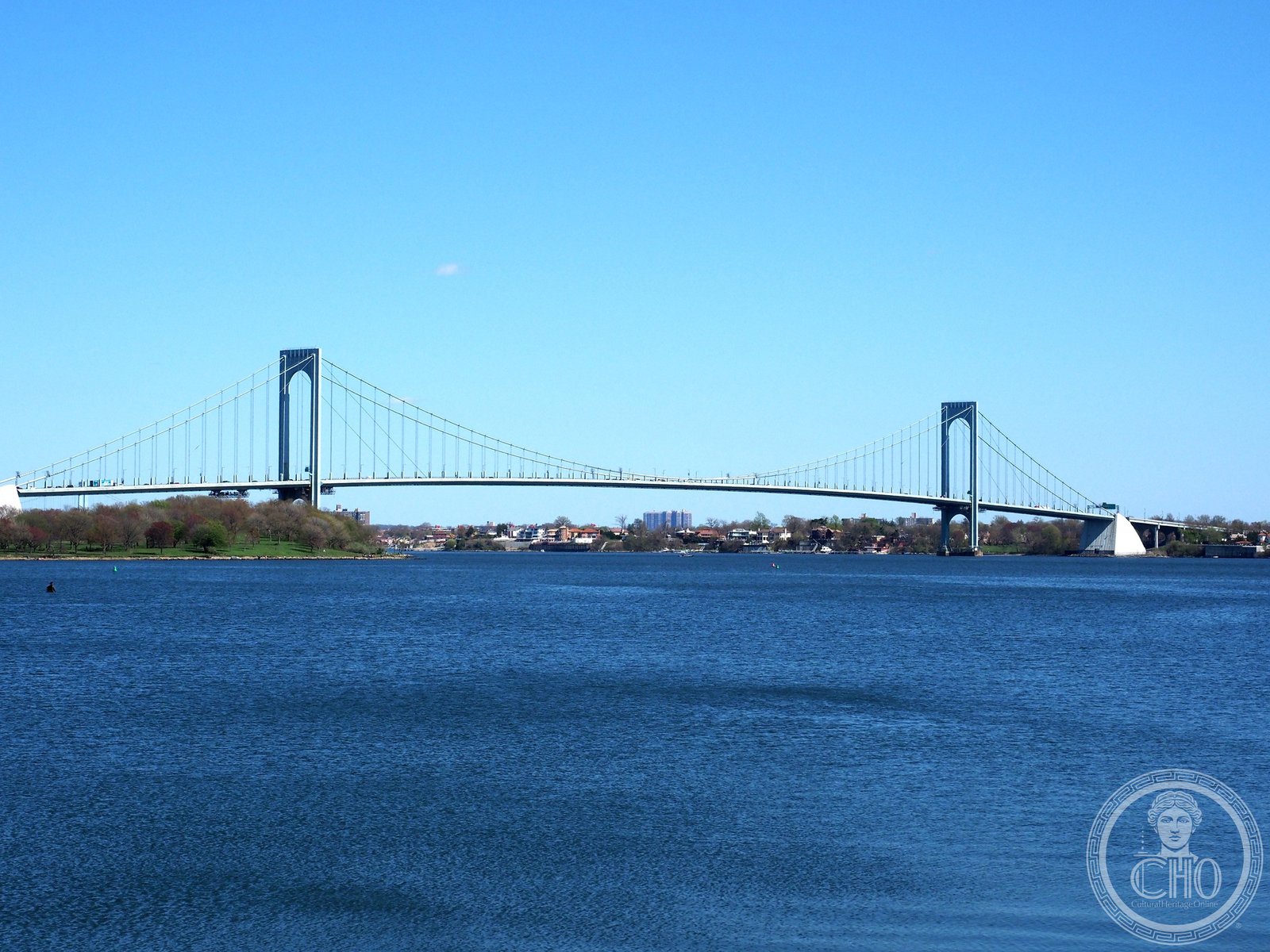
Considered one of the most graceful bridges in the United States at its opening in 1939, the Bronx–Whitestone Bridge carries the Art Deco suspension vocabulary of Othmar Ammann to its most refined expression — all slender towers and uninterrupted cable lines, without the heavy stiffening trusses of its contemporaries.
At a glance
The Bronx–Whitestone Bridge spans the East River at its transition into Long Island Sound, connecting the Whitestone neighbourhood of Queens to Throggs Neck in the Bronx. It was designed by Othmar Ammann — the Swiss-born engineer behind the George Washington and Bayonne bridges — and opened in April 1939, in time to serve traffic bound for the 1939 World’s Fair in Flushing Meadows. Its original design, featuring open-deck plate-girder stiffening rather than deep trusses, was later modified, but the Art Deco towers of limestone-clad steel remain unchanged from the day of opening.
Key facts
- Opened: 29 April 1939
- Type: Suspension bridge
- Engineer: Othmar H. Ammann
- Main span: over 2,000 feet
- Tower height: approximately 370 feet above water
- Designation: New York City Landmark
- Context: Opened to serve 1939 New York World’s Fair traffic; still primary crossing between Queens and the Bronx
History
Planning for the Bronx–Whitestone Bridge was driven by Robert Moses, the New York parks commissioner and master builder who envisioned a network of parkways linking the outer boroughs. The bridge was conceived as the final link in a route connecting the Hutchinson River Parkway in the Bronx to the Whitestone Expressway in Queens, enabling a new approach to the 1939 World’s Fair grounds at Flushing Meadows-Corona Park. Ammann was the logical choice as engineer: he had already delivered the George Washington Bridge (1931) and the Bayonne Bridge (1931), and his reputation for blending structural efficiency with architectural elegance was unmatched.
The bridge opened on 29 April 1939 — two days before the World’s Fair itself — and became an immediate sensation. The engineering press praised its visual refinement: unlike most suspension bridges of the era, the original Whitestone used a relatively shallow plate-girder deck rather than deep through-trusses, which kept the silhouette exceptionally clean. This choice, however, proved consequential: the catastrophic collapse of the Tacoma Narrows Bridge in November 1940 — attributed in part to similar aerodynamic instability — prompted the Port Authority to add stiffening trusses to the Whitestone deck as a precaution. Those trusses were themselves replaced in the early 2000s with a composite box girder system that restored much of the original sleek profile.
The towers, with their Art Deco limestone cladding and streamlined verticality, have stood unchanged throughout these deck modifications. The bridge was subsequently designated a New York City Landmark.
What you see
The towers are the defining visual element: two pairs of rectangular shafts, clad in cream-coloured limestone, rising approximately 370 feet above the water with a controlled taper and a flat, unornamented crown. No arched portals, no finials, no figurative ornament — the Art Deco programme is exercised entirely through proportion, material, and the rhythm of vertical fluting. The restraint is almost Miesian; what distinguishes it from pure functionalism is the deliberate choice of limestone facing over bare steel, giving the towers a civic dignity that bare structural metal cannot achieve.
The best views are from Clason Point Park on the Bronx shore, where the bridge reads against the Queens skyline and the water of Little Neck Bay beyond. At dusk, with the towers floodlit and the cables illuminated, the bridge is as close to architectural jewellery as any crossing in the New York metropolitan area. Traffic on the bridge is continuous; the most peaceful views are from the parks below rather than from the crossing itself.
Practical information
- Access: Vehicle crossing only; no pedestrian or cycling access on the bridge itself
- Best viewpoint: Clason Point Park, Bronx (free parking, waterfront access)
- Tolls: Eastbound (Bronx to Queens); cashless E-ZPass or Pay By Mail
- Time needed: 30–45 minutes for waterfront viewing at Clason Point
- Accessible: Clason Point Park is accessible via BX39/BX36 bus from Westchester Avenue
Getting there
The Bronx–Whitestone Bridge connects the Whitestone Expressway (I-678) in Queens to the Hutchinson River Parkway in the Bronx. Clason Point Park, the best viewpoint, is accessible by car from Soundview Avenue in the South Bronx; BX39 and BX36 buses serve the surrounding neighbourhood from Westchester Avenue. From Midtown Manhattan, the Cross Bronx Expressway (I-95) provides direct access via the bridge’s Bronx approaches.
Nearby
- Throgs Neck Bridge (1961) — the parallel crossing immediately north, giving a rare opportunity to compare two generations of suspension bridge engineering from the same vantage point
- Flushing Meadows-Corona Park — site of the 1939 and 1964 World’s Fairs, a 30-minute drive through Queens; retains the Unisphere and the New York Hall of Science
- New York Botanical Garden — Bronx cultural anchor, a 20-minute drive north of Clason Point
Sources
- Triborough Bridge and Tunnel Authority / MTA Bridges and Tunnels — bridge history and engineering documentation
- New York City Landmarks Preservation Commission — Bronx–Whitestone Bridge designation report (1991)
- Jameson W. Doig, Empire on the Hudson (Columbia University Press, 2001) — Ammann and the Port Authority bridge programme
- Wikipedia: Bronx–Whitestone Bridge — engineering data and primary sources
Find it on the map
See this place and what’s around it →Record researched and written by Luigi De Marchi for Cultural Heritage Online, 2026.
📷 Become a Cultural Heritage Online photographer
Share your photos of places: they stay published under your name as the author. The more they're seen, the more you get noticed — and soon a contest will reward the most appreciated photos.
Log in or sign up free to add a photoIs this page about you?
This page is read by travellers and heritage enthusiasts who find it on Google. Tell us how you are connected to this place and we will take it from there.