
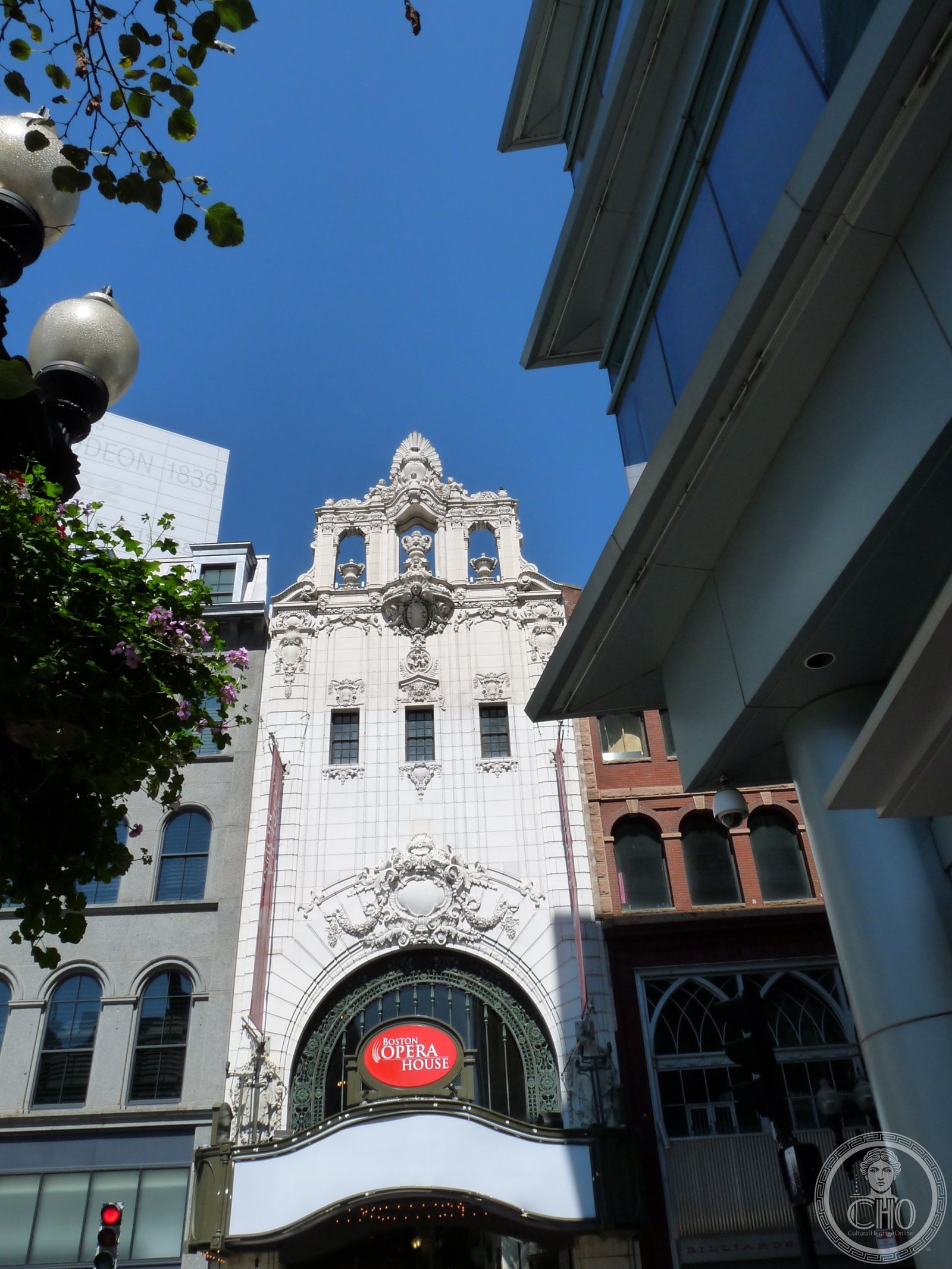
On Washington Street in the heart of Boston’s Theater District, the Boston Opera House has anchored New England’s entertainment culture since 1928 — opened as the B.F. Keith Memorial Theatre, the flagship of America’s most powerful vaudeville circuit, and restored in 2004 as the city’s primary home for touring opera, ballet, and Broadway.
At a glance
The Boston Opera House at 539 Washington Street is one of the finest Art Deco theaters in New England and the jewel of Boston’s historic Washington Street Theater District. Opened in 1928 as the B.F. Keith Memorial Theatre — a monument to the founder of American vaudeville built by the circuit that bore his name — it was designed by Thomas W. Lamb, the most prolific and influential theater architect in American history, whose portfolio encompassed hundreds of movie palaces and legitimate theaters across the United States. After decades of varying use and eventual closure, a thorough restoration in 2004 brought the building back to full theatrical use as the Boston Opera House, now hosting touring productions of the Metropolitan Opera, the Boston Ballet, and major Broadway touring companies.
Key facts
- Address: 539 Washington Street, Boston, MA 02111
- Opened: 1928 as the B.F. Keith Memorial Theatre
- Architect: Thomas W. Lamb
- Named for: Benjamin Franklin Keith (1846–1914), founder of the Keith vaudeville circuit
- Style: Art Deco
- Restored and reopened: 2004 as the Boston Opera House
- Designation: National Register of Historic Places
History
Benjamin Franklin Keith built his entertainment empire from a single museum on Washington Street in Boston in the 1880s, gradually expanding his concept of continuous vaudeville programming — acts performed from morning to evening without pause — into a national circuit that eventually merged with the Edward Albee organization to form the Keith-Albee chain. Keith died in 1914 before his organization reached its greatest extent; the theater that the Keith circuit built in his memory in 1928 was designed to be the permanent monument to his achievement.
Thomas W. Lamb’s design for the Keith Memorial was one of the grandest commissions of his career. Lamb had designed hundreds of theaters across the country by 1928, moving through successive styles from Beaux-Arts to Italian Renaissance Revival to the Art Deco vocabulary that had by the late 1920s become the lingua franca of American entertainment architecture. The Keith Memorial brought that vocabulary to Washington Street with full resources: an elaborate lobby sequence, a grand auditorium with tiered balconies and ornate plasterwork, and a facade that commanded attention among Boston’s theater row.
The theater operated as first-run cinema and later as a venue for various entertainment formats through the mid-twentieth century, eventually closing and falling into disrepair. The 2004 restoration — one of the most thorough theater restorations in recent New England history — returned the building to its original grandeur while adapting it for contemporary theatrical use. As the Boston Opera House, it serves as the primary alternative to the BSO’s Symphony Hall for large-scale touring productions, offering the Theater District a major venue with the scale and stage facilities that touring opera and ballet require.
What you see
The Washington Street facade delivers Lamb’s characteristic confidence: a formal composition in terra cotta and stone with Art Deco ornamental panels, vertical pilasters, and a cornice line that gives the building a distinctive presence on the theater block. The entrance sequence leads through a series of lobby and lounge spaces — all restored with their Art Deco decorative programs intact — into the main auditorium.
The auditorium is the defining architectural experience: Lamb designed the room with the proportions and acoustic geometry needed for a 2,500-seat legitimate theater, balancing the grandeur of the decorative program against the sightlines and acoustic requirements that distinguish a theater from a cinema. The tiered balconies, ornate proscenium arch, and elaborate ceiling work create a room that reads as both theatrical and intimate — the hallmark of the best American movie palace designers at their peak.
Practical information
- Events: Boston Ballet, Metropolitan Opera national tour, Broadway touring productions; check bostonoperahouse.com for schedule
- Theater District: Washington Street between West Street and Stuart Street is Boston’s historic theater block; the Opera House is within a 5-minute walk of the Shubert and Wang theaters
- Nearest T: Boylston (Green Line) and Tufts Medical Center (Orange Line) are the closest T stations; Downtown Crossing (Orange/Red Line) is also walkable
Getting there
Boston is one of the best-connected cities in the Northeast: Logan International Airport is 3 miles from downtown; the Silver Line bus connects Logan to South Station in 15 minutes. South Station serves Amtrak’s Acela and Northeast Regional (New York 4 hours, Providence 35 minutes). The MBTA Green and Orange Lines provide frequent service to the Theater District; Boylston station is the closest stop to the Opera House. Boston is also the southern terminus of the Massachusetts Bay Commuter Rail network for regional connections.
Nearby
- Wang Theatre (1925) / Boch Center — the Metropolitan Theatre, another great Art Deco performing arts venue, is a five-minute walk north in the Theater District on Tremont Street; together with the Opera House, it anchors Boston’s surviving historic theater district
- Boston Public Garden — the oldest public botanical garden in the United States (1837), with its iconic swan boats and Ether Monument; a 10-minute walk northwest along Boylston Street
- Freedom Trail — Boston’s 2.5-mile walking route connecting 16 sites of American Revolutionary history, from Boston Common to Bunker Hill; the trail passes within two blocks of the Opera House at the Old South Meeting House
- Chinatown — Boston’s compact and historic Chinatown begins immediately south of the Theater District; one of the oldest Chinatowns in the country, with concentrated restaurants and the iconic Chinatown Gate on Beach Street
Sources
- National Register of Historic Places, B.F. Keith Memorial Theatre nomination
- Boston Opera House, institutional history
- Boston Landmarks Commission architectural records
- Massachusetts Historical Commission survey
- Boston Preservation Alliance documentation
Find it on the map
See this place and what’s around it →📷 Become a Cultural Heritage Online photographer
Share your photos of places: they stay published under your name as the author. The more they're seen, the more you get noticed — and soon a contest will reward the most appreciated photos.
Log in or sign up free to add a photoDo you manage this place?
This page is read by travellers and heritage enthusiasts who find it on Google. Keep it accurate — and make it work for you. Free for non-profit heritage institutions.