
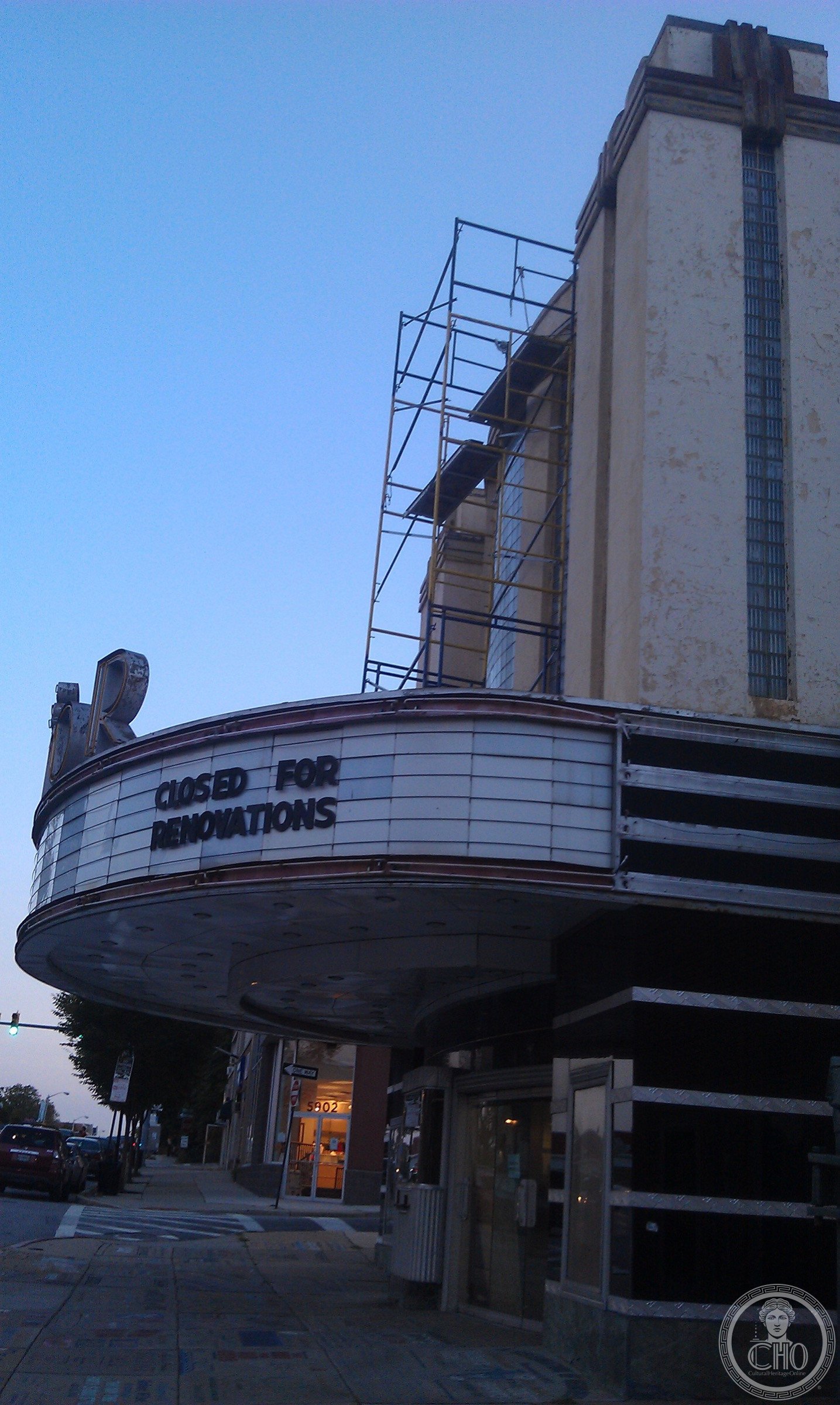
On York Road in the Govans neighborhood, the Senator Theatre has been Baltimore’s most beloved single-screen cinema since 1939 — its curved Art Moderne marquee a landmark of the city’s residential north side, and its screen the backdrop to decades of film premieres and community ritual in one of America’s great movie cities.
At a glance
The Senator Theatre at 5904 York Road is one of the finest surviving Art Moderne movie theaters in the United States and the most cherished single-screen cinema in Baltimore. Opened in 1939 as the decade’s final flourishing of the American movie palace produced the streamlined, curvilinear forms of Art Moderne, the Senator brought the vocabulary of speed and modernity to the residential neighborhoods north of Baltimore’s downtown. Its distinctive curved marquee — a masterwork of neon and illuminated signage on the corner of York Road — has been a Baltimore landmark for eight decades. Preserved and restored through sustained community support, the Senator operates today as an active cinema and cultural venue, the last of Baltimore’s grand neighborhood movie theaters still showing films.
Key facts
- Address: 5904 York Road, Baltimore, MD 21212
- Completed: 1939
- Style: Art Moderne (Streamline Moderne)
- Current use: Active single-screen cinema; special events and film premieres
- Designation: National Register of Historic Places
- Neighborhood: Govans, north Baltimore
History
Baltimore in 1939 was a city of neighborhoods, each with its own commercial strip and community institutions. The Govans area of north Baltimore, along York Road, was a prosperous residential district whose commercial corridor served the surrounding middle-class rowhouse neighborhoods with shops, restaurants, and entertainment. The Senator was built into this environment — not as a downtown palace serving the entire city, but as a neighborhood theater scaled to the surrounding residential community while aspiring to a level of architectural distinction that exceeded that context.
The building’s design reflected the final phase of the great American movie theater tradition: where the 1920s had produced ornate picture palaces, the late 1930s brought the cleaner, more streamlined aesthetic of Art Moderne. The Senator’s curved forms, horizontal banding, and dramatically illuminated marquee reflected the period’s fascination with speed, aerodynamics, and the forms of modern industrial design. The marquee in particular — a curved, cantilevered structure of neon and backlighting that wraps around the building’s corner — became one of the most recognizable signs in Baltimore.
The Senator served the Govans community for decades as a first-run cinema, hosting major releases alongside the suburban multiplexes that gradually captured most of the American movie-going audience. The theater gained particular status among Baltimore filmmakers and audiences as a preferred venue for premieres and special screenings. Film director Barry Levinson, Baltimore’s most prominent cinematic chronicler, has been associated with the theater throughout his career. After facing closure and changing hands, the Senator was preserved and restored through a combination of public support and community fundraising, reopening as a nonprofit cinema and event venue.
What you see
The exterior is the Senator’s signature achievement: a corner composition in which the curved marquee element wraps around the angle of York Road, combining neon signage, backlit panels, and structural metalwork into a dynamic composition that reads from both approaching directions simultaneously. At night, the illuminated marquee is one of the most dramatically lit street corners in Baltimore — a reminder of how American cities once organized their commercial landscapes around the spectacle of moving images and electric light.
The auditorium interior follows the Art Moderne sensibility of the exterior: horizontal banding and streamlined detailing replace the elaborate plasterwork ornament of the earlier movie palaces with a cleaner, more restrained vocabulary. The single-screen format — unusual in contemporary cinema — means that the auditorium is experienced as a single unified room rather than one of many multiplexed boxes. The sight lines, scale, and screen are calibrated for the single-room experience that the Senator’s designers intended.
Practical information
- Films: The Senator programs first-run films, classics, and special events; check thesenatortheatre.com for current programming
- Premieres: The theater hosts Baltimore-connected film premieres; check for upcoming events
- Parking: Street parking available on York Road and surrounding streets; the neighborhood is easily navigable
- Best experience: An evening screening, when the marquee is fully illuminated, represents the theater at its most atmospheric
Getting there
The Senator is in the Govans neighborhood of north Baltimore, five miles from the Inner Harbor. Baltimore Washington International Airport is 12 miles south. The Light Rail’s Woodberry and Cold Spring stations are the nearest rail stops, each about a mile from the theater; Charm City Circulator buses run north on York Road from downtown. From Washington, DC, the MARC Penn Line train reaches Baltimore Penn Station in 45 minutes; the Senator is a 20-minute Uber or bus ride north from the station.
Nearby
- Baltimore Museum of Art — the largest art museum in Maryland, adjacent to the Johns Hopkins University campus; the collection includes the largest holding of Matisse works in the world; two miles south of the Senator
- Johns Hopkins University, Homewood Campus — the Georgian Revival main campus of one of America’s great research universities; two miles south; the Baltimore campus also hosts the Sheridan Libraries and the Homewood House Museum
- Cylburn Arboretum — 207 acres of urban forest and formal gardens maintained by Baltimore City, a green escape about a mile northwest of York Road, off Greenspring Avenue
- Downtown Baltimore Inner Harbor — the revitalized waterfront five miles south, with the National Aquarium, Maryland Science Center, and historic ships of the Baltimore maritime collection
Sources
- National Register of Historic Places, Senator Theatre nomination
- The Senator Theatre, institutional history
- Maryland Historical Trust architectural survey records
- Baltimore City Historic Preservation Commission documentation
- Baltimore Sun archives — Senator Theatre coverage
Find it on the map
See this place and what’s around it →Record researched and written by Luigi De Marchi for Cultural Heritage Online, 2026.
📷 Become a Cultural Heritage Online photographer
Share your photos of places: they stay published under your name as the author. The more they're seen, the more you get noticed — and soon a contest will reward the most appreciated photos.
Log in or sign up free to add a photoIs this page about you?
This page is read by travellers and heritage enthusiasts who find it on Google. Tell us how you are connected to this place and we will take it from there.