
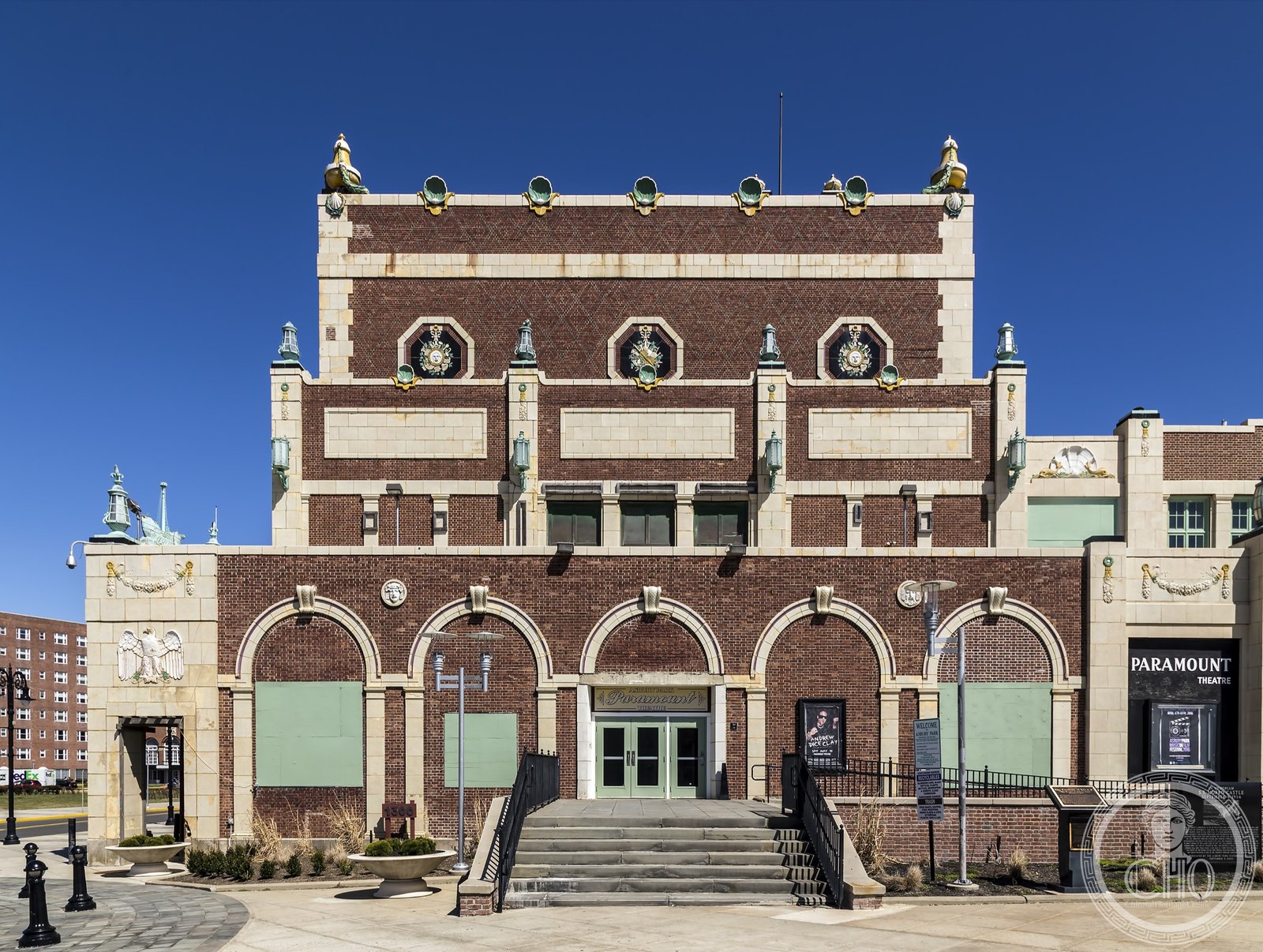
On the Asbury Park boardwalk where the Atlantic meets a city that has reinvented itself more times than almost any other in America, the Paramount Theatre has anchored the shore town’s cultural life since 1930 — an Art Deco jewel whose elaborate facade and rich interior survived decades of urban decline to emerge as a centerpiece of New Jersey’s most dramatic beachfront revival.
At a glance
The Paramount Theatre at 1300 Ocean Avenue is the landmark entertainment venue of Asbury Park’s historic boardwalk district and one of the finest Art Deco theaters surviving on the American Atlantic coast. Part of the waterfront complex built in 1930 that also included the adjacent Convention Hall, the Paramount brought first-class theatrical and cinematic entertainment to one of New Jersey’s most popular seaside resorts during the boardwalk’s golden age. Its elaborate exterior ornament, distinctive Art Deco facade facing the boardwalk, and carefully detailed interior made it the visual anchor of the Ocean Avenue waterfront. Restored after decades of neglect and returned to active use, the Paramount now operates as a live music and performing arts venue at the center of Asbury Park’s remarkable cultural renaissance.
Key facts
- Address: 1300 Ocean Avenue, Asbury Park, NJ 07712.
- Completed: 1930.
- Style: Art Deco.
- Adjacent: Convention Hall (1930), now Asbury Park Convention Hall.
- Current use: Active performing arts and live music venue.
- Designation: National Register of Historic Places (Asbury Park boardwalk complex).
History
Asbury Park was born as a planned resort community in 1869, founded by New York businessman James Bradley, who named it after Methodist bishop Francis Asbury and built it as a temperance resort — a city without saloons, designed for the respectable middle classes of New York and New Jersey who wanted a seaside retreat. The boardwalk and its hotels, pavilions, and entertainment venues grew through the late nineteenth and early twentieth centuries into one of the most popular resort destinations on the Jersey Shore.
The 1930 construction of the Convention Hall and Paramount Theatre complex represented the apex of Asbury Park’s ambition. The complex was built on a scale commensurate with the resort’s vision of itself: a major civic facility that could host large conventions and a performing arts theater that could serve as the entertainment center of the Jersey Shore. The Art Deco design, with its elaborate ornamental facade and detailed interior, reflected the era’s confidence in the resort’s future.
The mid-twentieth century brought the familiar decline of the American urban resort: the rise of the automobile and the expansion of affordable air travel eroded the captive market of day-trippers and vacationers who had made the Jersey Shore towns prosper. Asbury Park suffered more acutely than most, with the civil unrest of the late 1960s accelerating the departure of businesses and residents. The boardwalk complex stood increasingly vacant through the 1970s and 1980s, its fabric slowly deteriorating.
The revitalization of Asbury Park that began in the early 2000s — driven in part by the city’s emergence as a culturally progressive community and by the longstanding association of the boardwalk with New Jersey’s rock and roll tradition — brought the Paramount back to life. Restored and reactivated, it now serves a city that has become one of the most creatively vital on the Jersey Shore.
What you see
The Ocean Avenue facade presents the Paramount’s full Art Deco vocabulary: a symmetrical composition with an elaborate central portico, ornamental panels in the Art Deco idiom, and the kind of architectural confidence that characterized the best resort buildings of the period. The building reads as a backdrop to the boardwalk promenade — designed to be seen from a distance and to draw visitors in through the spectacle of its ornamentation.
The interior spaces have been adapted for contemporary performance use while preserving the character of the original design. The main performance hall, with its proscenium stage and audience capacity, serves the range of acts that have made the Paramount a destination for live music — a tradition that reflects both the building’s own history and the Jersey Shore’s broader musical legacy.
Practical information
- Events: Live music, performing arts, special events; check apboardwalk.com or the Paramount’s ticketing partners for schedule.
- Boardwalk access: The Paramount faces the boardwalk at the heart of Asbury Park’s historic waterfront; the Convention Hall is immediately adjacent; the beach is across the boardwalk.
- Parking: Municipal parking is available within the boardwalk district; the area is walkable from the train station.
Getting there
Asbury Park is 56 miles south of New York City. NJ Transit North Jersey Coast Line trains run frequently from New York Penn Station to Asbury Park (about 90 minutes); the boardwalk is a 10-minute walk east from the train station. By car, take the Garden State Parkway toward Asbury Park and follow signs to the boardwalk. Newark Liberty International Airport is the most convenient gateway for air travelers, about 55 miles north.
Nearby
- Convention Hall (1930) — the adjacent landmarked building that forms the other half of the 1930 boardwalk complex; a major event venue whose ornate interior has hosted conventions, concerts, and boxing matches for nearly a century.
- The Stone Pony — the legendary live music venue on Ocean Avenue whose role in launching the careers of Bruce Springsteen and Southside Johnny Lloyd makes it one of the most historically significant rock clubs in America; a few blocks south on the boardwalk.
- Asbury Park boardwalk — the Victorian-era wooden boardwalk stretching along the Ocean Avenue waterfront, lined with bars, restaurants, and pop-up vendors; one of the liveliest boardwalk scenes on the Jersey Shore.
- Bradley Beach, Ocean Grove — the adjoining shore communities to the north and south of Asbury Park; Ocean Grove is a Victorian-era camp meeting community whose extraordinary concentration of gingerbread cottages is a National Historic Landmark district.
Sources
- National Register of Historic Places, Asbury Park Boardwalk Historic District nomination.
- New Jersey Historic Preservation Office architectural records.
- Asbury Park Press archives — boardwalk history coverage.
- Monmouth County Historical Association documentation.
- Paramount Theatre, Asbury Park, institutional history.
Find it on the map
See this place and what’s around it →Record researched and written by Luigi De Marchi for Cultural Heritage Online, 2026.
📷 Become a Cultural Heritage Online photographer
Share your photos of places: they stay published under your name as the author. The more they're seen, the more you get noticed — and soon a contest will reward the most appreciated photos.
Log in or sign up free to add a photoIs this page about you?
This page is read by travellers and heritage enthusiasts who find it on Google. Tell us how you are connected to this place and we will take it from there.