

The Bauhaus lasted fourteen years and was closed by the Nazis. In that time it produced a curriculum, a set of formal principles and a generation of designers that collectively constituted the most influential art school of the twentieth century.
At a glance
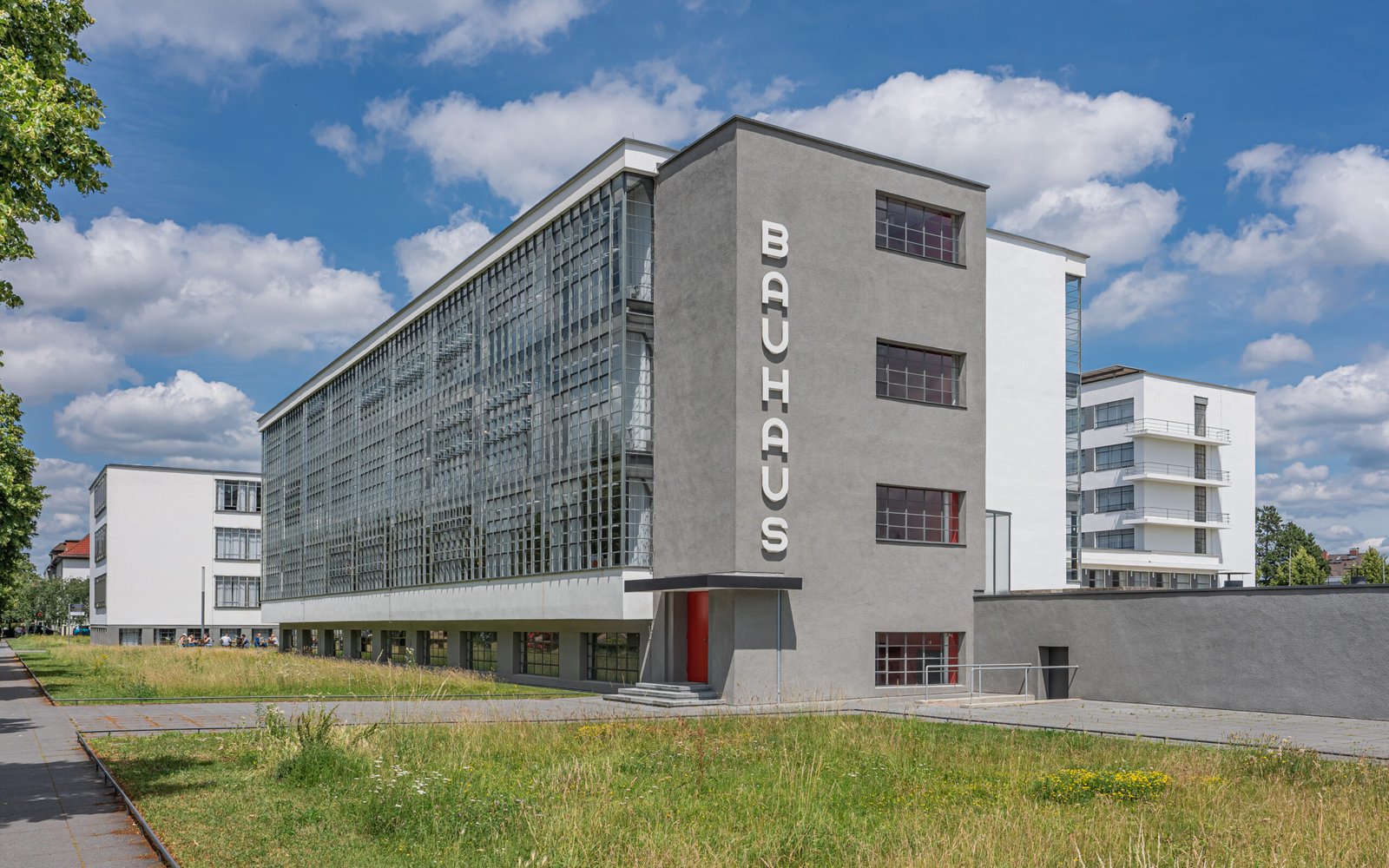
The Bauhaus was founded in Weimar in 1919 by Walter Gropius, moved to Dessau in 1925, and closed under pressure in Berlin in 1933. Its core proposition — that art, craft and industrial production should be unified under a single educational programme — generated a new visual language: geometric, functional, reproducible, unadorned. The school building Gropius designed for Dessau (1925–1926) is the programme made architecture: a glass curtain wall workshop block, a white studio wing for student housing, a covered bridge connecting the two. The building is now a UNESCO World Heritage Site and the most-visited monument of the Bauhaus legacy, while Berlin’s Bauhaus-Archiv holds the world’s largest collection of the school’s objects, drawings and photographs.
Key facts
- Country: Germany (Saxony-Anhalt for Dessau; Berlin)
- Key period: 1919–1933 (Bauhaus / International Style / Rationalism)
- Key figure: Walter Gropius (1883–1969) — architect, founder and first director of the Bauhaus
- Also notable: Ludwig Mies van der Rohe (last director, Neue Nationalgalerie Berlin), László Moholy-Nagy, Marcel Breuer, Herbert Bayer, Paul Klee, Wassily Kandinsky (masters)
- UNESCO heritage: Bauhaus and its Sites in Weimar, Dessau and Bernau (1996)
- Essential sites: Bauhaus Dessau, Meisterhäuser, Bauhaus-Archiv Berlin, Neue Nationalgalerie (Mies), Hufeisensiedlung Berlin
- Annual anniversaries: Gropius nascita 18 maggio, Gropius morte 5 luglio
History
Walter Gropius was born in Berlin on 18 May 1883 into an architectural family — his great-uncle Martin Gropius designed the Berlin Kunstgewerbemuseum. After training under Peter Behrens (alongside Le Corbusier and Mies van der Rohe), Gropius founded the Bauhaus in Weimar in April 1919, merging the former Grand-Ducal School of Arts and Crafts with the Academy of Fine Arts. The school’s first manifesto declared: “The ultimate aim of all creative activity is building.” Every student would learn both a craft and a fine art; every workshop would be led jointly by a craftsman-master and an artist-master.
Political pressure from Weimar’s conservative government forced the school to Dessau in 1925. Gropius designed the new building in the most radical mode available: a glass-and-concrete factory aesthetic applied to an educational institution. The Meisterhäuser — semi-detached cubic villas for the faculty, including Klee, Kandinsky, Moholy-Nagy and Schlemmer — were built adjacent to the school in the same year. Gropius resigned in 1928, succeeded briefly by Hannes Meyer and then by Mies van der Rohe; Mies closed the school in Berlin in 1933 under Nazi pressure, ten weeks after assuming directorship.
Gropius emigrated to England in 1934 and to the United States in 1937, where he taught at Harvard for fifteen years and designed the Gropius House in Lincoln, Massachusetts (1938, now a National Historic Landmark). He died in Boston on 5 July 1969. Mies van der Rohe’s final major work — the Neue Nationalgalerie in Berlin (1968) — stands as the definitive statement of the Bauhaus minimalist legacy: a single room under a steel-and-glass roof, raised on a granite plinth, containing nothing but the possibility of exhibition.
What you see
The Bauhaus building in Dessau (Gropiusallee 38) is open for guided tours and overnight stays in the student studio wing. The glass curtain wall of the workshop block — the first major example of a fully glazed structural facade in German architecture — reflects the sky and the landscape simultaneously, refusing the distinction between interior and exterior that traditional architecture maintained. The adjacent Meisterhäuser (Ebertallee 59–71) have been carefully restored; the Kandinsky/Klee house and the Moholy-Nagy house are open to visitors and display reconstructions of the original interiors.
In Berlin, the Bauhaus-Archiv (Klingelhöferstraße 14) holds the world’s largest collection of Bauhaus-related material: furniture by Breuer, typography by Bayer, weaving by Gunta Stölzl, photographs by László Moholy-Nagy. The museum building was designed by Gropius himself in his late career (1964, completed posthumously in 1979). The Neue Nationalgalerie (Potsdamer Straße 50, Mies van der Rohe, 1968) is a 15-minute walk and offers, in its lower-level galleries, one of Berlin’s finest collections of modern art beneath the most serene architectural canopy in the city.
Practical information
- Bauhaus Dessau: open daily; guided tours and overnight booking at bauhaus-dessau.de
- Meisterhäuser: open Tue–Sun; separate ticket from the main building
- Bauhaus-Archiv Berlin: open Wed–Mon 10:00–17:00; bauhaus.de/de/das-bauhaus/kontakt/museum
- Neue Nationalgalerie: Thu–Mon 10:00–18:00, Fri until 20:00; smb.museum
- Berlin–Dessau day trip: direct trains hourly, ~1h30; combined day ticket available
Getting there
Berlin Brandenburg Airport (BER) opened in 2020 and connects to Berlin Hauptbahnhof by the FEX express train in 30 minutes. From Hauptbahnhof, direct regional trains to Dessau take approximately 1h30 (Deutsche Bahn). Within Berlin, the Bauhaus-Archiv is served by bus M29 or U Nollendorfplatz (10 min walk); the Neue Nationalgalerie by S1/S2/S25 (Potsdamer Platz).
Related in CHO
- Anniversario nascita: Walter Gropius — 18 maggio 1883
- Anniversario morte: Walter Gropius — 5 luglio 1969
- Berlin Cathedral (existing CHO card)
- Chicago — Wright, Mies and the Architecture of Modernity
Sources
Find it on the map
See this place and what’s around it →Events here — now on & upcoming
- Birth Anniversary: Walter Gropius — May 18, 188318 May 2027See the event →
- Death Anniversary: Walter Gropius — July 5, 196905 Jul 2027See the event →
📷 Become a Cultural Heritage Online photographer
Share your photos of places: they stay published under your name as the author. The more they're seen, the more you get noticed — and soon a contest will reward the most appreciated photos.
Log in or sign up free to add a photo