
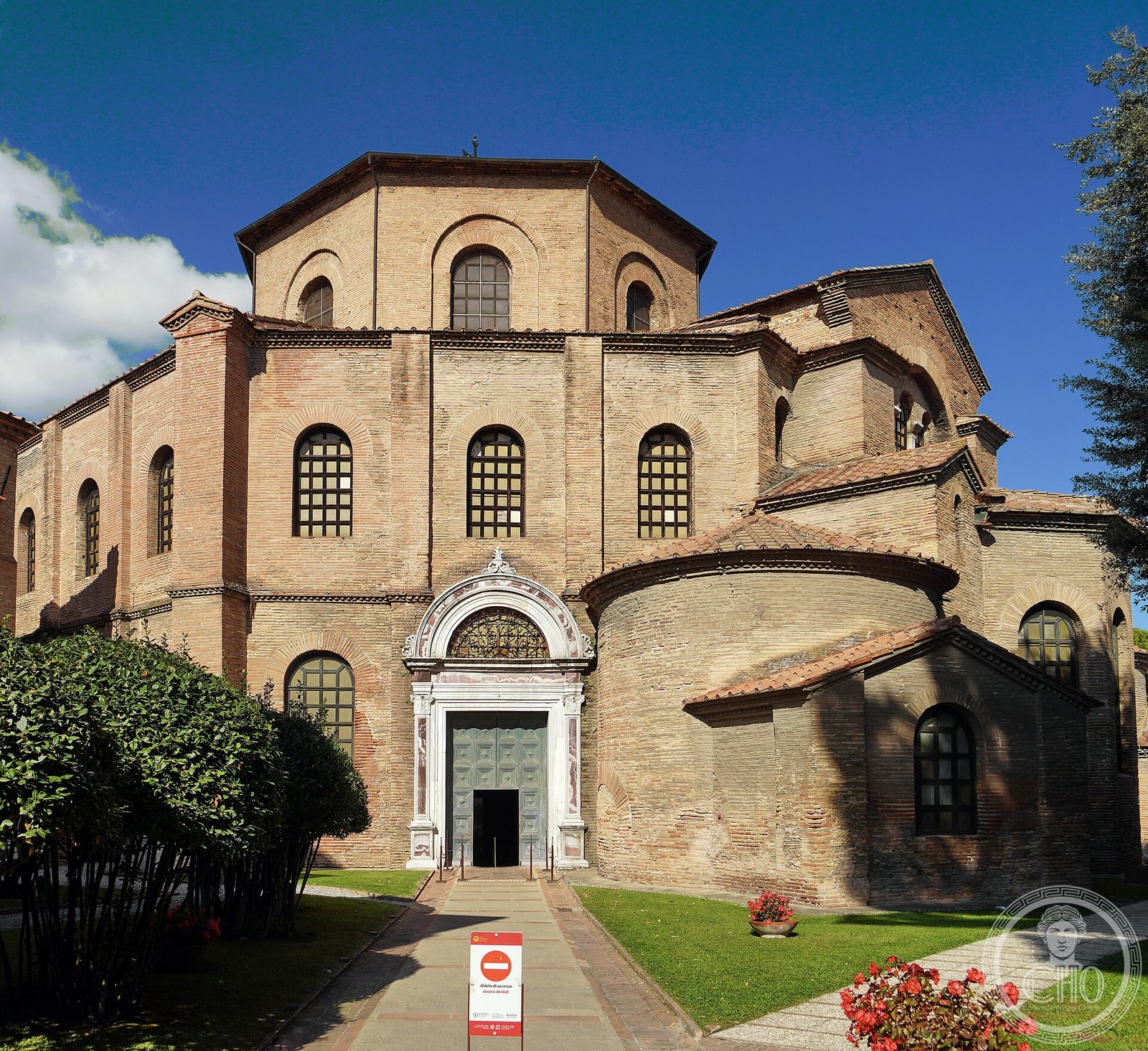
San Vitale is one of the most complete surviving examples of early Byzantine art in the West. The octagonal church was consecrated in 547, two years before Justinian closed his reconquest of Italy, and the gold-ground mosaics of the presbytery still carry the imperial portrait of the emperor and Theodora that art-history textbooks reproduce on their covers.
- Address
- Via San Vitale 17, 48121 Ravenna (RA)
- Built
- Begun c. 526 under Bishop Ecclesius; consecrated 547 by Bishop Maximian
- Architectural style
- Byzantine, octagonal central plan with ambulatory and gallery
- Status
- UNESCO World Heritage Site since 1996 ("Early Christian Monuments of Ravenna"); minor basilica since 1960
- Managed by
- Opera di Religione della Diocesi di Ravenna; tickets via Ravennamosaici circuit
- Coordinates
- 44.4205° N, 12.1963° E
Visit on the map
Via San Vitale 17, 48121 Ravenna (RA) · 44.4205° N, 12.1963° E
Download for your navigator
A single waypoint, ready for GPS apps, navigators, and contacts.
Construction began around 526 under Bishop Ecclesius, with funding provided in large part by Julianus Argentarius, a banker of Ravenna whose name appears in the dedicatory inscriptions. The basilica was completed twenty years later under Bishop Maximian, by which time Ravenna had passed from Ostrogothic to Byzantine rule. The choice of an octagonal central plan, unusual in the Latin West, follows models from the Eastern Empire — Saints Sergius and Bacchus in Constantinople is the closest comparison — and would in turn become the reference for Charlemagne’s Palatine Chapel at Aachen, built two and a half centuries later.
“The unique character of Ravenna lies in its having combined the traditions of Roman antiquity, the iconography of Christianity, and Oriental and Western styles in a manner unsurpassed in the history of European art.”
ICOMOS evaluation for UNESCO — Ravenna, 1996
The mosaics of the presbytery are the reason most visitors come. On the lower walls, two facing panels show Justinian on the north side, with Bishop Maximian and a guard, and Theodora on the south, with her court of women — both processions presenting offerings, both rendered in the flat hieratic style that would dominate Byzantine sacred art for the next thousand years. The Old Testament cycle on the upper walls treats Abel and Melchizedek, Abraham, and Moses as prefigurations of the Eucharist celebrated below.
San Vitale anchors a circuit of eight monuments inscribed together by UNESCO in 1996 as "Early Christian Monuments of Ravenna". The others — the Mausoleum of Galla Placidia next door, the Arian and Neonian baptisteries, Sant’Apollinare Nuovo, Sant’Apollinare in Classe, the Mausoleum of Theoderic, and the Archiepiscopal Chapel — can all be visited on a single combined ticket. Together they preserve more square metres of fifth- and sixth-century mosaic than anywhere else in the world.
Resources & References
Editorial picks across Wikipedia, photo archives, and the official institution.
Photographs via Wikimedia Commons (CC-BY-SA) unless otherwise stated. Editorial text Cultural Heritage Online, OASIS Tech LLC USA.
Plan your visit
Open to visitors year-round; check local tourism offices for seasonal hours, admission fees, and guided tour availability. GPS coordinates: 44.42049027313786, 12.19632089138031.
Find it on the map
See this place and what’s around it →

📷 Become a Cultural Heritage Online photographer
Share your photos of places: they stay published under your name as the author. The more they're seen, the more you get noticed — and soon a contest will reward the most appreciated photos.
Log in or sign up free to add a photoIs this page about you?
This page is read by travellers and heritage enthusiasts who find it on Google. Tell us how you are connected to this place and we will take it from there.