
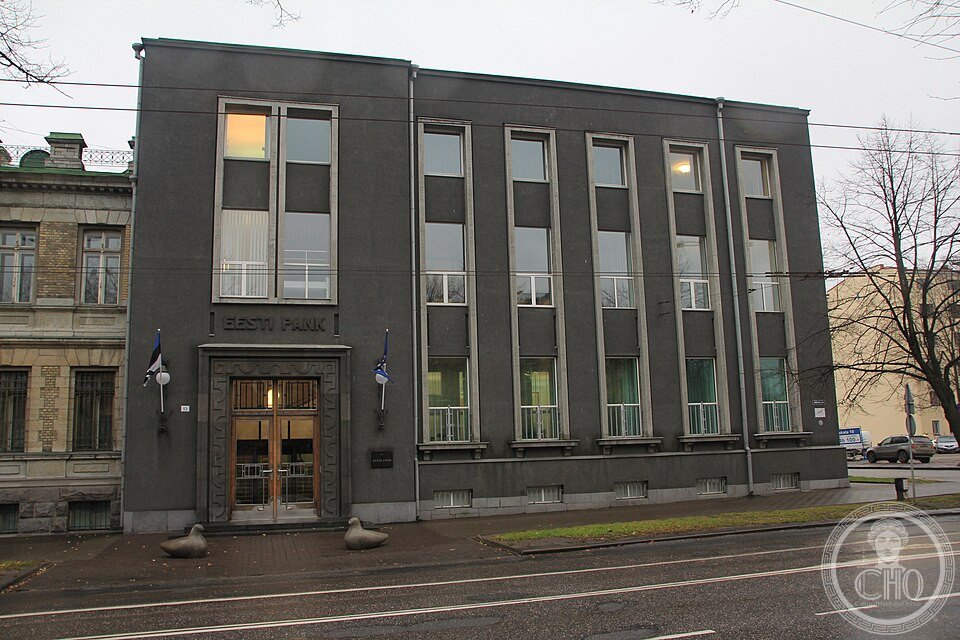
The headquarters of the Bank of Estonia in Tallinn stands as one of the most eloquent expressions of Estonian national confidence during the brief, luminous window of interwar independence between 1918 and 1940. Designed by architect Herbert Johanson and completed in 1935, the building occupies a commanding position in the historic centre with a sober Neoclassical facade distinguished by clean Ionic columns, restrained stone detailing, and a rational interior plan that speaks of institutional permanence and fiscal order. The design was a deliberate architectural statement: where the pre-independence tsarist period had favoured ornate eclecticism, the new Estonian republic chose clarity and discipline. The bank was the institution that had issued the Estonian kroon in 1928, stabilising the young republic economy and anchoring its sovereignty. During the Soviet occupation the building became the Estonian SSR State Bank, its name changed but its fabric intact. When Estonia regained independence in 1991, the Bank resumed operations here almost immediately, one of the most rapid democratic economic transitions ever recorded in a European nation. The building carries a Heritage B listing.
At a glance
- Type
- Central bank headquarters
- Period
- 1935
- Style
- Neoclassical / Functionalist
- Location
- Estonia pst 13, Tallinn, Estonia
- Coordinates
- 59.4386 N, 24.7456 E
- Architect(s)
- Herbert Johanson
Overview
The Bank of Estonia Building is the institutional centrepiece of Estonian financial history, designed in a transitional style that bridges late Neoclassicism and early Functionalism. Its Ionic-columned entrance portico and granite-clad base project authority, while the simplified upper storeys and rational fenestration reflect the emerging Modernist sensibility of 1930s European civic architecture. The building has served continuously as a banking headquarters since its opening, surviving both Soviet occupation and the turbulent transition to re-independence, and remains the operational seat of the Bank of Estonia today.
History
Estonia declared independence in 1918 and moved quickly to establish the institutional architecture of a sovereign state. The Bank of Estonia was founded in 1919 and issued the kroon in 1928, a currency that became a symbol of national pride. The current building, completed in 1935, replaced earlier premises and was intended to project the republic economic maturity. Soviet annexation in 1940 ended Estonian independence; the building became the headquarters of the Estonian SSR State Bank. The Soviet period left the structure physically unaltered. Estonia Singing Revolution and formal re-independence in 1991 saw the Bank resume its functions here within months, issuing new kroon banknotes as a sovereign act, a transition that astonished observers with its speed and orderliness.
Architecture & Design
Johanson design occupies an interesting stylistic position: the Ionic portico and symmetric massing are classically derived, but the stripped surfaces, minimal ornament, and functional interior layout place it firmly in the rationalist current running through 1930s Nordic and Baltic architecture. The building granite lower courses and dressed stone upper facade give it a gravity appropriate to its institutional role. The interior was designed for efficient banking operations, with generous teller halls, secure vault access, and executive offices arranged around a central circulation spine. The overall effect is of disciplined sobriety, architecture as institutional character.
Cultural significance
The Bank of Estonia Building is more than a piece of good civic architecture: it is a monument to Estonian economic sovereignty. The kroon issued from this building in 1928 was one of the most stable currencies in interwar Europe. The building survival through occupation and its rapid return to its original function in 1991 make it a physical symbol of Estonian resilience and institutional memory. For Estonians, it carries the same emotional weight as independence monuments, representing the continuity of national economic identity across fifty years of foreign rule.
Visiting today
The Bank of Estonia operates a public Museum of Estonian Banking on the premises, offering free admission. The museum traces the history of Estonian monetary policy, the kroon, and the economic aspects of independence and re-independence. Temporary exhibitions are regularly mounted. The exterior can be viewed at any time; guided group visits to the museum can be arranged by appointment through the Bank of Estonia communications office.
Getting there
The building is located on Estonia puiestee (Estonia Avenue) in central Tallinn, within easy walking distance of the Old Town. Trams 1, 2, and 4 stop at Estonia Theatre / Estonia puiestee, a two-minute walk. From Tallinn Airport, tram line 4 runs directly to the city centre stop in approximately 20 minutes. Parking in the immediate area is limited; public transport is strongly recommended.
Sources & resources
Find it on the map
See this place and what’s around it →Record researched and written by Luigi De Marchi for Cultural Heritage Online, 2026.
📷 Become a Cultural Heritage Online photographer
Share your photos of places: they stay published under your name as the author. The more they're seen, the more you get noticed — and soon a contest will reward the most appreciated photos.
Log in or sign up free to add a photoIs this page about you?
This page is read by travellers and heritage enthusiasts who find it on Google. Tell us how you are connected to this place and we will take it from there.