
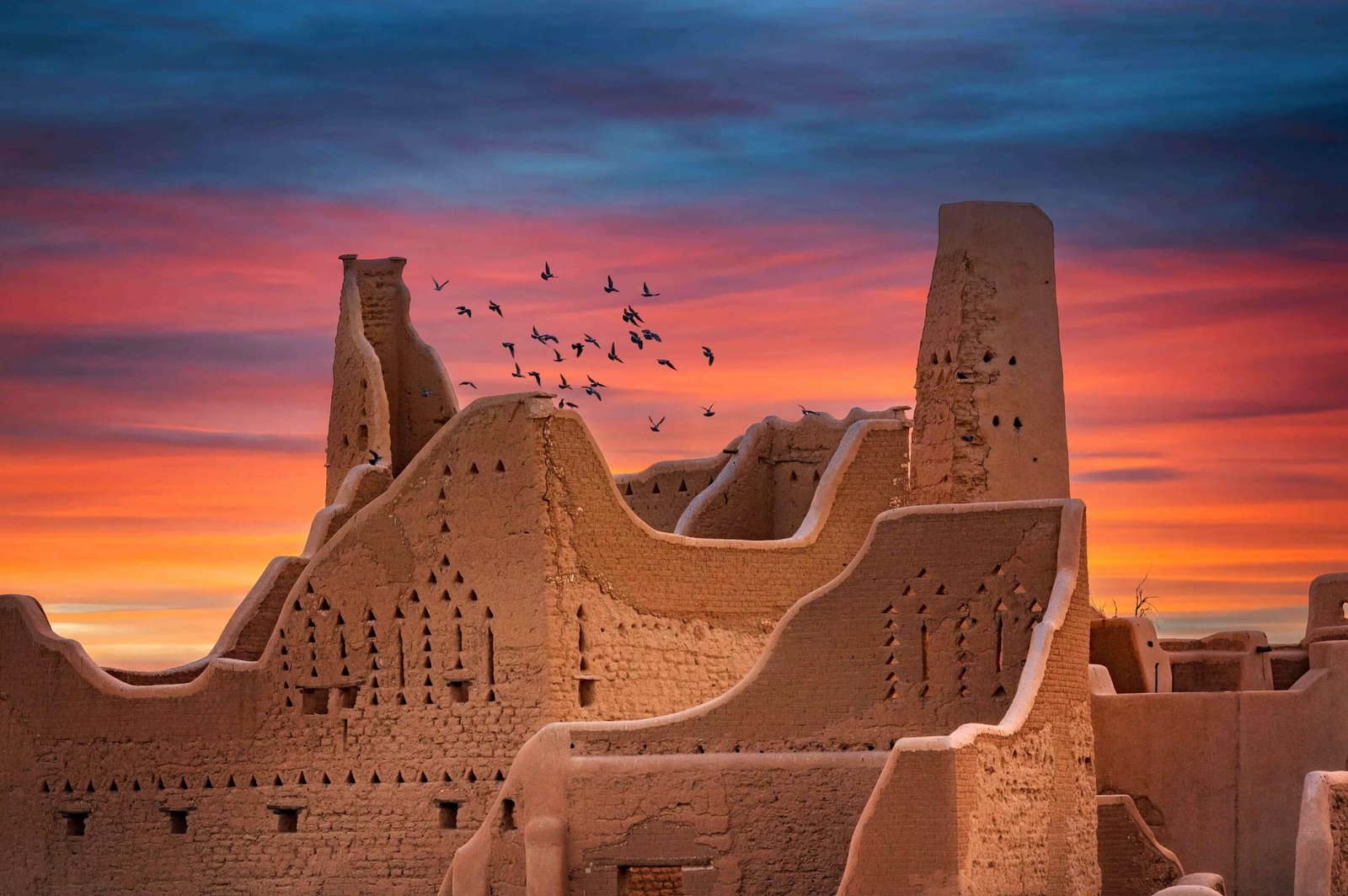
The mud-brick ruins of At-Turaif mark the birthplace of the Saudi state — where a 1744 CE alliance between a desert chieftain and a religious reformer launched a political-religious movement that would reshape the Arabian Peninsula and endure to the present day.
At a glance
Inscribed by UNESCO in 2010, the At-Turaif District occupies a dramatic ridge above the Wadi Hanifah valley, on the northwestern outskirts of modern Riyadh. Founded c. 1446 CE by the ancestors of the Al Saud family, it grew into the capital of the First Saudi State (1727–1818 CE) and the seat of the Wahhabi-Saudi alliance — the religious-political compact between Muhammad ibn Saud and the reformer Muhammad ibn Abd al-Wahhab that created the ideological foundation of modern Saudi Arabia. The ruins preserve extraordinary examples of Najdi architecture — the distinctive mud-brick building tradition of the Najd plateau — including palace complexes, mosques, and a dense residential quarter, all destroyed by the Egyptian-Ottoman army in 1818 CE and preserved by the desert’s arid climate ever since.
Key facts
- UNESCO inscription: 2010
- Founded: c. 1446 CE by ancestors of the Al Saud family
- Period of significance: 1727–1818 CE (First Saudi State)
- The 1744 CE alliance: Muhammad ibn Saud + Muhammad ibn Abd al-Wahhab — combined political authority and Wahhabi religious reform, creating the ideological basis of modern Saudi Arabia
- Destruction: 1818 CE — Egyptian-Ottoman army of Muhammad Ali razed the palace complex and expelled the population
- Architecture: Najdi style — unfired mud-brick, diamond-shaped parapet decoration (the “Najdi fringe”), narrow shaded streets, decorated interior courtyards
- Key structures: Al-Turaif Palace complex, Imam Mohammed bin Saud mosque, defensive towers, merchants’ houses, network of streets
- Restoration: Major Saudi government project since the 1990s under Vision 2030; opened to visitors 2019
History
At-Turaif was founded c. 1446 CE when Mani’ al-Muraidi, an ancestor of the Al Saud family, settled the ridge above the Wadi Hanifah and built the first settlement. The site grew slowly as a farming and trading community over the next two centuries, fed by the wadi’s water and date-palm groves. By the early 18th century it had become a local political centre of some importance under successive emirs of the Al Saud.
The pivotal moment came in 1744 CE, when the emir Muhammad ibn Saud entered a compact with the itinerant religious scholar Muhammad ibn Abd al-Wahhab, who had been expelled from his own town for preaching a strict, reform-oriented interpretation of Sunni Islam. Ibn Saud offered political protection; Ibn Abd al-Wahhab offered religious legitimacy. The alliance proved world-changing. Within decades the First Saudi State had expanded across most of the Arabian Peninsula, with At-Turaif as its capital and Wahhabi religious teaching as its ideological engine.
The First Saudi State reached its maximum extent around 1805 CE, controlling Mecca and Medina and threatening the Ottoman Empire’s claim to custodianship of the holy cities. The Ottoman Sultan dispatched Muhammad Ali, the powerful Viceroy of Egypt, to suppress it. His son Ibrahim Pasha captured and destroyed At-Turaif in 1818 CE, burning the palace complex, deporting the Saudi royal family to Istanbul, and temporarily ending the First Saudi State. The ruins were left to the desert. A Second Saudi State and eventually the current Kingdom of Saudi Arabia arose from the same family and the same ideological roots — making At-Turaif the direct ancestor of the modern state.
What you see
The ruins cover a ridge about 500 metres long above the wadi, enclosed by defensive walls with watchtowers at regular intervals. The Al-Turaif Palace complex dominates the northern end — a multi-courtyard ensemble of reception halls, private quarters, storage rooms and a palace mosque, all built in the Najdi mud-brick tradition. The most immediately striking architectural feature is the diamond-shaped parapet decoration (called the Najdi fringe or saw-tooth battlement) that runs along the top of every wall and tower — rows of triangular projections in unfired mud-brick that cast dramatic shadows at sunrise and sunset.
The Imam Mohammed bin Saud mosque stands near the palace; its simple mud-brick prayer hall and minaret are among the best-preserved structures on site. Descending from the palace, a dense maze of residential streets reveals the ordinary life of the capital: narrow lanes shaded by upper-storey corbelling, doorways with carved wooden lintels, the outlines of courtyard houses and merchants’ stores. Ongoing restoration by the Royal Commission for Diriyah has stabilised many structures and created viewing platforms that allow safe exploration without disturbing the ruins.
Practical information
- Location: Diriyah, northwest of central Riyadh; GPS 24.7344°N 46.5744°E
- Opening hours: Check Royal Commission for Diriyah website — typically Sat–Thu 9am–10pm, Fri 2pm–10pm
- Admission: Entry fees apply; combined tickets with Diriyah Season events available
- Getting there from central Riyadh: ~20 minutes by car (King Salman Road northwest); Diriyah Metro station on Riyadh Metro Line 4 (Orange Line)
- Dress code: Conservative dress required; abaya for women (available to borrow at entrance)
- Photography: Permitted throughout the site for personal use
- Guided tours: Available on-site and through official Diriyah tourism operators
Getting there
Diriyah is ~20 km northwest of central Riyadh, easily reached by car along King Salman Road. Riyadh Metro Line 4 (Orange Line) has a Diriyah station within walking distance of the site — a comfortable option that avoids Riyadh’s traffic. King Khalid International Airport (RUH) serves Riyadh with flights from worldwide. From the airport, the site is approximately 30 minutes by taxi or rideshare.
Nearby
- Diriyah Season — the annual cultural festival held in the wider Diriyah development area; events, concerts and heritage exhibitions typically October–February
- Bujairi Terrace — a restored traditional quarter adjacent to At-Turaif, with restaurants, cafés and artisan workshops overlooking the wadi
- National Museum of Saudi Arabia — Riyadh; 8 galleries tracing Arabian history from prehistory to the modern state, directly relevant context for At-Turaif
- Al-Hijr (Hegra / Madain Saleh) — Saudi Arabia’s first UNESCO WHS, the Nabataean city 1,000 km northwest
Sources
- UNESCO World Heritage List — At-Turaif District in ad-Dir’iyah, inscribed 2010. whc.unesco.org/en/list/1329
- Royal Commission for Diriyah — official site documentation and visitor information
- Wikipedia — “At-Turaif District in ad-Dir’iyah”
- Vassiliev, A. (1998). The History of Saudi Arabia. Saqi Books.
Find it on the map
See this place and what’s around it →📷 Become a Cultural Heritage Online photographer
Share your photos of places: they stay published under your name as the author. The more they're seen, the more you get noticed — and soon a contest will reward the most appreciated photos.
Log in or sign up free to add a photo