
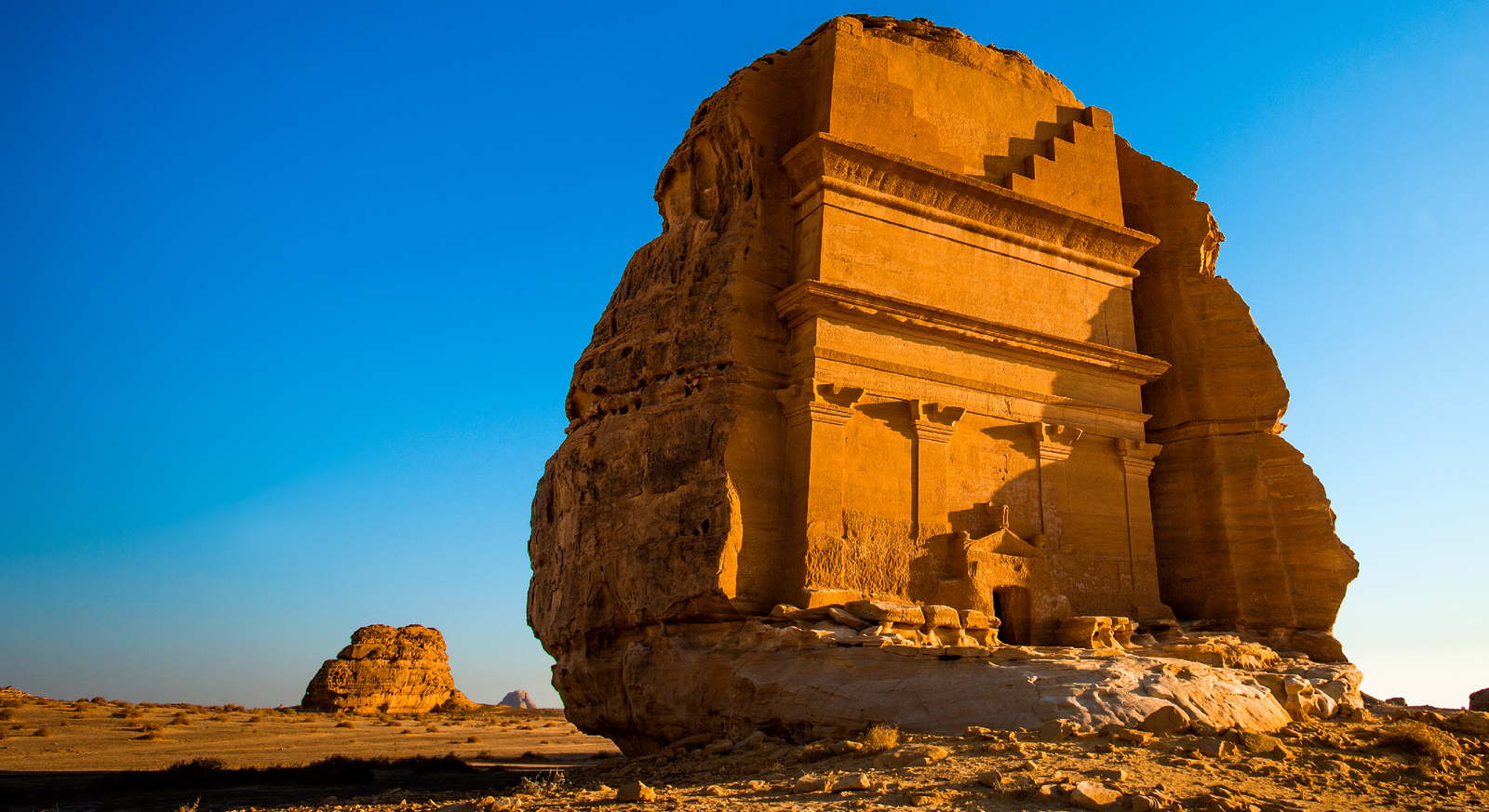
In the desert highlands north of Medina, 111 elaborately carved Nabataean tombs rise from sandstone outcrops — a ghost city of the dead that medieval travellers considered cursed, and that Saudi Arabia has only recently opened to tourism.
At a Glance
Al-Hijr (known in Saudi tourism promotion as Hegra, and historically as Madain Saleh) is located in the AlUla governorate in north-western Saudi Arabia, approximately 380 km north of Medina. It was the southernmost significant city of the Nabataean Kingdom and their largest settlement after Petra (in modern Jordan). UNESCO inscribed it as Saudi Arabia’s first World Heritage Site in 2008. Long closed to all but permit holders, it has only recently been opened to visitors, as the AlUla region has been developed as a major cultural tourism destination.
The Nabataean Kingdom
The Nabataeans were an Arab people who dominated the overland spice and incense trade routes between southern Arabia, the Mediterranean, and Mesopotamia from roughly the 4th century BC to the 1st century AD. Their capital was Petra; Al-Hijr was their southern gateway, controlling the caravan routes between Medina and Damascus. The city flourished under the Nabataean kings, particularly during the 1st century BC and 1st century AD. When Rome annexed the Nabataean Kingdom in 106 AD, Al-Hijr declined; the trade routes shifted and the city was gradually abandoned.
The Tombs
The defining feature of Al-Hijr is its 111 monumental rock-carved tombs, cut directly into the sandstone hills (called jabal). The tomb facades are decorated with elaborate architectural motifs — Corinthian capitals, Egyptian cavetto cornices, classical pediments — a synthesis of Nabataean, Hellenistic, and Egyptian artistic traditions. Many carry inscriptions in the Nabataean script (the ancestor of Arabic calligraphy) identifying the owner, the burial rights, and severe curses against violators. Unlike the bare facades of many ancient sites, Hegra’s sandstone is strikingly coloured in bands of red, ochre, and cream, giving the tomb fronts a painterly quality. The interiors were used for multiple burials by wealthy families over generations.
The Quranic Dimension
Medieval Arab travellers avoided Al-Hijr with unusual intensity. The reason lies in the Quran: Surah 15 (Al-Hijr) and Surah 7 (Al-A’raf) both reference the people of Thamud, who lived in this region, as a people destroyed by God for rejecting the Prophet Salih and slaughtering the miraculous she-camel. The site became associated with divine punishment, and pilgrims on the Hajj route to Mecca were instructed by the Prophet Muhammad (according to hadith) not to enter the buildings or drink from the wells. This prohibition kept the site remarkably well-preserved — the tombs were not stripped for building materials as happened elsewhere. The Quran’s connection adds a layer of significance that has no parallel at Petra.
What You See Today
The most photographed group is Qasr al-Farid — a solitary, unfinished tomb whose single massive facade rises from a freestanding sandstone boulder in the open desert. Its incompleteness, visible in the unfinished lower sections, reveals the Nabataean carving technique: top-down, working from the cornice to the door. Other notable groups include the Tombs of Lihyan Son of Kuza (among the largest), the Lion Tomb, and the Diwan (a large open chamber used for ritual banqueting). The site also preserves the remains of a Nabataean city with a well system, a Hegra Haram (sacred precinct), and a Roman military garrison. A Hejaz Railway station (Ottoman, 1907) sits incongruously at the edge of the site.
UNESCO and Tourism Development
Al-Hijr’s 2008 UNESCO inscription was a milestone: the first World Heritage Site in Saudi Arabia, and a signal of the kingdom’s willingness to engage with pre-Islamic heritage (a politically sensitive area domestically). Since the Vision 2030 economic reform programme, the site has been integrated into the AlUla mega-project: luxury lodges, an airport, and a visitor infrastructure that now receives hundreds of thousands of tourists annually. Access is managed; individual exploration without a guide was prohibited at the time of writing.
Practical Information
AlUla has a regional airport (ULH) with direct flights from Riyadh and Jeddah. The site is managed by the Royal Commission for AlUla (RCU); all visits are booked through the Experience AlUla platform. Guided tours depart in the morning and late afternoon to avoid midday heat. The best light for photography of the sandstone tombs is at sunrise and late afternoon when the rock colours intensify. Accommodation ranges from luxury resorts to boutique lodges in the AlUla old town.
Sources & Resources
- UNESCO World Heritage Centre — Al-Hijr Archaeological Site (Madain Salih)
- Wikipedia: Hegra
- Experience AlUla — Official visitor site
- John F. Healey, The Nabataean Tomb Inscriptions of Mada'in Salih (1993)
Find it on the map
See this place and what’s around it →📷 Become a Cultural Heritage Online photographer
Share your photos of places: they stay published under your name as the author. The more they're seen, the more you get noticed — and soon a contest will reward the most appreciated photos.
Log in or sign up free to add a photo