
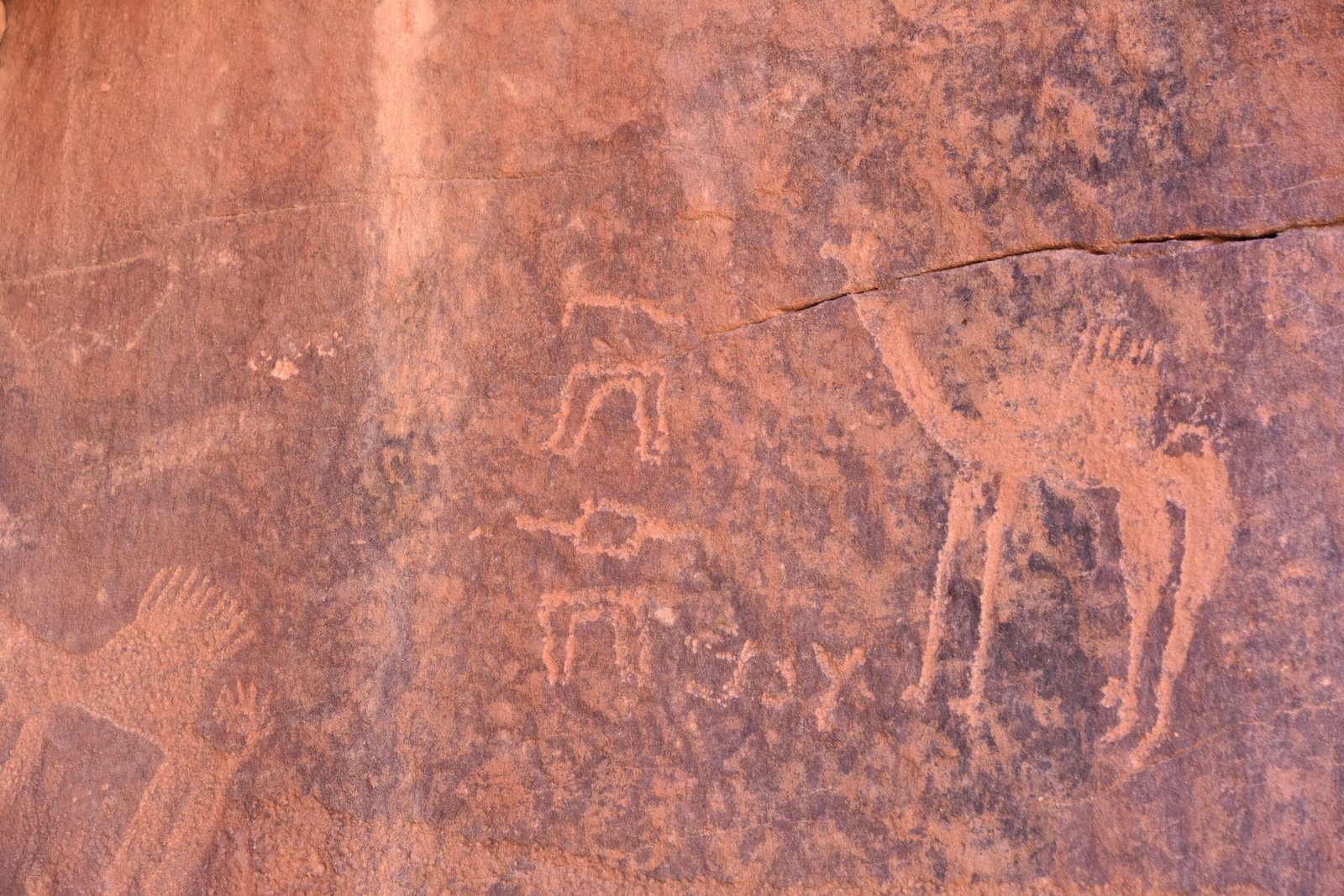
More than 10,000 years of human presence in Arabia — carved in stone at two extraordinary sites in the northwestern desert — reveal a world of permanent lakes, roaming ostriches, and the earliest known horses in the Arabian Peninsula.
At a glance
Inscribed by UNESCO in 2021, the Rock Art in the Hail Region comprises two sites in Hail Province, northwestern Saudi Arabia: Jabal Umm Sinman at Jubbah and Jabal al-Manjor and Raat at Shuwaymis. Together they contain thousands of petroglyphs and inscriptions spanning from the Neolithic period (c. 8000 BCE) through the early Islamic era (c. 1000 CE). The carvings are a direct visual record of the “Green Arabia” period — when the Nafud desert received monsoon rains, supported savannah ecosystems, and hosted large human communities living beside freshwater lakes.
Key facts
- UNESCO inscription: 2021 (serial property, two component sites)
- Time span of art: c. 8000 BCE – 1000 CE (ten millennia of continuous human presence)
- Site 1 — Jubbah (Jabal Umm Sinman): Rocky outcrops rising from the An Nafud sand sea; petroglyphs, inscriptions, and paleolake shoreline evidence
- Site 2 — Shuwaymis (Jabal al-Manjor and Raat): ~130 km south of Jubbah; the largest concentration of rock art panels in Saudi Arabia
- Subjects carved: Humans, horses, donkeys, dogs, ibex, cattle, ostriches, lions, camel caravans, and inscriptions in proto-Semitic and Thamudic scripts
- Green Arabia evidence: Fossilised animal bones and ancient shorelines confirm the Nafud held permanent lakes ~10,000 years ago
- Earliest Arabian horses: Shuwaymis carvings (c. 1800–2200 BCE) show horses with riders — among the earliest evidence of domesticated horses in the Arabian Peninsula
History in stone
The story told by the Hail petroglyphs begins at the end of the last Ice Age, when the African Humid Period (c. 11,000–5000 BCE) pushed monsoon rains far into the Arabian Peninsula. The Nafud, today one of the world’s most forbidding sand seas, was then a patchwork of savannah, seasonal rivers, and permanent lakes. Hunter-gatherers who occupied the shores of these paleolakes began carving images into the sandstone outcrops rising above the water — ibex, ostriches, cattle and human figures armed with bows and spears.
As the climate dried and the lakes shrank (c. 6000–4000 BCE), the art shifted: cattle herding became prominent. By the Bronze Age (c. 3000–1200 BCE) horses appeared — the Shuwaymis carvings of mounted riders are among the earliest such images in Arabia. Later, camel caravans, tribal symbols, and inscriptions in proto-Semitic and Thamudic scripts were added to panels that had already been used for millennia. The Jubbah site contains legible ancient inscriptions naming individuals and tribes — a rare surviving window into pre-Islamic Arabian society.
Systematically surveyed from the 1980s onward, the sites were inscribed on the UNESCO World Heritage List in 2021 as a unique archive of human adaptation to climate change across ten thousand years.
What you see
At Jubbah, the sandstone outcrops of Jabal Umm Sinman rise abruptly from the orange dunes of the An Nafud. Rock surfaces are densely covered with carved figures — some superimposed over earlier carvings, creating layered visual palimpsests that archaeologists use to establish relative chronologies. Fossilised bones and distinct horizontal banding in the rock mark ancient water levels.
At Shuwaymis, the escarpment of Jabal al-Manjor extends for several kilometres with rock faces carrying thousands of images. Particularly striking are large-scale hunting scenes — lion hunts, cattle drives, and human figures with elaborate headdresses — executed with a fluid line suggesting specialist carvers. The horse-and-rider images are among the most studied panels in Arabian rock art scholarship.
Practical information
- Location: Hail Province, northwestern Saudi Arabia
- Jubbah site: ~90 km north of Hail city; GPS approx. 28.03°N 40.93°E
- Shuwaymis site: ~130 km south of Jubbah, ~220 km south of Hail city
- Best season: October to March (desert heat extreme May–September)
- Getting to Hail: Hail Airport (HAS) — direct flights from Riyadh, Jeddah, Dammam
- Entry: No admission charge; valid Saudi visa or eVisa required; guides available at Jubbah via Saudi Heritage Commission
Getting there
Hail Airport (HAS) has flights from Riyadh (~1 hr), Jeddah (~1.5 hrs) and other major Saudi cities. From Hail, Jubbah is ~90 km north via Highway 65 (about 1 hour on paved road). A 4WD vehicle is recommended. Organised tours from Hail and Riyadh are the recommended option for most international visitors.
Nearby
- Al-Ula — Saudi Arabia’s other great pre-Islamic landscape, ~600 km southwest, with Nabataean tombs at Hegra (Madain Saleh)
- Tayma — ancient oasis city where the last Babylonian king Nabonidus lived in exile; rich with rock inscriptions
- Hail Old City — the traditional mud-brick quarter with the restored Qishlah fortress
Sources
- UNESCO World Heritage List — Rock Art in the Hail Region of Saudi Arabia, inscribed 2021. whc.unesco.org/en/list/1565
- Saudi Heritage Commission — Jubbah and Shuwaymis site documentation
- Wikipedia — “Rock art in the Hail Region of Saudi Arabia”
Find it on the map
See this place and what’s around it →📷 Become a Cultural Heritage Online photographer
Share your photos of places: they stay published under your name as the author. The more they're seen, the more you get noticed — and soon a contest will reward the most appreciated photos.
Log in or sign up free to add a photo