
For over 1,300 years, pilgrims from Africa, South Asia, and East Asia arrived in this Red Sea city to begin their journey to Mecca — and left behind one of the most extraordinary collections of traditional Islamic urban architecture in the world.
At a glance
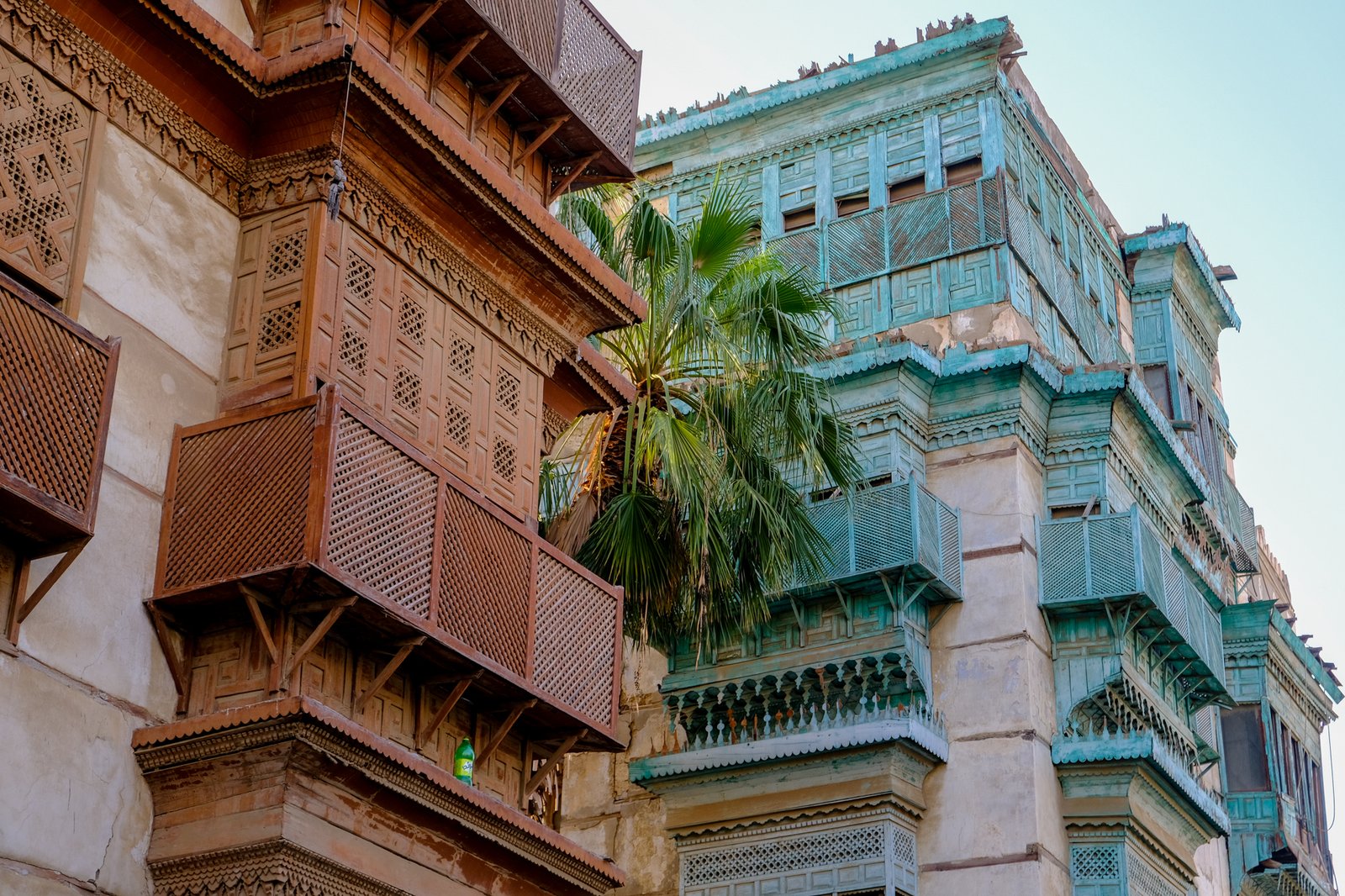
Inscribed by UNESCO in 2014, the Historic Jeddah (Al-Balad) district on the Red Sea coast of Saudi Arabia is the preserved medieval core of a city that served for more than a millennium as the principal gateway for Hajj pilgrims travelling from Africa, South Asia, and East Asia to Mecca, 74 km away. The historic quarter preserves over 600 traditional buildings in Hejazi architecture — a distinctive style combining fossil coral blocks (mangabi coral) with elaborately carved wooden oriel windows (rawasheen) that project from every facade, creating canyons of latticed shade along narrow medieval streets. The rawasheen are recognised as among the finest examples of Islamic domestic architecture anywhere in the world.
Key facts
- UNESCO inscription: 2014
- Historic district name: Al-Balad (“The Town”)
- Period: 7th century CE onward; peak development 13th–19th century CE
- Distance to Mecca: 74 km (1.5 hrs by road)
- Building material: Mangabi fossil coral blocks — a local Red Sea material cut from ancient coral reefs, naturally cool and humidity-regulating
- Rawasheen: Multi-storey projecting oriel windows of carved wood with latticed screens; some buildings have 4–5 storeys of stacked wooden balconies
- Preserved buildings: 600+ traditional structures still standing in the historic quarter
- Al-Shafi Mosque: Said to date to c. 628 CE (during the lifetime of the Prophet Muhammad), one of the oldest mosques in the world
- Traditional burial of Eve: A large tomb complex in central Jeddah marks the traditional location of the grave of Hawa (Eve), the Quranic and Biblical first woman
History
Jeddah’s rise to significance began in 647 CE when the Caliph Uthman designated it as the official port of entry for pilgrims travelling to Mecca. The city’s location on the Red Sea, at the crossroads of trade routes between Arabia, Africa, South Asia, and the Mediterranean, made it simultaneously the world’s busiest pilgrimage port and one of the most cosmopolitan trading cities in the pre-modern Islamic world.
For over a millennium, ships from Swahili East Africa, Mughal India, Ming and Qing China, Malay Southeast Asia, and the Ottoman Mediterranean all put into Jeddah. The city’s merchants — many of them long-settled immigrant trading families — built the extraordinary multi-storey townhouses of Al-Balad, each family competing in the elaborateness of their carved wooden rawasheen facades as a visible display of prosperity. The diverse origins of the city’s population are preserved in the names of its old neighbourhoods, which still reflect the ancestral homes of their founders: the Yemeni quarter, the Hadrami quarter, the Malay quarter.
The Ottoman period (1517–1916 CE) saw Jeddah at the height of its prosperity as a commercial and pilgrimage hub. The city walls, much of the existing Al-Balad building stock, and the great merchant houses date from the Ottoman centuries. The opening of the Suez Canal in 1869 brought steamships and a new wave of pilgrims, accelerating the pace of construction. After Saudi Arabia’s unification in 1932 and the oil boom of the mid-20th century, Jeddah expanded dramatically outside the historic walls. Al-Balad declined commercially but its physical fabric, built of durable coral stone, survived largely intact.
UNESCO inscription in 2014 triggered major restoration investment. Al-Balad remains a living quarter — inhabited, commercially active, and increasingly popular with both Saudi domestic tourists and international visitors.
What you see
Walking into Al-Balad from the waterfront is stepping into a compact medieval city largely unchanged in its street pattern since the 15th century. The streets are narrow — often only 3–4 metres wide — designed to create shade and funnel sea breezes in the Red Sea heat. The buildings that line them are remarkable: rising 3–5 storeys in blocks of pale fossil coral, their facades almost entirely obscured by the projecting wooden rawasheen that cantilever out over the lane below.
The rawasheen are the defining element of Hejazi domestic architecture. Each is a complex joinery construction: a projecting box-bay window built of local teak-like wood, its sides covered with latticed screens of turned wooden spindles — the mashrabiyya — that filter light, allow breezes, and permit the women of the household to observe street life while remaining unseen. On the grandest merchant houses (particularly around the old spice market, Al-Alawi Square) the rawasheen stack five storeys high, each floor’s projection slightly larger than the one below, creating a dramatically cantilevered silhouette. The colour of the wood — silvered grey with age, or deep brown where recently restored — changes the character of every street.
Key sites within Al-Balad include: Al-Shafi Mosque (one of the world’s oldest mosques), the Naseef House (a grand 19th-century merchant mansion now a museum), the Al-Mazloum Mosque, the old covered spice and textile souqs, and the Friday Mosque. The waterfront Corniche immediately adjacent to Al-Balad offers views back over the coral-block skyline.
Practical information
- Location: Al-Balad district, central Jeddah; GPS 21.4858°N 39.1869°E
- Opening: Al-Balad is a living urban quarter — always accessible on foot; individual monuments keep varying hours
- Naseef House museum: Check current hours with Jeddah Municipality; typically open daily except Friday morning
- Best time to visit: October–April (summer heat 38–45°C; Al-Balad’s narrow streets provide shade but remain very hot May–September)
- Dress code: Conservative dress required; abaya available to borrow at some entrances
- Getting there: Al-Balad is in central Jeddah, ~25 minutes from King Abdulaziz International Airport (JED) by taxi or rideshare
Getting there
King Abdulaziz International Airport (JED) is one of the busiest airports in the Middle East, with direct flights from Europe, Asia, Africa, and North America. Al-Balad is in central Jeddah, approximately 25 minutes by taxi or rideshare from the airport. The historic district is walkable once reached — the old quarter covers roughly 2.5 km² and is best explored on foot. Parking is available at the periphery of Al-Balad.
Nearby
- Jeddah Waterfront (Corniche) — the 30 km Red Sea promenade immediately adjacent to Al-Balad, with the famous King Fahd Fountain (tallest fountain in the world at 312 m)
- Traditional burial site of Eve (Hawa) — a large walled tomb complex a short walk north of Al-Balad, a site of pilgrimage for many Muslim visitors
- Mecca — 74 km east (non-Muslims cannot enter; the road to Mecca passes through Al-Balad’s historic pilgrimage quarter)
- Al-Hijr (Hegra) — the Nabataean rock-cut city, ~1,000 km north; reachable by Saudi Railways from Jeddah or Madinah
Sources
- UNESCO World Heritage List — Historic Jeddah, the Gate to Mecca, inscribed 2014. whc.unesco.org/en/list/1361
- Jeddah Municipality / Royal Commission for Historic Jeddah — official site and restoration documentation
- Wikipedia — “Historic Jeddah”
- Bianca, S. (2000). Urban Form in the Arab World. Thames and Hudson.
Find it on the map
See this place and what’s around it →📷 Become a Cultural Heritage Online photographer
Share your photos of places: they stay published under your name as the author. The more they're seen, the more you get noticed — and soon a contest will reward the most appreciated photos.
Log in or sign up free to add a photo