
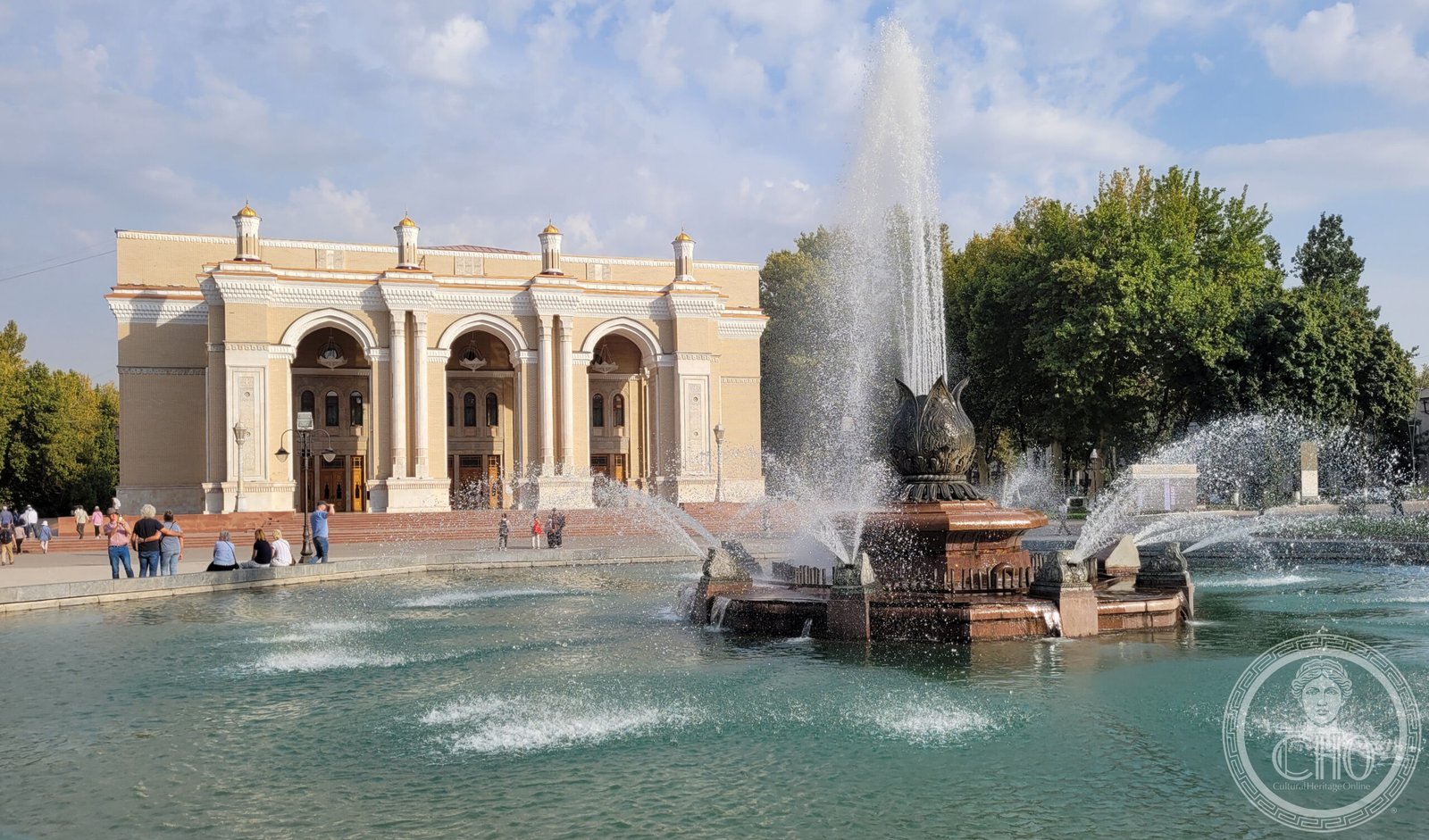
Rising above the centre of Tashkent like a statement carved in stone and ornament, the Alisher Navoi National Theatre is one of the most extraordinary opera houses in Asia and one of the most unusual stories in twentieth-century architecture. Commissioned in the final years of Stalin’s rule and completed in 1947, the theatre wears two faces simultaneously: the grand Soviet neoclassical columns and symmetrical facades that proclaimed imperial ambition from Moscow, and the intricate, exuberant interior decoration drawn from the living craft traditions of Uzbekistan’s ancient cities. Each of the six ceremonial foyers is dedicated to a distinct historical region of the republic — Fergana, Bukhara, Samarkand, Tashkent, Khorezm, and Termez — and was adorned by local masters who applied carved wood, painted ceilings, and ganch plasterwork in styles unique to their homeland. Beneath the monumental exterior breathes a building of genuine cultural complexity, one that survived the Soviet era and a catastrophic 1966 earthquake to remain Uzbekistan’s premier stage for opera and ballet.
At a glance
- Type
- Opera and ballet theatre
- Period
- Completed 1947
- Style
- Soviet Neoclassicism with Uzbek National ornament
- Location
- Tashkent, Uzbekistan
- Coordinates
- 41.309° N, 69.272° E
- Architect(s)
- Alexei Shchusev (lead); interior foyers by regional Uzbek masters
Overview
The Navoi Theater stands at the intersection of two political imperatives: Soviet cultural prestige and the incorporation of non-Russian peoples into a unified ideological project. Shchusev, the same architect responsible for Lenin’s Mausoleum on Red Square, was tasked with designing a building that would signal civilisational advancement while simultaneously celebrating local tradition. The result is a hybrid object, porticoed and symmetrical from the outside, kaleidoscopic and regionally differentiated within. Today it is Uzbekistan’s national stage for opera and ballet and a venue of significant cultural gravity in Central Asia.
History
Construction began in the 1930s under Shchusev’s direction and continued through the turbulence of the Second World War. Among the most remarkable aspects of the building’s history is the documented participation of Japanese prisoners of war in its construction after 1945. Accounts from the period suggest that many of these workers approached the project with a seriousness and discipline that left an impression on local observers; some returned decades later in organised visits. The theatre was inaugurated in 1947 and named after the fifteenth-century Chagatai poet Alisher Navoi, whose literary legacy is central to Uzbek national identity. It survived the devastating 1966 Tashkent earthquake, which destroyed much of the city, with comparatively little structural damage.
Architecture & Design
Shchusev’s exterior presents a neoclassical screen of colonnaded porticos and restrained ornament appropriate to Stalinist civic ambition. But the theatre’s defining achievement lies inside. The six foyers, each dedicated to a different historical region of Uzbekistan, were designed and decorated by craftsmen brought from those regions. Istaravshan masters executed carved wooden screens and columns; Bukharan artisans applied blue-ground painted ceilings; ganch, the traditional gypseous plasterwork carved in dense geometric and floral patterns, appears throughout in distinct regional registers. The integration of these crafts with neoclassical spatial planning was an architectural experiment with no direct parallel elsewhere in Soviet architecture.
Cultural significance
For Uzbekistan the Navoi Theater represents more than a performance venue: it is a repository of craft traditions that might otherwise have been marginalised or lost under Soviet standardisation. The decision to commission regional masters, and to dedicate discrete ceremonial spaces to different parts of the country, created a building that functioned as a living ethnographic record. Named for Alisher Navoi, the poet who elevated the Chagatai Turkic vernacular to a literary language, the theatre carries a double symbolic weight — both Soviet universalism and Uzbek particularity — that remains productively unresolved.
Visiting today
The Navoi Theater is fully operational as Uzbekistan’s principal opera and ballet house, presenting a regular repertoire of classical productions and contemporary work. The building can be visited on performance evenings and sometimes by guided interior tour by arrangement with the management. The foyers are the essential experience; arrive early before a performance to walk through each regional room. Tashkent has seen significant tourism development in recent years, and the theatre sits in the city centre, walkable from the main hotels and metro network.
Getting there
The theatre is located at 28 Amir Temur Avenue in central Tashkent. The nearest metro station is Amir Temur Hiyoboni on the Chilonzor Line, a short walk from the main entrance. Tashkent International Airport connects to major Central Asian cities, Istanbul, Moscow, Frankfurt, and Dubai, with growing direct service from European capitals. From the airport, a taxi to the centre takes approximately 20 to 30 minutes depending on traffic.
Sources & resources
Find it on the map
See this place and what’s around it →📷 Become a Cultural Heritage Online photographer
Share your photos of places: they stay published under your name as the author. The more they're seen, the more you get noticed — and soon a contest will reward the most appreciated photos.
Log in or sign up free to add a photoIs this page about you?
This page is read by travellers and heritage enthusiasts who find it on Google. Tell us how you are connected to this place and we will take it from there.