
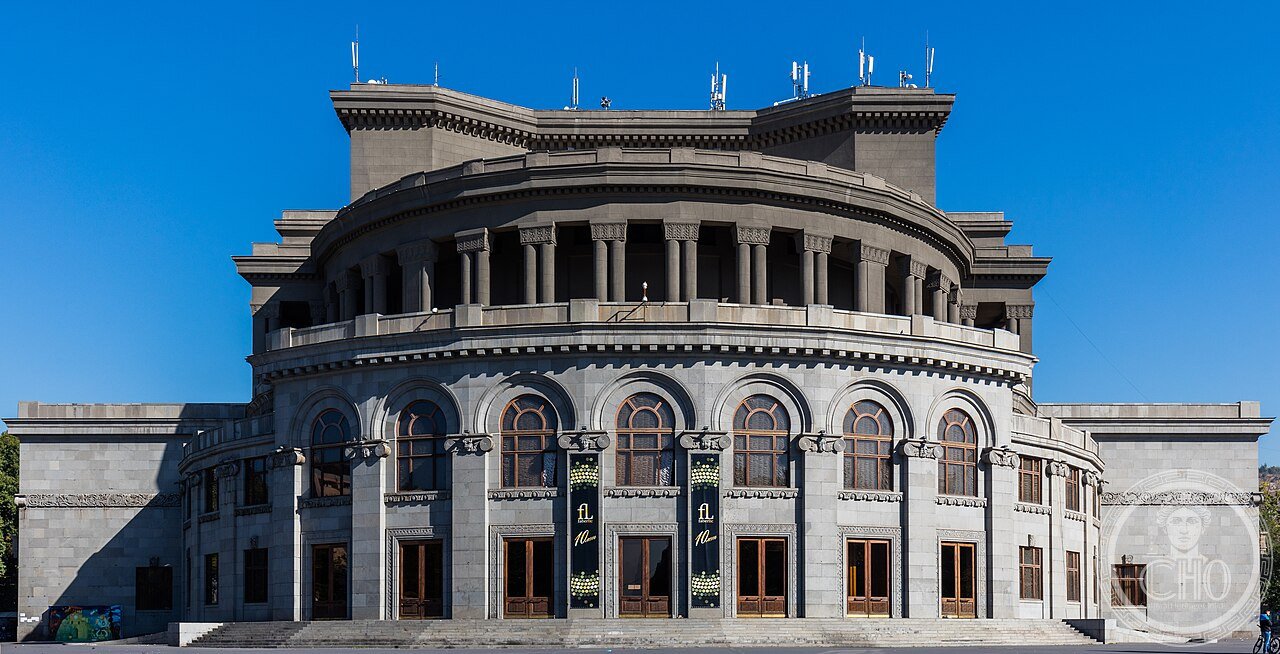
Anchoring the gracious elliptical square that Alexander Tamanian planned as the civic heart of Soviet-era Yerevan, the Alexander Spendiaryan National Academic Opera and Ballet Theatre is the defining monument of Armenian cultural architecture. Designed by the visionary urban planner who conceived Yerevan’s entire modern street grid, the theatre opened in January 1933 with a performance of Spendiaryan’s opera Almast and has since become the stage on which Armenian musical identity has been continuously performed and renewed. Its neoclassical volumes, warm tuff-stone facade, and sweeping colonnaded approach make it the most photographed building in the country, known to every Armenian simply as Opera. Two auditoriums—the 1,400-seat Aram Khachaturian Concert Hall and the 1,200-seat opera house—together form a cultural institution of international stature.
At a glance
- Type
- Opera House and Concert Hall
- Period
- 1930–1953 (opened 1933)
- Style
- Armenian Soviet Classicism
- Location
- Freedom Square, Yerevan, Armenia
- Coordinates
- 40.1858° N, 44.5150° E
- Architect(s)
- Alexander Tamanian (design); completed under his son’s supervision
Overview
The Yerevan Opera Theatre consists of two interconnected halls set within a landscaped public space that functions as the living room of the Armenian capital. The Aram Khachaturian Concert Hall with 1,400 seats and the Spendiaryan Opera and Ballet Theatre with 1,200 seats host the full range of operatic, ballet, and symphonic programming. The theatre company has toured more than twenty countries and since 1956 has held the status of National Academic Opera and Ballet Theatre. Its repertoire spans Armenian premieres, Russian classics, and Western European works, making it the primary gateway through which Armenian audiences encounter the global operatic tradition.
History
The groundbreaking took place on 28 November 1930 to mark the tenth anniversary of Soviet Armenia. Tamanian based the design on his comprehensive Yerevan General Plan, which reshaped the city around a network of radiating boulevards and grand civic squares. The theatre officially opened on 20 January 1933, though large-scale construction continued. Tamanian died before the work was finished; his son oversaw completion of the main theatre hall in 1939. The entire building complex, including additional wings and the surrounding square, was not fully realised until 1953. The theatre was named after composer Alexander Spendiaryan, whose opera Almast inaugurated it. Major renovations followed in 2002, restoring the building for the twenty-first century.
Architecture & Design
Tamanian synthesised neoclassical formality with Armenian vernacular motifs, using the warm pink and ochre volcanic tuff stone characteristic of Yerevan’s built environment. The building’s massing is monumental yet graceful: a central block with colonnaded porticos rises above the elliptical square, its profile softened by curved wings that embrace the public space. Decorative details reference Armenian ecclesiastical carving traditions, grounding the Soviet-era civic typology in a longer national history. The interior of the opera house features a horseshoe auditorium with excellent acoustics, ornate plasterwork, and a painted ceiling that celebrates Armenian artistic heritage.
Cultural significance
The Yerevan Opera Theatre is the primary institution of Armenian classical music and the symbolic locus of the nation’s cultural life. It was here that Aram Khachaturian’s ballet Happiness received its first performance, and here that generations of Armenian singers, conductors, and dancers built careers that extended across the Soviet world and beyond. The square in front of the theatre—a focal point for public gatherings, summer concerts, and political events—reinforces its role as a social institution as much as an artistic one. For the Armenian diaspora worldwide, the Opera is an image of homeland.
Visiting today
The theatre stages opera, ballet, and concert performances throughout the season, typically September to June. Tickets can be purchased at the box office on Freedom Square or online at the official website (opera.am). The surrounding square is a pleasant public space open at all hours. Guided tours of the building can sometimes be arranged through the theatre administration. The area around the theatre is Yerevan’s most vibrant cultural district, with cafés and galleries within walking distance.
Getting there
The theatre stands on Freedom Square in central Yerevan, easily reachable on foot from Republic Square and the main hotel district. Several trolleybus and minibus routes serve the area. Taxis and rideshare apps (GG Taxi, Yandex) are widely available across the city. Yerevan is served by Zvartnots International Airport, approximately 12 kilometres west of the centre, with frequent connections to European and Middle Eastern hubs.
Sources & resources
Find it on the map
See this place and what’s around it →📷 Become a Cultural Heritage Online photographer
Share your photos of places: they stay published under your name as the author. The more they're seen, the more you get noticed — and soon a contest will reward the most appreciated photos.
Log in or sign up free to add a photoIs this page about you?
This page is read by travellers and heritage enthusiasts who find it on Google. Tell us how you are connected to this place and we will take it from there.