

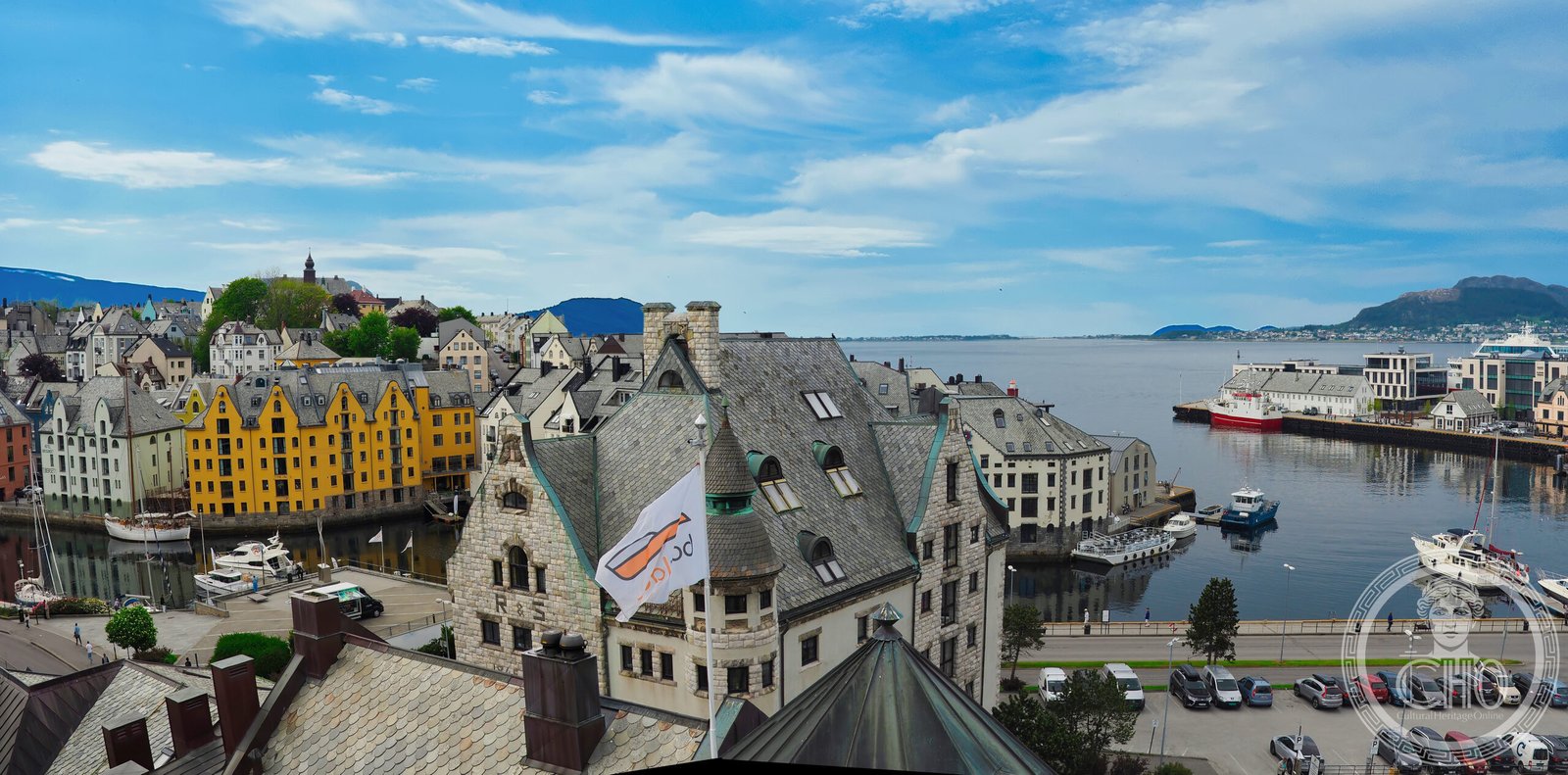
After a single night of fire in January 1904 erased nearly 850 wooden houses, an entire Norwegian fishing town was rebuilt in stone within three years — and the result is the most coherent Art Nouveau urban ensemble in Scandinavia.
At a glance
Ålesund sits on three islands between fjords and the open sea on Norway’s western coast. Today a city of around 55,000 people, its historic centre still reads as it did when the last scaffolding came down in 1907: a compressed grid of stone and brick buildings rising in towers, turrets and floral ornament above the harbour water. What makes the ensemble exceptional is its unity — roughly 50 architects working inside a three-year window, all drawing from the same vocabulary of German and Austrian Jugendstil, produced a streetscape without the usual century of stylistic interruption. The result has been recognised through membership of the European Art Nouveau Network since 1999.
Key facts
- Location: Aspøya and Nørva islands, Ålesund, Møre og Romsdal, Norway
- Style: Jugendstil (Art Nouveau)
- Reconstruction period: 1904–1907
- Buildings destroyed in fire: approximately 850 houses
- People displaced: over 10,000
- Architects involved: approximately 20 master builders and 30 architects, most trained in Trondheim and Charlottenburg, Berlin
- Materials: stone, brick, and mortar (replacing the previous all-timber town)
- Network: Art Nouveau Network Europe (member since 1999)
- GPS reference point: 62.4718° N, 6.1522° E (Jugendstilsenteret)
The Fire of 1904
At around 2:00 AM on 23 January 1904, a torch was knocked over in the Aalesund Preserving Company’s factory on Aspøya island — by a cow, according to the account that has travelled down through local memory. A January gale was already blowing. Within hours, practically the entire town centre was gone.
Nearly 850 houses burned to the ground. More than 10,000 people walked out into the sub-zero night with almost nothing. The death toll was one: an elderly woman named Ane Heen, aged 76, who turned back into her burning house to retrieve her purse. The fire swept along Strandgate, Kirkegate and half a dozen parallel streets, jumping the narrow channels between islands before it was contained.
Kaiser Wilhelm II, who knew the Ålesund fjords from his summer cruises, responded with speed that surprised Europe. While the fire was still smouldering, his first telegram arrived. He followed it with four ships loaded with food, medicine, building materials and personnel to erect temporary shelters. His intervention accelerated a reconstruction that Norwegian historians have since described — with some ambivalence — as among the most consequential urban renewals in the country’s modern history: the old town had been dangerously overcrowded and lacked basic sanitation. The fire was catastrophic. What replaced it was not.
Jugendstil Reconstruction
Around twenty master builders and thirty Norwegian architects took on the rebuilding commissions between 1904 and 1907. Most had trained in Trondheim or at the Charlottenburg technical university in Berlin, and they brought back a fluent command of Jugendstil’s formal repertoire: organic ornament, asymmetrical towers, curved gables, dragons and sea-creatures worked into carved stone. For the first time, the town was built in permanent materials — stone, brick and mortar — which made coherence not only an aesthetic choice but a structural necessity. Individual clients chose their architects freely, yet the resulting streetscape reads as a single composition. Stand at the harbour end of Strandgate and the towers step back against the sky in an almost choreographed sequence.
The ensemble is also a monument to speed. Three years from catastrophe to a completed, inhabited town in permanent construction is an achievement of logistics and collective will that has few equivalents in European urban history. No single master architect imposed a plan; the coherence came from shared training, shared materials, and shared urgency.
Architecture of the Town
Walking the centre today, the most immediate impression is vertical: corner towers punching four and five storeys above the harbour waterline, their copper roofs oxidised to grey-green against the sky. Carved ornament — stylised plant forms, dragon heads, female faces framed in foliage — runs along facade lines at second-floor height, where it catches the low northern light and casts narrow shadows even on overcast days. The buildings are never quiet surfaces.
The best single introduction to the architectural variety is Apotekergata, where the former pharmacy building designed by Hagbarth Martin Schytte-Berg (1860–1944) between 1905 and 1907 presents the town’s most intact original interior — tiled counters, carved woodwork, a ceiling that has not been touched since the pharmacist locked up for the last time. Schytte-Berg’s building became the first listed Jugendstil monument in Ålesund in 1984, and it now houses the Jugendstilsenteret interpretation centre. The street level of the town retains enough original shopfronts to make the commercial Art Nouveau character legible without imaginative effort.
Visiting
- Jugendstilsenteret (Art Nouveau Centre): Apotekergata 16, central Ålesund. Opened by Queen Sonja of Norway on 6 June 2003. Multimedia exhibitions on the 1904 fire, the reconstruction, and Art Nouveau design. The building itself — Schytte-Berg’s pharmacy — is the best-preserved original interior in the town.
- Best vantage point: Aksla hill, above the Aalesund Museum, gives the panoramic view of the roofscape that defines the town’s visual identity. Reached by 418 steps from Kirkegata, or by road. The view is available at all hours.
- Walking the centre: The Jugendstil district is compact and entirely walkable. Allow at least two to three hours on foot for Strandgate, Apotekergata, Kongens gate and the harbour waterfront.
- Season: The town is accessible year-round. Summer brings the longest light; winter visits offer the roofscape under snow, which sharpens the silhouette of the towers. Pack waterproofs regardless of season.
Getting There
Ålesund Airport (AES), also known as Vigra, is located about 15 km from the town centre and operates domestic connections to Oslo (Norwegian, SAS) and seasonal international routes. The airport bus runs to the city centre in around 25 minutes. By rail, the nearest station with a direct service is Åndalsnes, roughly 90 km to the east, from which a bus or hired car covers the remaining distance along the E136; the mountain drive along the Romsdalen valley is itself notable. Car ferries connect the islands of the archipelago with the mainland via the Storfjord and Hjørundfjord routes. The town centre is served by a local bus network, but the Jugendstil district is small enough that transport within it is irrelevant — the point is to walk.
Nearby
- Geirangerfjord — UNESCO World Heritage Site, approximately 100 km by road. One of Norway’s most dramatic fjords, accessible by ferry from Hellesylt.
- Romsdalen valley — The drive or rail journey through Romsdalen between Åndalsnes and Dombås, passing the Trollveggen (Troll Wall), is among the most spectacular mountain routes in Scandinavia.
- Runde island — Seabird sanctuary and Norway’s most important gannet colony, approximately 60 km southwest of Ålesund by road and ferry.
Sources
- Wikipedia: Ålesund — general history, reconstruction figures, Art Nouveau Network.
- Wikipedia: Ålesund Fire — fire date, cause, displaced persons count, Kaiser Wilhelm II relief effort.
- Wikipedia: Jugendstilsenteret — museum founding, architect Schytte-Berg dates, listed monument status 1984.
- Art Nouveau Network: artnouveau-net.eu — European network membership context.
Find it on the map
See this place and what’s around it →Record researched and written by Luigi De Marchi for Cultural Heritage Online, 2026.

📷 Become a Cultural Heritage Online photographer
Share your photos of places: they stay published under your name as the author. The more they're seen, the more you get noticed — and soon a contest will reward the most appreciated photos.
Log in or sign up free to add a photo