
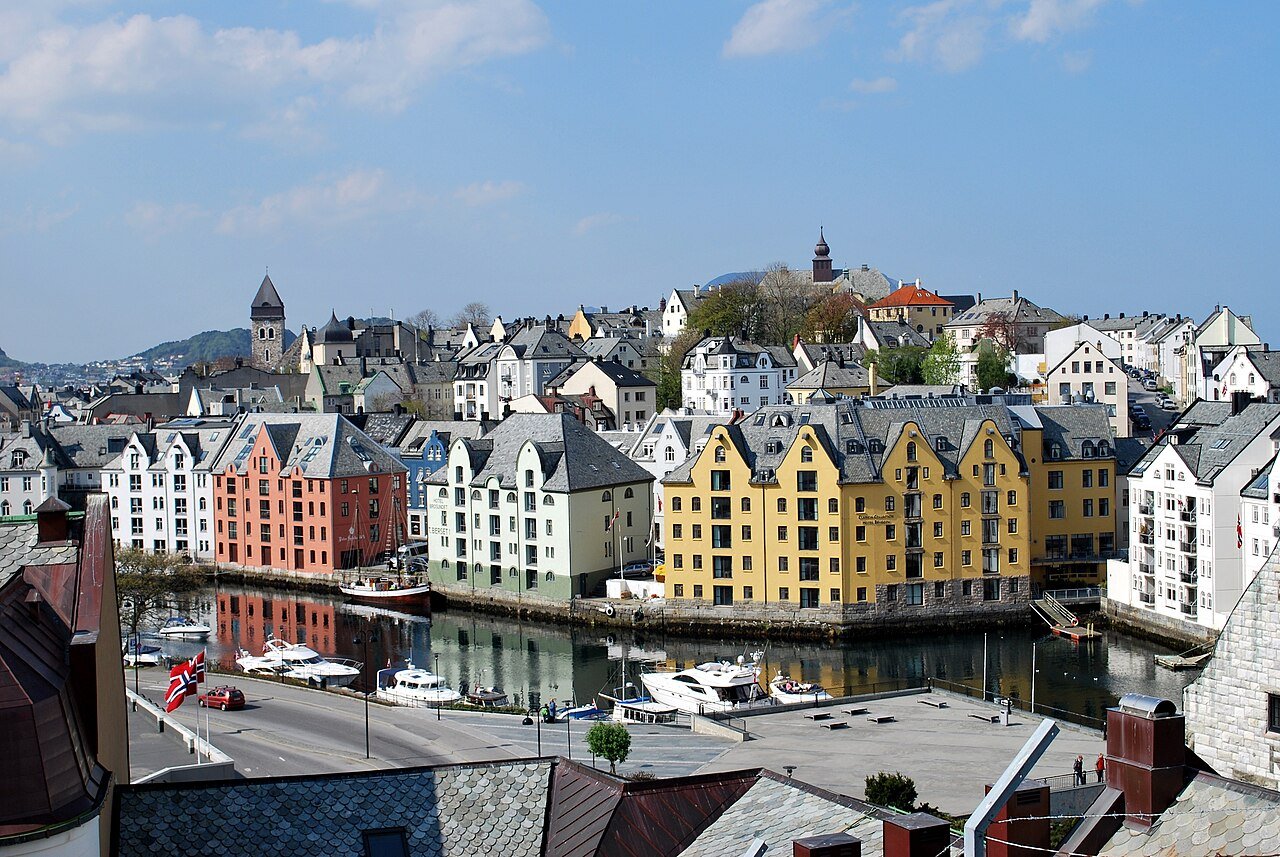
A single night in January 1904 erased almost the entire town. The Ålesund that rose from the ashes within three years is one of the most coherent Art Nouveau townscapes anywhere in Europe.
At a glance
Ålesund sits on a cluster of islands along Norway’s western coast, its harbour wrapped around the narrow Brosundet canal. What makes the town extraordinary is the result of a catastrophe: after the fire of 23 January 1904 destroyed nearly everything, the centre was rebuilt between 1904 and 1907 in the Jugendstil idiom then sweeping Europe. Some twenty master builders and around thirty Norwegian architects, many trained in Trondheim and in Charlottenburg, Berlin, gave the new town a remarkable visual unity of stone, brick and mortar. The towers, turrets and ornamented gables that line the canal and the surrounding streets have survived largely intact, and the Jugendstilsenteret in the former Swan Pharmacy interprets the whole story for visitors.
Key facts
- Country: Norway
- Key period: 1904–1907 reconstruction
- Catalyst: the fire of 23 January 1904
- Style: Jugendstil (Art Nouveau), built in stone, brick and mortar
- Essential sites: Jugendstilsenteret (in the former Svaneapoteket), the Brosundet harbour facades, the Aksla viewpoint
- Population: approximately 55,700 (2024)
History
On the night of 23 January 1904 a fire broke out in Ålesund and, fanned by a gale, spread through the timber town with terrifying speed. The inhabitants were given only minutes to flee into the winter night, and by morning practically the entire centre was gone. More than 10,000 people were left without shelter; remarkably, only one person died, a woman of 76. The scale of the disaster drew attention across the continent.
Help arrived from an unexpected quarter. Kaiser Wilhelm II of Germany, who had often holidayed along this coast, sent four warships carrying materials to build temporary shelters and barracks for the homeless. With emergency housing in place, the town turned to reconstruction. The decision to rebuild in stone, brick and mortar rather than timber was both a practical safeguard against fire and an opportunity to adopt the most modern architecture of the day.
The work was carried out at speed between 1904 and 1907. Roughly twenty master builders and some thirty Norwegian architects designed the new town, many of them educated in Trondheim and at the technical school in Charlottenburg, Berlin, and drawing inspiration from across Europe. Because the rebuilding happened in such a compressed period and under a shared aesthetic, Ålesund acquired an unusually consistent character — a whole town centre conceived as a single Art Nouveau ensemble rather than an accumulation of styles over generations.
What you see
Walking the streets around the Brosundet canal, the eye is caught again and again by towers, turrets, spires and curving gables, by sculpted stone ornament and decorative ironwork. The architects blended the international Jugendstil vocabulary with motifs of their own, and many buildings carry details drawn from Norwegian and Nordic tradition. The most celebrated single building is the former Swan Pharmacy (Svaneapoteket), designed by the architect Hagbarth Martin Schytte-Berg and built between 1905 and 1907; it became the first Art Nouveau structure in Ålesund to be formally protected, in 1984.
To grasp the scale of the achievement, climb the 418 steps up Mount Aksla to the Fjellstua viewpoint, where the whole patterned roofscape unfolds against the surrounding fjords and islands. Back at street level, the Jugendstilsenteret occupies the old pharmacy and preserves the town’s best-kept Art Nouveau interior, including the pharmacists’ dining room, while its exhibitions set the local story within the wider European movement.
Practical information
- The Jugendstilsenteret (Art Nouveau Centre), in the former Svaneapoteket, was opened by Queen Sonja of Norway on 6 June 2003 and is the natural starting point for any visit.
- The Aksla viewpoint is reached on foot via a stepped path from the town park, or by road; allow time for the climb and the panorama.
- The compact historic centre is best explored on foot, following the streets along the Brosundet canal.
- Half a day suffices for the centre and the museum; a full day allows the climb to Aksla and a slower walk through the facades.
Getting there
Ålesund Airport, Vigra (AES) lies just outside the town and has several daily flights to and from Oslo, Bergen, Trondheim and Copenhagen. By sea, the town is a regular port of call for the Hurtigruten coastal service (the Norwegian Coastal Express), whose ships put in at Ålesund twice a day, making the approach by water one of the most memorable ways to arrive.
Related in CHO
- Helsinki — Alvar Aalto and Nordic Functionalism
- Riga — Art Nouveau
- Brussels — Victor Horta and Art Nouveau Architecture
Sources

Find it on the map
See this place and what’s around it →Record researched and written by Luigi De Marchi for Cultural Heritage Online, 2026.
📷 Become a Cultural Heritage Online photographer
Share your photos of places: they stay published under your name as the author. The more they're seen, the more you get noticed — and soon a contest will reward the most appreciated photos.
Log in or sign up free to add a photo