
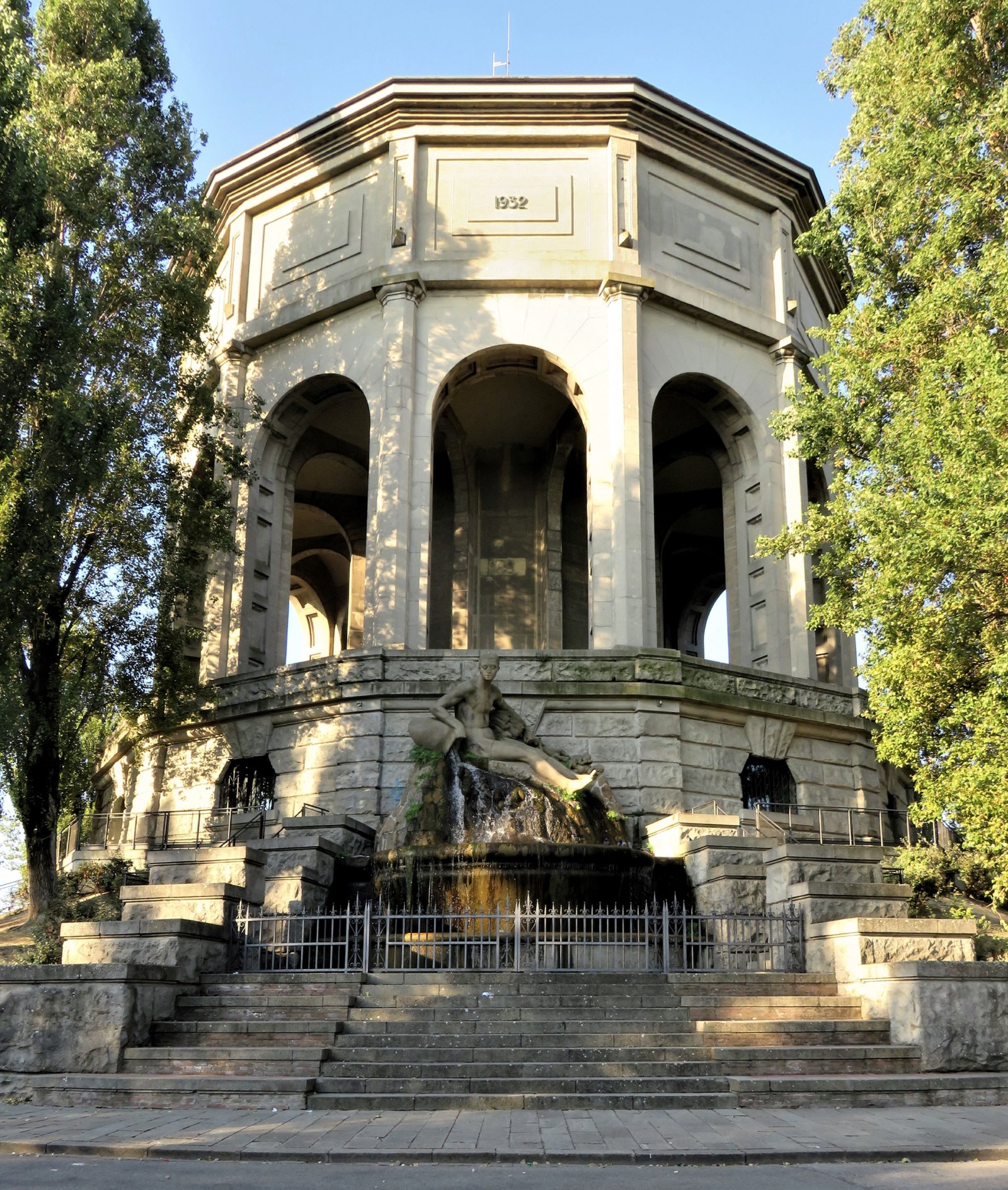
The monumental aqueduct on Piazza XXIV Maggio is the most theatrical infrastructure of interwar Ferrara. Carlo Savonuzzi designed it between 1930 and 1932 as a working water reservoir, lifting 2,500 cubic metres of drinking water onto a stepped concrete drum thirty-seven metres above the city. The dodecagonal colonnade reads as a Renaissance tempietto from across the square, yet every structural decision belongs to the rationalist decade: reinforced concrete, geometric clarity, civic scale without ornament.
- Address
- Piazza XXIV Maggio, 44121 Ferrara FE
- Period
- 1930–1932
- Architects
- Carlo Savonuzzi (1897–1973), municipal engineer of Ferrara
- Sculptor
- Arrigo Minerbi (fountain «Il Po e i suoi affluenti»)
- Client
- Comune di Ferrara
- Style
- Italian Rationalism (Razionalismo italiano) with neo-Renaissance references
- Function
- Original: elevated water reservoir for the municipal aqueduct. Current: civic landmark; the lower volume houses the children’s cultural centre «Isola del Tesoro».
- Floors / Capacity / Size
- Height 37 m; dodecagonal base on twelve 12-metre columns; tank capacity 2,500 m³; stepped concrete dome
- Status
- Twentieth-century civic landmark of Ferrara; the surrounding piazza is part of the city’s 1930s rationalist plan promoted by Savonuzzi as municipal engineer
- Coordinates
- 44.8375° N, 11.6082° E
Visit on the map
Piazza XXIV Maggio, 44121 Ferrara FE · 44.8375° N, 11.6082° E
Download for your navigator
A single waypoint, ready for GPS apps, navigators, and contacts.
Story
The commission belongs to the long mandate of Carlo Savonuzzi as municipal engineer, a post he took on in 1926 and held, with a wartime hiatus, until 1962. Ferrara entered the 1930s with an inadequate water network and a planning ambition to monumentalise the southern edge of the historic city. Savonuzzi answered both problems at once. He sited the reservoir at the head of Piazza XXIV Maggio, on a triangular plot opened by the demolition of the old Cittadella ramparts, so the tower could close the new perspective from Viale Cavour and Corso Isonzo. The structure was inaugurated in 1932, the tenth anniversary of the March on Rome, and presented as a civic gift rather than a Fascist monument—an ambiguity Savonuzzi cultivated throughout his career.
The architectural language is rationalist in everything that matters structurally and disciplined in what shows. Twelve reinforced-concrete columns, twelve metres tall, carry the elevated tank in a dodecagonal ring; above, a stepped concrete dome compresses the silhouette into the recognisable profile of a Renaissance tempietto. Savonuzzi keeps the surfaces flat and the openings rhythmic, refuses cornice mouldings, and lets the brick and intonaco do their work without classical orders. The fountain at the base, sculpted by Arrigo Minerbi as «Il Po e i suoi affluenti», anchors the tower with a recumbent allegory of the river and its tributaries, also in reinforced concrete. The neo-Renaissance reference is deliberate: Savonuzzi argued that the Po Valley city should not import Milanese-Como abstraction wholesale, but renegotiate rationalism through local memory of brick and proportion.
The aqueduct served as the city’s working reservoir for decades and survived the heavy Allied bombing that wrecked much of southern Ferrara in 1944. Decommissioned from the water network in the late twentieth century, the volume at the base was rehabilitated in the 2000s and now hosts «Isola del Tesoro», a municipal cultural centre for children and families. The piazza around it functions as the city’s open-air stage for civic events.
Savonuzzi’s other Ferrara works—the Liceo Ariosto, the Conservatorio Frescobaldi, the Mercato del Pesce, the Stadio Paolo Mazza, the Foro Boario—form a quietly coherent corpus of interwar civic architecture. The aqueduct remains its most legible signal: a piece of working infrastructure that the city has kept reading, ninety years on, as a monument.
Resources & References
Editorial picks across Wikipedia, photo archives, and architectural databases.
Find it on the map
See this place and what’s around it →Record researched and written by Stefano Vigolo for Cultural Heritage Online, 2026.
📷 Become a Cultural Heritage Online photographer
Share your photos of places: they stay published under your name as the author. The more they're seen, the more you get noticed — and soon a contest will reward the most appreciated photos.
Log in or sign up free to add a photo