
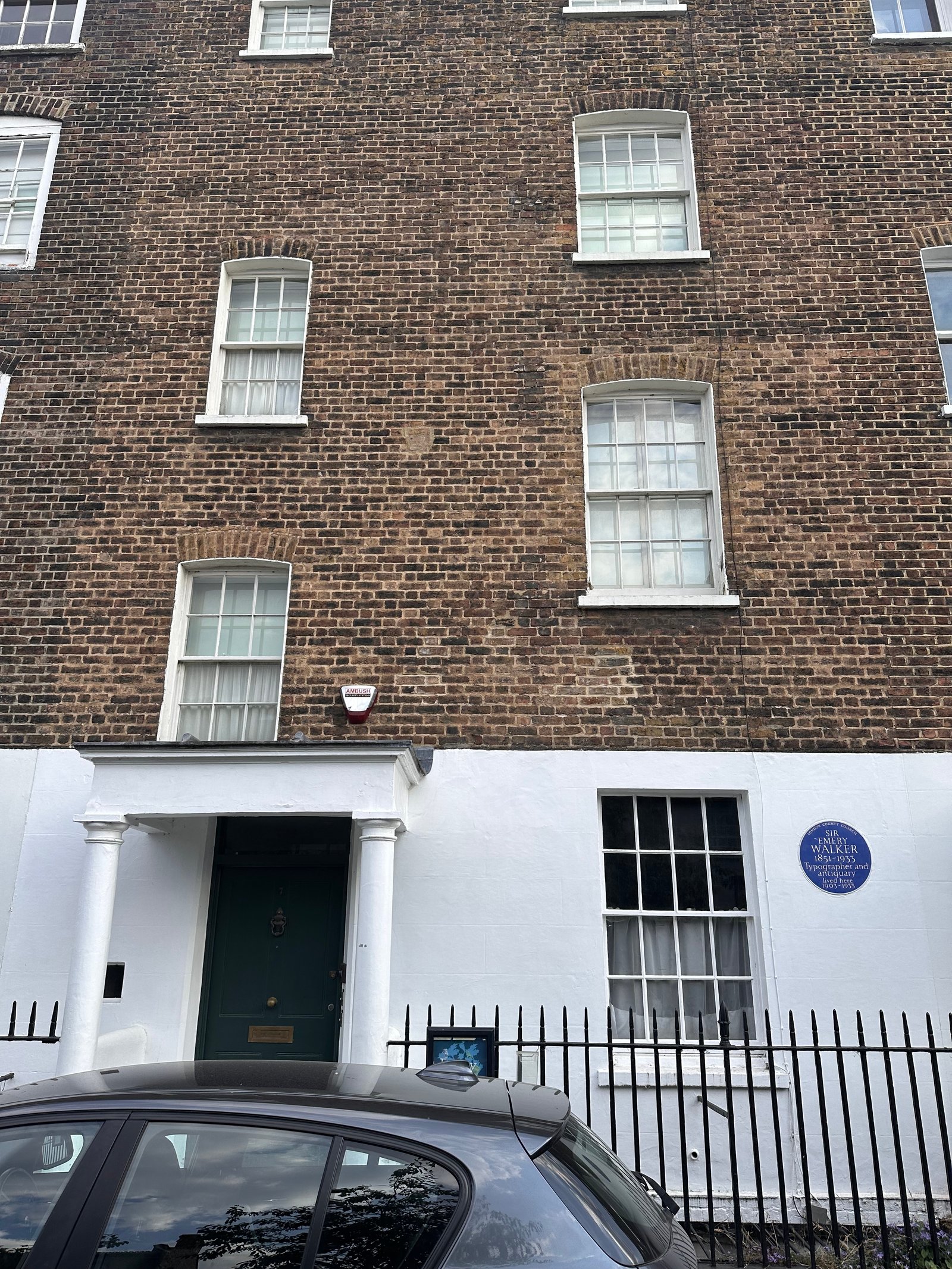

The most intact Arts and Crafts domestic interior in Britain, preserved almost exactly as Emery Walker left it in 1933 — a working typographer’s home lined with objects from William Morris, Edward Burne-Jones, and Philip Webb.
At a glance
Walker moved into number 7 Hammersmith Terrace in 1903 and lived there until his death thirty years later. His neighbours on the same Georgian riverside terrace included the Morris family at Kelmscott House, five doors west, and a circle of craftsmen and artists who gave each other furniture, textiles, and books rather than buying them. When Walker died in 1933 the house passed to his daughter Dorothy and then to his granddaughter. Very little was changed. Carpets, wallpapers, and curtains printed to Morris designs still hang on the walls. Tiles set by De Morgan line the fireplaces. Books from the Kelmscott Press sit on the shelves where Walker shelved them. The Emery Walker Trust now manages the house as a museum open by prior appointment.
Key facts
- Address: 7 Hammersmith Terrace, London W6 9TU, England
- GPS: 51.4898, −0.2424 — Google Maps
- Occupant: Sir Emery Walker (1851–1933), printer, typographer, engraver
- Occupied: 1903–1933
- Architectural period: Late Georgian terrace (c. 1825); Arts and Crafts interior fittings
- Managing body: The Emery Walker Trust
- Visits: By prior appointment only — small group tours, limited openings; not continuously open to the public
- Designation: Grade II* listed building; English Heritage blue plaque
Emery Walker and the Arts and Crafts movement
Walker was born in 1851 in London and trained as a process engraver. By the 1880s he was a central figure in the Arts and Crafts Exhibition Society and a close friend of William Morris, whose house Kelmscott Manor he visited regularly. In 1888 Walker delivered a lecture at the New Gallery on typography and type design, illustrated by lantern slides of enlarged letterforms. Morris attended; the two men walked home together along the Hammersmith towpath and Morris began planning what became the Kelmscott Press that night.
Walker did not found Kelmscott Press, but he guided almost every typographic decision Morris made there. The Golden Type — drawn in 1890 to revive Nicolas Jenson’s 15th-century roman — was designed with Walker’s expertise in enlarging historical typefaces photographically. The Troy Type and the Chaucer Type followed. When Morris died in 1896, Walker continued to apply the same principles of historical type study, co-founding the Doves Press in 1900 with Thomas James Cobden-Sanderson. The Doves Type, a clean roman cut expressly for the press, became one of the most admired typefaces of the Edwardian era.
Walker was knighted in 1930 for his services to printing and the arts. He died at 7 Hammersmith Terrace in 1933, aged eighty-one, surrounded by the objects his friends and collaborators had given him over five decades.
The house and its contents
The terrace itself is mid-Georgian, three storeys of London stock brick with plain sash windows facing the Thames towpath. Number 7 differs from its neighbours not in its exterior — the blue door and the English Heritage plaque are the only outward signs — but in what survived inside. Morris & Co. textiles, including woven silk and wool fabrics to designs by Morris himself, cover chairs and curtains. Wallpaper panels printed from the original blocks line the upstairs rooms. William De Morgan tiles, with their lustrous Iznik-derived birds and foliage, frame two fireplaces. A portrait of Morris hangs on the wall; Burne-Jones gave Walker drawings that remain where he pinned them.
The library is the room that most clearly records Walker’s working life. Kelmscott Press books are shelved alongside early printed volumes, reference works on historical typefaces, and proofs from the Doves Press. The sense is of a place that functioned, not one that was staged. The scale is intimate — a terraced town house, not a mansion — and the objects are ordinary in size: cups, photographs, ink bottles. Their significance is in their accumulation and in their survival.
Visiting
- Access: By prior appointment with the Emery Walker Trust only. The house is not open for walk-in visits.
- Group size: Small groups; specific limits are set by the Trust at time of booking.
- Booking: Via the Emery Walker Trust website.
- Photography: Check current policy with the Trust when booking.
- Accessibility: The house is a narrow Georgian terrace; contact the Trust in advance for specific accessibility information.
- Time needed: Approximately 90 minutes for a guided tour.
Getting there
The nearest Underground station is Hammersmith, served by the District, Piccadilly, and Circle lines. From the station, walk south along Hammersmith Bridge Road to the Thames towpath, then turn east along the river: number 7 is approximately ten minutes on foot. The Thames Path runs directly in front of the terrace. Cyclists can use the towpath from central London or from Chiswick. There is no dedicated car park; street parking in the immediate area is restricted.
Nearby heritage
- Kelmscott House (William Morris Society), 26 Upper Mall, Hammersmith — Morris’s London home from 1879 until his death in 1896; approximately 500 m west along the towpath. The William Morris Society runs a museum in the coach house.
- Chiswick House and Gardens — Palladian villa built 1726–29 by Lord Burlington; approximately 3 km south-west. English Heritage.
- Hogarth’s House, Hogarth Lane, Chiswick — William Hogarth’s country retreat, now a museum; approximately 2.5 km south-west.
Sources
- Emery Walker Trust: emerywalker.org.uk (official managing body)
- Wikipedia: Emery Walker
- Wikipedia: Kelmscott Press
- Wikipedia: Doves Press
- Historic England: Grade II* listed building, 7 Hammersmith Terrace
- William Morris Society: williammorrissociety.org
Find it on the map
See this place and what’s around it →📷 Become a Cultural Heritage Online photographer
Share your photos of places: they stay published under your name as the author. The more they're seen, the more you get noticed — and soon a contest will reward the most appreciated photos.
Log in or sign up free to add a photo