See all the places in Venezia →
A settlement on the lagoon islands that became a republic: how the city began, the saint, the shipyard and the ghetto that shaped it, and the places where all of it can still be read.
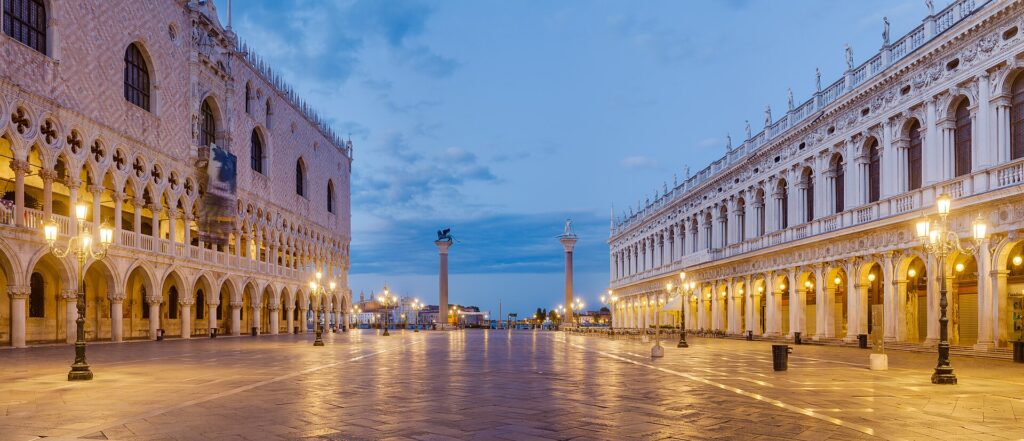
A city that grew out of the lagoon
Venice has no single founding day, whatever the later legends say. The Italian national encyclopaedia, the Treccani, ties its origins to the barbarian invasions that unsettled the mainland between the fifth and the seventh centuries. By the seventh century the Byzantine presence in the region had shrunk to the islands of the lagoon, where it formed a duchy under the exarchate of Ravenna. When the exarchate fell in 751 the duchy became autonomous.
The seat of that duchy moved more than once: from Cittanova to Eraclea, then to Malamocco, and finally to Rialto, where the city proper, the civitas, was founded between the ninth and the tenth centuries. The ducal office, first held under Byzantine authority, had become elective by the end of the ninth century. A town that had to choose its own leader, and could not rely on the land around it, was already a different kind of place.
The saint who arrived from Alexandria
In 828 the relics of Saint Mark the Evangelist were brought to Venice from Alexandria in Egypt, and the saint became the city’s patron. A basilica followed in 829. It was rebuilt in 976–978 and rebuilt again in 1063 under Doge Domenico Contarini, with further additions over the centuries, which is why the building reads as a layered record rather than a single design. The Bridge of Sighs, a few steps from the square, belongs to the same ceremonial centre of the Republic.
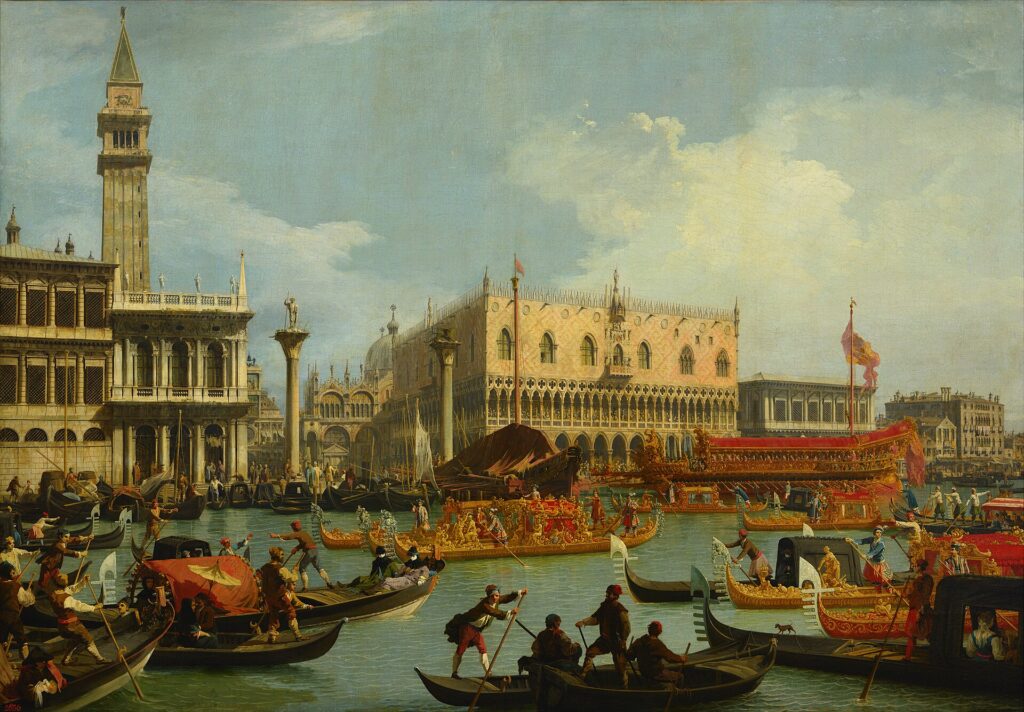
The shipyard that Dante put in hell
The Arsenale, according to the arte.it guide, arose in the twelfth century as the yard where all the ships of the Republic’s fleet were built, and it was enlarged several times to work as an efficient, rational production site. It was famous enough to appear in Dante’s Inferno, in Canto XXI, lines 7 to 18.
The land entrance is a monumental portal, possibly by Antonio Gambello and dated 1460, laid out like a triumphal arch. It reuses Byzantine columns and capitals from the eleventh century. In 1692 two colossal marble lions were set beside it. The one on the left came from Piraeus and carries runic inscriptions cut by Scandinavian mercenaries, which record that they helped put down a revolt in Athens in 1040. Part of the complex is now a venue of the Venice Biennale, and the church of San Biagio on the Riva, the Navy’s church, stands on the same waterfront.
The word “ghetto” began here
On 29 March 1516 the Senate decreed that the Jews of the city were to live in the Ghetto Nuovo, a spacious area near the church of San Girolamo. The site had held foundries, and the most likely origin of the word is the Venetian el getto, the place where bronze was cast: more than twelve foundries, according to the site’s own history of the quarter. The enclosure had high walls and gates that closed in the evening and reopened at dawn, with guards paid for by the Jewish community itself.
The quarter grew upward and outward. Levantine Jews took houses in the neighbouring streets in 1541, which became the Ghetto Vecchio, and the Sephardic Jews formed the Ghetto Nuovissimo in 1633. The German Grand Shul and the Cantòn Shul date from 1528–1532 and the Italian Shul from 1575. The gates came down in 1797, when French troops under Napoleon toppled the Republic.
Glass moved out of town
Murano’s glass furnaces were moved there from Venice in the 1290s (the Treccani gives 1295 in one entry and 1292 in another), and the city entry names fire risk as the reason. The furnaces reached their peak in the fifteenth and sixteenth centuries, and a glass museum now stands in the seventeenth-century Palazzo Giustinian on the island.
What to see, and in what order
Start where the Republic showed itself: the Piazzetta San Marco between the Doge’s Palace and the Marciana library, then the basilica and the Bridge of Sighs. Walk on to Rialto, where the city was founded, and look at the Palazzo dei Camerlenghi, then follow the Grand Canal by water. Cross to Cannaregio for the Ghetto Nuovo and its synagogues, and east along the waterfront to the Arsenale gate and its lions.
For the lagoon itself, the Basilica of Santa Maria Assunta on Torcello is the place to go, with the virtual tour of the Venetian lagoon for the view from above. On the Giudecca, Palladio’s votive church, the Redentore, and the walk described in The Heritage Walk: Crossing the Giudecca show the city away from the main routes.
Smaller places that tell the same story
The Republic’s trade and craft left traces well away from the great monuments. The Magazzini del Sale on the Zattere were the Republic’s salt warehouses. The Corte del Calderer, in San Polo, is the coppersmiths’ courtyard. San Giovanni in Bragora is the church where Vivaldi was baptised, and Santo Stefano has a roof built like the keel of a ship. Each has its own page, with the sources, the coordinates and the photographs.
The end of the Republic, and what remained
The Treaty of Campoformio in 1797 ceded Venice to Austria and ended its independence. The city rose once more in 1848–49, when a republic under Daniele Manin held out until it surrendered on 23 August 1849. What the Republic left behind is mostly still standing, and the pages of this archive follow it district by district and island by island.
Every place we have documented in Venice, on one page: palaces, churches, bridges, courtyards and the lagoon islands.
Explore all the places in Venice →Sources
- Treccani, Enciclopedia Italiana, “Venezia” · https://www.treccani.it/enciclopedia/venezia/
- Treccani, Enciclopedia Italiana, “Murano” · https://www.treccani.it/enciclopedia/murano/
- arte.it, “Arsenale” · https://www.arte.it/location/arsenale-1180
- Ghetto of Venice, “The Jews in Venice (1516–1797)” · https://www.ghettovenezia.com/en/the-history/
- Our pages on Venice · https://culturalheritageonline.com/place_city/venezia/
Spotted an error? Write to the editors and we correct it the same day.