

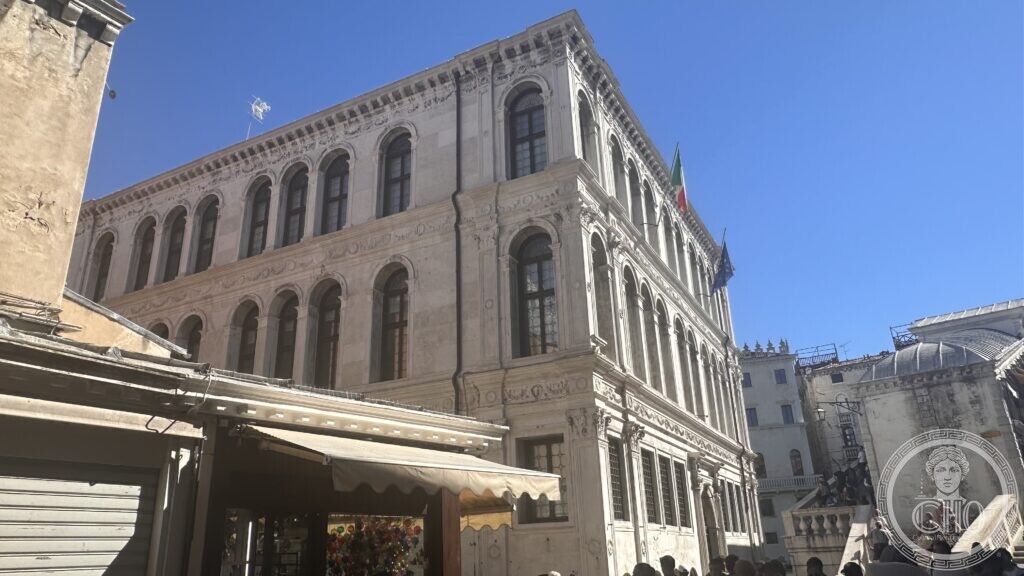
A pentagonal Renaissance palace beside the Rialto Bridge, built as the offices of Venice’s financial magistrates and still used as a public accounts court.
At a glance
The palace stands on the inner side of the Volta di Canal, immediately beside the Rialto Bridge, with a pentagonal plan that follows the curve of the Grand Canal. It was built between 1525 and 1528 to a design by Guglielmo dei Grigi, known as Bergamasco, as the seat of the Camerlenghi de Comun and other financial magistrates. Today it houses the Corte dei Conti.
Key facts
- Where: San Polo, 1, Venezia
- What: Palace
- When: 1525–1528
- GPS: 45.4384, 12.3354 · Open in Google Maps
History
The palace was erected between 1525 and 1528 on the site of an old merchants’ loggia, under Doge Andrea Gritti, whose name appears on a commemorative inscription on the facade. The designer was Guglielmo dei Grigi, called Bergamasco, drawing on the work of Mauro Codussi and Pietro Lombardo. It was one of the first buildings in Europe intended exclusively for public offices. The Camerlenghi de Comun, the state cashiers responsible for collecting and redistributing revenue, worked on the first floor. The earliest law concerning them dates from 1236, though their origins are certainly older; they numbered two at first and were increased to three in 1527. The ground floor served as a prison for insolvent debtors, visible to passers-by on Fondamenta de la Preson as a warning. After the fall of the Republic, the building’s art collection was dispersed: in 1806 the Kingdom of Italy disposed of it, and in 1815 Venice passed to Austria. Some works returned to Venice in 1919 and are now at the Gallerie dell’Accademia and the Fondazione Giorgio Cini.
What you see
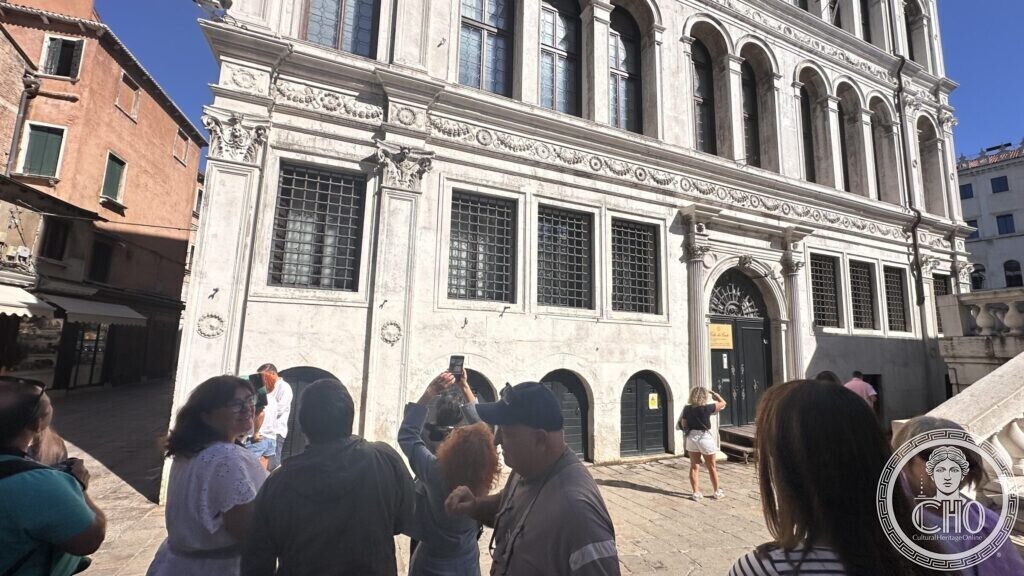
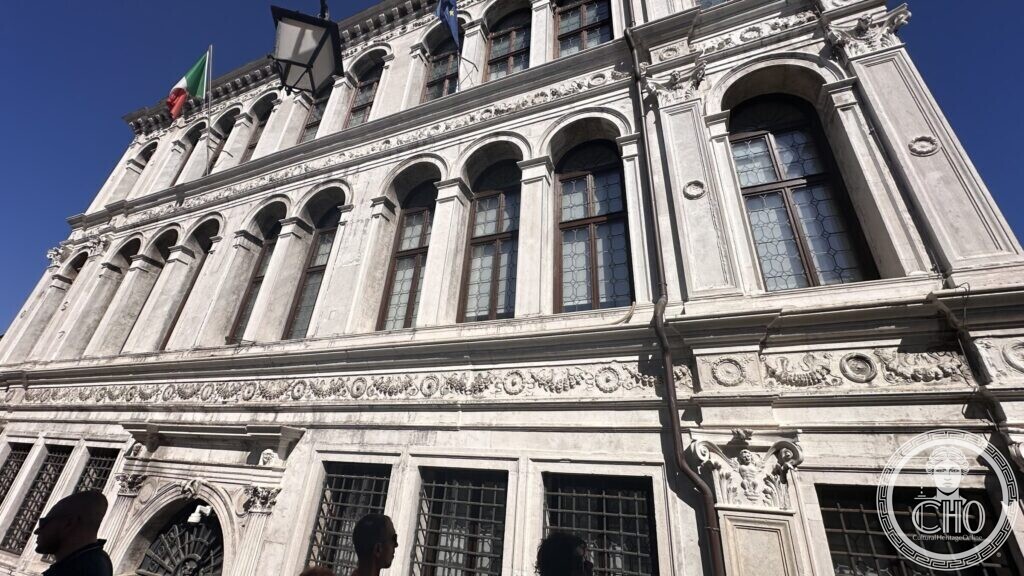
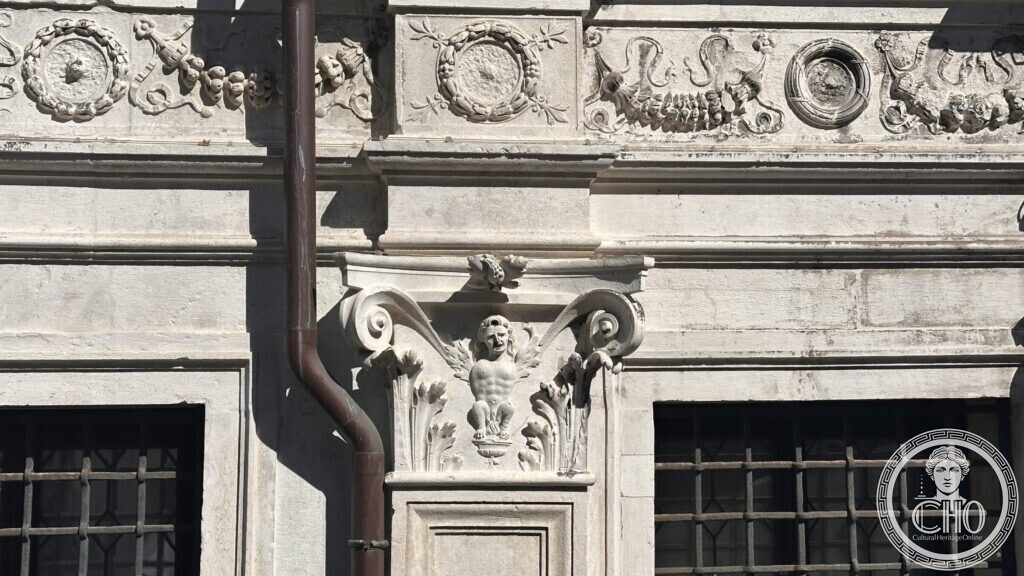
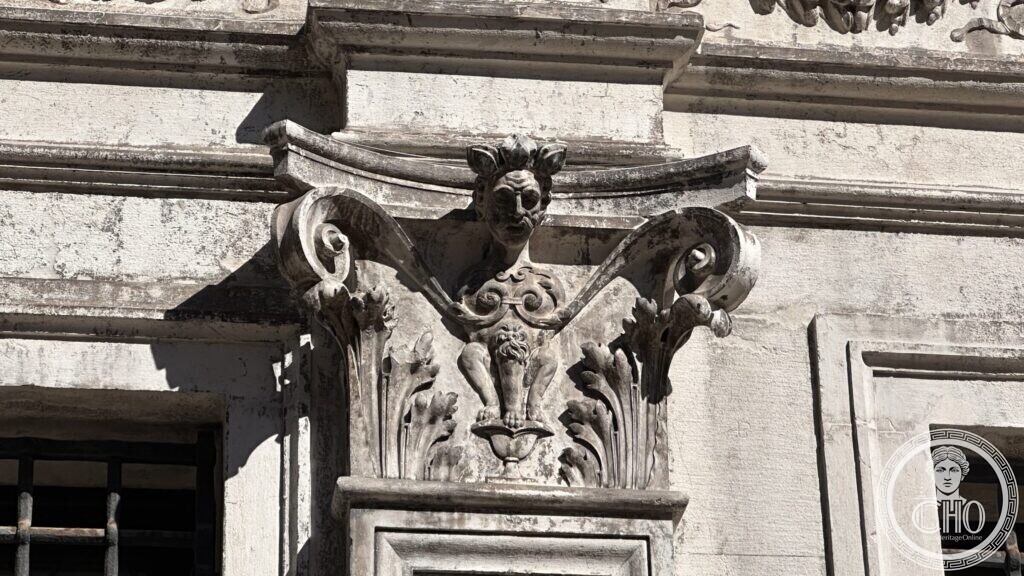
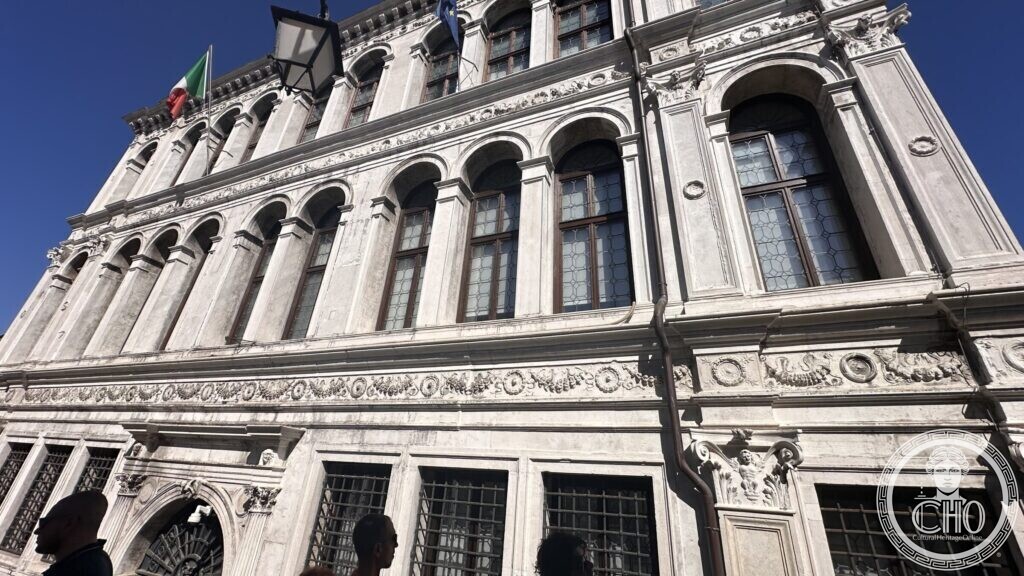
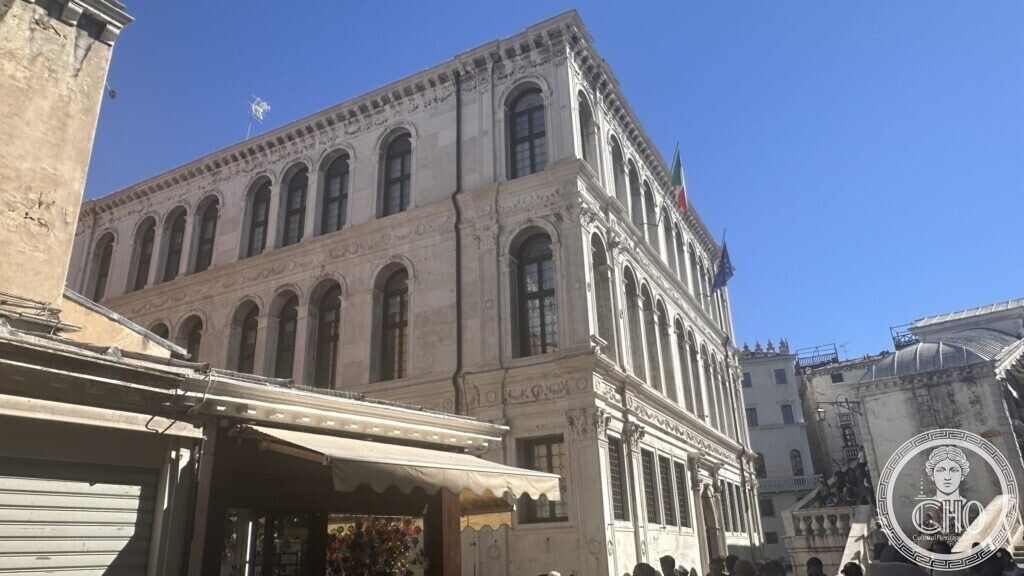
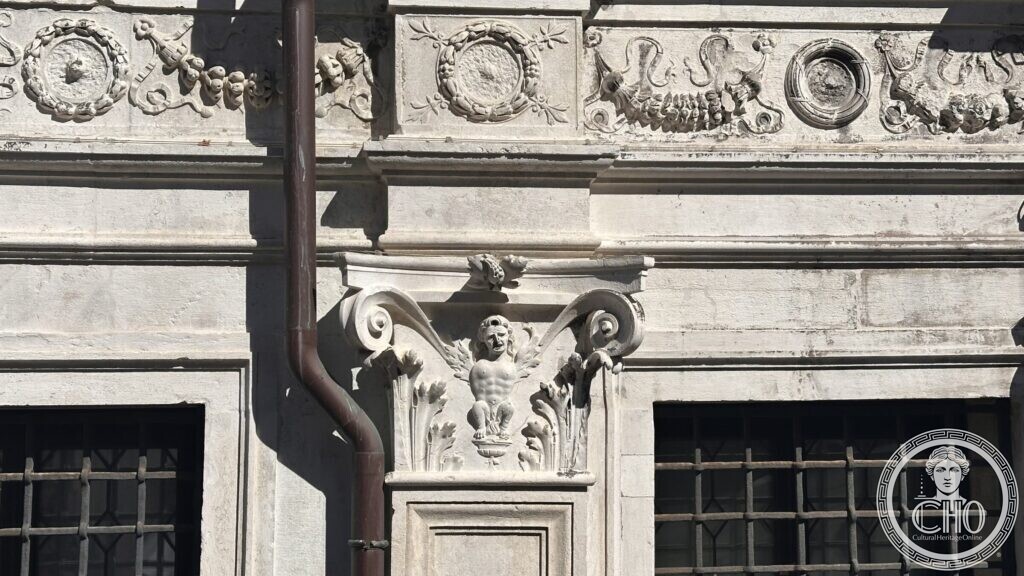
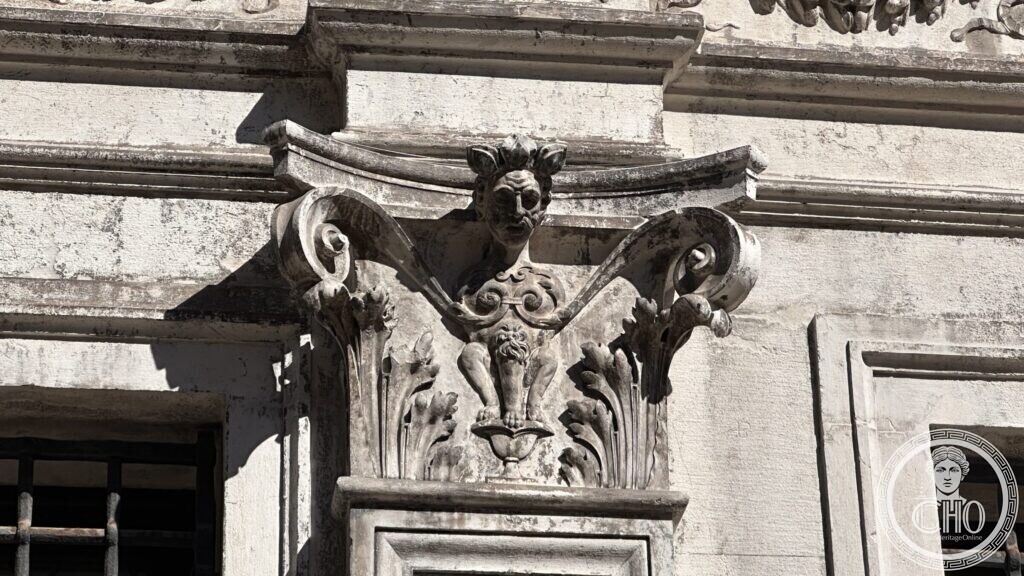
The building rises on three floors over a pentagonal base and has no single main facade. Its walls are enlivened by diamond-cut Istrian stone, with sequences of tall arched windows of varying widths. Pilasters and entablatures divide the fronts. Two capitals beside the entrance portal carry unusual carvings: one shows a man with a clawed paw in place of his genitals, the other a woman with flames between her thighs. Popular tradition links these to two Venetians who joked about the endless reconstruction of the Rialto Bridge, saying it would be finished when a penis grew a claw and when a vagina caught fire. The photographs show the upper facade with its arched windows and the Italian flag, the ground-floor iron grates facing the paved area, and close views of the carved stone details, including a sculpted cherub corbel and a capital with a head and leaves.
Carla Szathvary’s notes describe the second photograph as a side profile of the palace taken from a nearby street with a market awning in the foreground, a setting that the existing gallery does not otherwise illustrate. The photograph visible behind the awning reinforces how the building is free on all sides, a quality that the Web Gallery of Art says is rare among Venetian palaces. The third and fourth photographs add carved details not yet singled out on the page: a small sculpted figure between windows and an ornate stone capital with a bearded face and floral motifs. Engineering records show that the palace’s Istrian stone coverings were restored in a 2014 redevelopment carried out for the Corte dei Conti, which explains the clean, crisp carving visible in these close views.
Do you know more about this place?
If you know a date, a name, a document, a plaque or a photograph that tells its story, write to Sofia through the contact page. What arrives with a source goes into this page, with your name as the contributor.
Nearby
- The Fabbriche Vecchie di Rialto, Venice — the long market building facing the palace across the Rialto area
- San Giacomo di Rialto: the clock of 1410 and the last Gothic porch in Venice — the ancient parish church a few steps west of the palace
- The Gobbo di Rialto: the stone Venice read its sentences from — the crouching figure opposite the church, where laws were proclaimed
- Campo San Giacomo di Rialto: the square Venice rebuilt in nine years, and still — the small square between the palace and the church
Gallery
Sources
- Evenice, Il Palazzo dei Camerlenghi, gli esattori delle tasse e i moniti della Serenissima: dates of construction, architect, functions of the Camerlenghi, prison use, later dispersion and return of artworks
- Canal Grande di Venezia, Palazzo dei Camerlenghi: construction dates, Doge Gritti’s inscription, magistrates, architectural description, popular tradition of the two capitals, collection dispersed in 1806 and 1815, return of works in 1919
- FAI, Palazzo dei Camerlenghi: address and location in Venice
- Victorian Web, Palazzo dei Camerlenghi in the sestiere of San Polo, Venice: Ruskin’s description of the building as a pentagonal Renaissance palazzo, the Camerlenghi di Comune as three officers, and the current use by the Comptroller and Auditor General for the Veneto
- OpenStreetMap, Palazzo dei Camerlenghi: address and coordinates
- Carla Szathvary, photographs and notes to the editorial staff (2026): identification of the subject. Not a published source
Find it on the map
See this place and what’s around it →
Advertisement. Pictured, from the Cleveland Museum of Art (CC0) and not for sale: a parure of about 1850, a Lalique brooch, a Castellani bangle. How we handle this
📷 Become a Cultural Heritage Online photographer
Share your photos of places: they stay published under your name as the author. The more they're seen, the more you get noticed — and soon a contest will reward the most appreciated photos.
Log in or sign up free to add a photoIs this page about you?
This page is read by travellers and heritage enthusiasts who find it on Google. Tell us how you are connected to this place and we will take it from there.
This entry stays online and free either way — and a free account lets you add to it yourself.