Qatar has one UNESCO World Heritage Site — a number that belies the depth of history compressed into the country’s single inscription. That site, a ruined coastal town on the northwestern tip of the peninsula, speaks to centuries of pearl trading, regional power, and the slow work of desert preservation. It stands as evidence that a short list can carry significant weight. From Cultural Heritage Online.
Why Qatar’s list looks the way it does
Qatar submitted its first property to UNESCO’s World Heritage List in 2013, relatively late compared to neighbouring Gulf states. The country’s archaeological record is genuine but concentrated: the peninsula’s interior sustained only sparse settlement before the twentieth century, and rapid urbanisation since the 1970s has complicated the preservation of built heritage in and around Doha. What Qatar does have, it has protected seriously.
Two properties currently sit on Qatar’s Tentative List — Khor Al Adaid, a remarkable inland sea ecosystem ringed by sand dunes, submitted in 2008, and the National Museum of Qatar, a contemporary landmark whose rose-desert-crystal architecture was added in 2025. Neither has yet reached full inscription, but their presence on the list signals an expanding ambition for the country’s engagement with UNESCO processes.
The first inscription
Qatar’s sole World Heritage inscription is also its first:
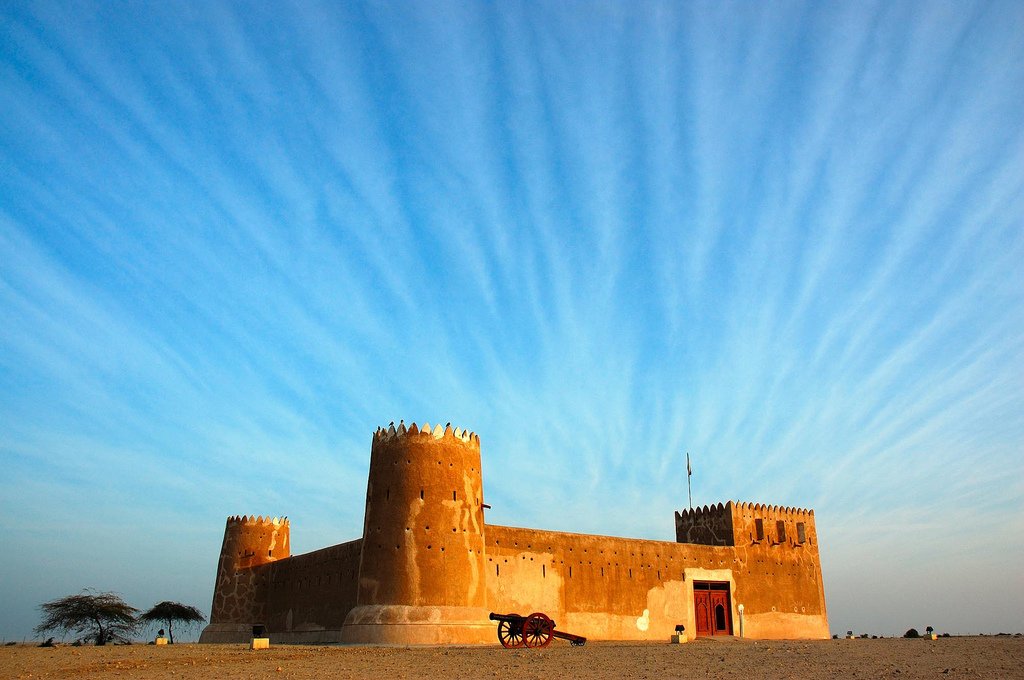
- Al Zubarah Archaeological City (2013) — a walled coastal settlement that flourished as a pearling and trading centre in the late eighteenth and early nineteenth centuries, before its destruction in 1811 and definitive abandonment in the early twentieth century.
The site met three UNESCO criteria: it bears outstanding testimony to a now-vanished cultural tradition (criterion iii), exemplifies a significant stage in human history through its urban form (criterion iv), and represents an exceptional example of a traditional settlement associated with a living tradition — pearl diving — that became irreversibly altered by external pressures (criterion v). Its inscription recognised not merely a ruin, but an unusually complete record of a Gulf trading economy.
The most visited — and the alternatives
Al Zubarah is, by definition, both Qatar’s most visited World Heritage Site and its least visited: there is only one. The site lies roughly 105 kilometres northwest of Doha, reached via a straight highway through flat, stony desert. At the site itself, the Qatar Museums authority has developed a visitor centre and maintains access to the excavated urban core, where palaces, mosques, courtyard houses, and fishermen’s huts survive in varying states of exposure after decades of protective sand drift.
For travellers interested in what lies beyond the single inscribed site, the Tentative List offers useful orientation. Khor Al Adaid — the inland sea — draws visitors into a landscape where tidal channels penetrate deep into the dune fields, creating an ecosystem unlike anything else on the peninsula. The National Museum of Qatar in Doha, meanwhile, offers context for the archaeological material recovered from sites like Al Zubarah: its galleries trace Qatari history from prehistoric settlement through the pearl era and into the present. Neither carries UNESCO inscription yet, but both are part of the country’s stated heritage strategy.
Natural and shared sites
Qatar’s sole inscribed property is cultural; the country has no inscribed natural World Heritage Sites. The closest candidate, Khor Al Adaid, has been on the Tentative List since 2008 without progressing to nomination. The inland sea qualifies under natural criteria for its geomorphological character — a tidal creek system advancing into one of the Gulf’s most active aeolian landscapes — but the nomination process requires extensive documentation and management planning that has not yet been completed.
Qatar is not party to any transnational or serial World Heritage inscriptions. Unlike some Gulf states, it has not joined regional nominations linking shared archaeological or environmental heritage across borders. Its heritage engagement with UNESCO remains, for now, defined entirely by the single site at Al Zubarah.
How to find them
Al Zubarah Archaeological City is signposted from the main coastal road in Al Shamal Municipality. The site is managed by Qatar Museums and is open to visitors, with structured access to excavation areas and a permanent interpretation centre. Road conditions are reliable; the drive from Doha passes through open desert with few landmarks, making GPS navigation practical.
Qatar’s World Heritage sites sit alongside thousands of other places on CHO’s interactive map, with GPS and sourced editorial history for each. See also our guides to Italy’s and France’s UNESCO sites, and our piece on cultural travel beyond mass tourism.
Frequently Asked Questions
How many UNESCO World Heritage Sites does Qatar have?
Qatar has one inscribed UNESCO World Heritage Site: Al Zubarah Archaeological City, added to the list in 2013. The country also maintains two properties on UNESCO’s Tentative List — Khor Al Adaid and the National Museum of Qatar — which are candidates for future nomination.
What was Qatar’s first UNESCO World Heritage Site?
Al Zubarah Archaeological City was Qatar’s first, and to date only, UNESCO inscription, recognised in 2013. The site is a ruined pearling and trading town on the northwestern coast of the Qatari peninsula, abandoned in the early twentieth century and preserved beneath desert sand.
What is Al Zubarah and why is it significant?
Al Zubarah was a walled coastal town that operated as a major pearl-diving and commercial hub in the Persian Gulf during the late eighteenth and early nineteenth centuries. Its archaeological remains — including mosques, palaces, courtyard houses, and a fortified perimeter — offer an unusually complete record of pre-oil Gulf urban life, which is why UNESCO recognised it under three separate cultural criteria.
Does Qatar have any natural UNESCO World Heritage Sites?
No. Qatar’s single inscription is cultural. The country’s main natural candidate, Khor Al Adaid — an inland sea surrounded by active sand dunes — has been on the Tentative List since 2008 but has not yet advanced to a formal nomination before the World Heritage Committee.
Sources used in this article
- UNESCO — State Party Qatar — World Heritage list.
- UNESCO — Qatar: World Heritage Sites.
- CHO magazine — What is a World Heritage Site?
- CHO — Interactive map of heritage sites.
Sources
- S1 — Crystal, Jill. Oil and Politics in the Gulf: Rulers and Merchants in Kuwait and Qatar. Cambridge University Press, 1990. ISBN 978-0-521-36639-7.
- S2 — Fromherz, Allen J. Qatar: A Modern History. Georgetown University Press, 2012. ISBN 978-1-58901-910-2.
Spotted an error? Write to editorial@culturalheritageonline.com and we correct it the same day.