

On an island that once held tens of thousands of people and now holds a few dozen, the cathedral founded in the seventh century and rebuilt in the eleventh keeps the Last Judgement on its inner wall and, by the altar, the stone that is called the first document of Venetian history.
At a glance
Santa Maria Assunta stands on the small square of Torcello, in the northern lagoon, with the church of Santa Fosca at its side and the two palaces of the island museum facing it. It dates from the seventh century and was rebuilt in the eleventh, when the tall brick campanile that marks the island from far away was also raised. Inside, three naves divided by eighteen Greek marble columns lead to the apse; on the inner face of the front wall the great Venetian-Byzantine mosaic of the Last Judgement rises in tiers, with Christ between Mary and John above the ranks of the saved and the damned. To the left of the altar a stone inscription from the foundation of the church is regarded as the first written document of Venetian history.
Key facts
- Founded: seventh century; rebuilt in the eleventh
- Campanile: eleventh century, with pilaster strips and a bell chamber with paired openings
- Narthex: eleventh century, enlarged and altered in the thirteenth; the central marble portal has jambs of about the year 1000
- Inside: three naves on eighteen Greek marble columns with Corinthian capitals; marble and mosaic floor; the Last Judgement mosaic on the inner front wall; iconostasis with carved peacocks and lions
- Altar: rebuilt in 1923 from its original parts; holds the remains of Sant’Eliodoro, first bishop of Altino
- Status: minor basilica; open daily, 10:30–17:30
- GPS: 45.4983, 12.4191 · Open in Google Maps (OpenStreetMap)
History
Torcello was the first great centre of the lagoon. From the seventh to the ninth century tens of thousands of people lived here, on the wealth of its port, its salt pans and its wool; then the waters around the island silted into marsh, and it was slowly abandoned until only a handful of inhabitants remained. The cathedral is what survives of that city. Its first building belongs to the seventh century; the church that stands today is the rebuilding of the eleventh, when the campanile went up beside it. The basilica, the church of Santa Fosca and a baptistery dedicated to St John, of which only traces remain in front of the narthex, formed a single religious complex, to which the bishop’s palace was also once joined.
The interior kept its early medieval form: a basilican plan of three naves, a floor of marble and mosaic, an iconostasis of thin marble columns with Byzantine capitals and panels carved with peacocks and lions. The Last Judgement on the inner front wall, in the Venetian-Byzantine manner, is the largest of the mosaics; the high altar in the apse was rebuilt in 1923 with its original pieces. A small oratory nearby stands on the site of the church of San Marco and is linked by tradition to Rustico da Torcello, one of the two merchants who brought the relics of St Mark from Alexandria.
What you see
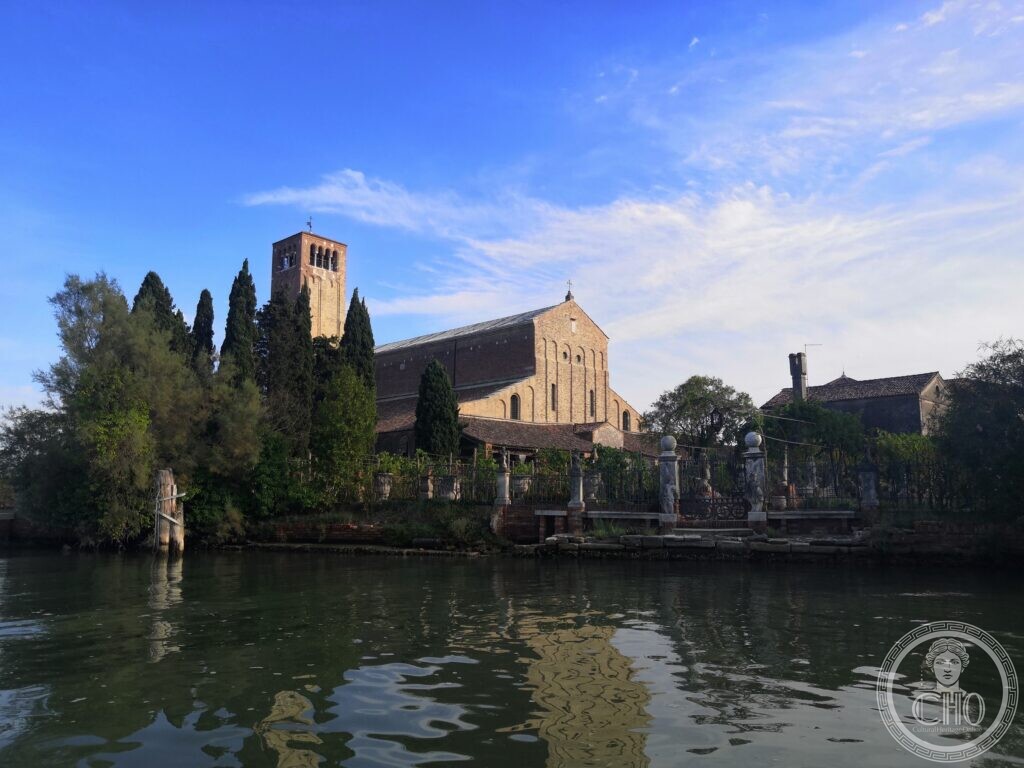
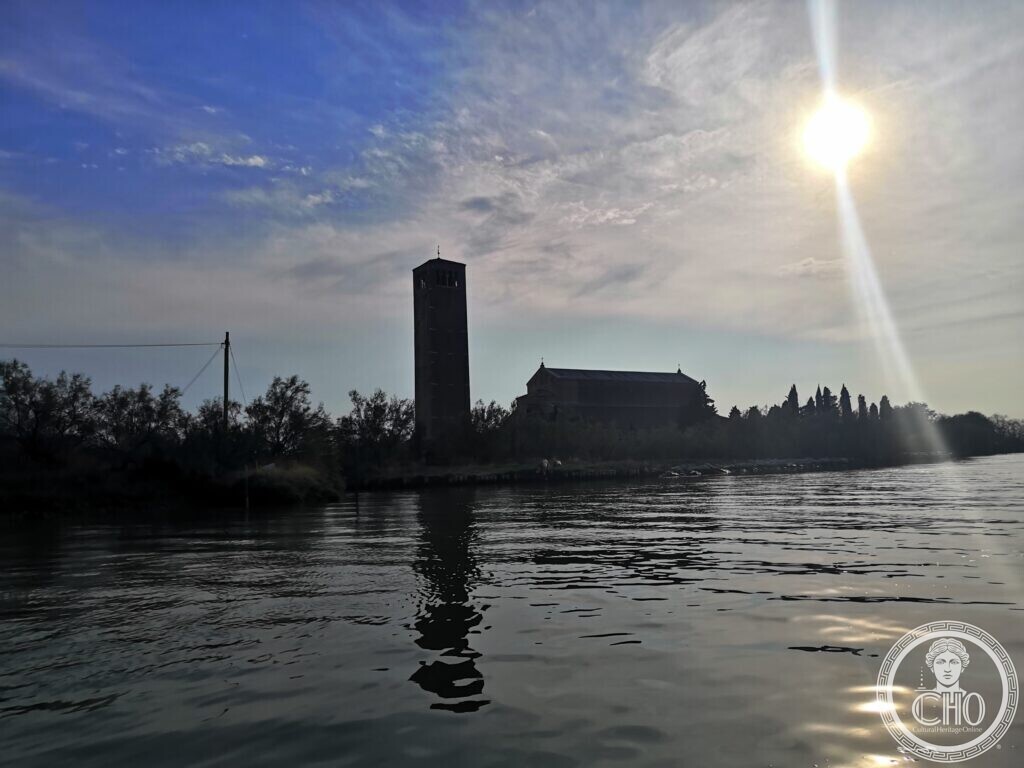
From the canal, as in the photographs, the basilica is a long brick box with a gabled front and a row of small windows high in the nave wall, its roof covered in sheet metal, with the low roofs of the narthex at its foot and a vineyard behind an iron fence along the water. The campanile stands apart to the left: a square brick shaft with pilaster strips, a bell chamber with paired openings and a low pyramidal roof, taller than anything else in the northern lagoon. Cypresses and a tamarisk stand between the two, and at low sun the whole group is a silhouette over the water.
Nearby
- Torcello Island — the island, its history and its museum
- The Scuola Vecchia di Torcello — on the same square
Gallery
Sources
- Italia.it (Ministero del Turismo), Torcello: the basilica of the seventh century rebuilt in the eleventh, the eleventh-century campanile with its paired openings, the three naves and the marble and mosaic floor, the Last Judgement, the island’s population from the seventh to the ninth century and its abandonment to the marsh, the church of Santa Fosca
- Museionline, Basilica di Santa Maria Assunta, Torcello: the minor basilica, the single complex with Santa Fosca and the baptistery of St John, the narthex of the eleventh century altered in the thirteenth, the portal jambs of about 1000, the eighteen Greek marble columns, the iconostasis, the altar rebuilt in 1923 with the remains of Sant’Eliodoro, the foundation inscription, the oratory of San Marco and Rustico da Torcello, opening hours and tickets
- OpenStreetMap, Basilica di Santa Maria Assunta, Torcello: the position
Find it on the map
See this place and what’s around it →📷 Become a Cultural Heritage Online photographer
Share your photos of places: they stay published under your name as the author. The more they're seen, the more you get noticed — and soon a contest will reward the most appreciated photos.
Log in or sign up free to add a photo