

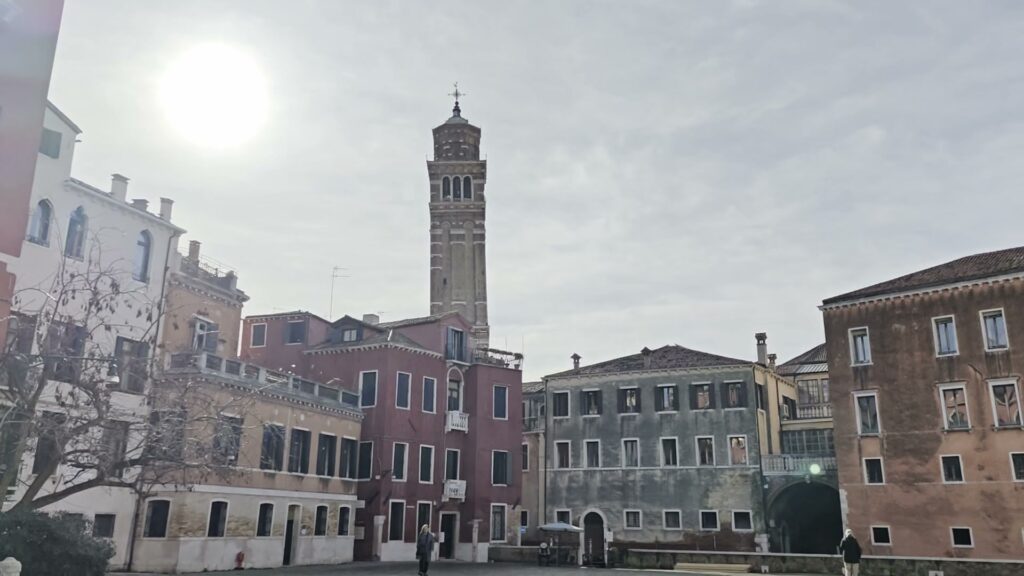
Venice does not need Pisa. The campanile of Santo Stefano began to lean while it was going up, stands about two metres out of plumb, and has been propped, tied and measured ever since.
At a glance
The Augustinian hermits bought houses in the parish of Sant’Angelo in 1264 or 1274 and built a convent there. The first stone of the church was laid in 1294 and the building was finished in 1325. It is the third of the great conventual churches of Venice, after the Frari and Santi Giovanni e Paolo, and it became a parish church in 1810, when the parishes of San Vitale, San Samuele and San Maurizio were folded into it. Blood shed inside it forced the church to be reconsecrated six times, the first at Pentecost in 1348 and the last in 1594.
What you see
The marble portal on the campo is by Bartolomeo Bon. Inside, the roof is the thing to look up at: a wooden ceiling shaped like the upturned hull of a ship. The inlaid choir dates from 1488. In the middle of the nave floor lies the tomb of Francesco Morosini, the commander who took the Peloponnese and died doge in 1694; it was designed by Antonio Gaspari, with bronzes by Filippo Parodi. The composer Giovanni Gabrieli is buried in front of the first altar on the left.
The sacristy is now a small museum. It holds four canvases by Jacopo Tintoretto: the Last Supper, the Washing of the Feet and the Prayer in the Garden, all of 1579–80, and a Resurrection of about 1565. A small cloister beyond it keeps Antonio Canova’s funerary stele for Senator Giovanni Falier, carved in 1808.
The bell tower
The campanile was built in the sixteenth century. On the evening of 7 August 1585 lightning set its bell chamber on fire; the chamber fell and all the bells melted. The lean showed from the moment of construction, according to the Soprintendenza, and it has never stopped. By 1904 the top stood 170 centimetres out of plumb, and five masonry buttresses were built on a platform laid on the bed of the canal beside it, with metal ties inside. The work slowed the movement without ending it: the figure today is about 200 centimetres. Between 2001 and 2005 the Soprintendenza fitted a monitoring system, a pendulum with strain gauges and inclinometers, that reads the tower continuously. At about 66 metres it is among the tallest towers in the historic city, and the most tilted.
Why it matters
A leaning tower is usually a failure that became a postcard. This one is a lesson in how Venice looks after what it has: when the tower moved, the city answered with buttresses, chains and instruments, not with demolition. The church, too, stands on water in the literal sense. The Rio del Santissimo runs beneath the chapel of the Holy Sacrament, which gave the canal its name.
Practical information
- The church belongs to the Chorus network: entry to the church is free, the sacristy museum charges a small fee
- Opening hours change with the season and with services; check the Chorus website before going
- The lean reads best from a distance, across the rooftops, rather than from the foot of the tower
Getting there
The church closes the north end of Campo Santo Stefano, between the Accademia bridge and San Marco. Waterbus to Sant’Angelo or Accademia, then five minutes on foot.
Sources
- Chorus — Associazione Chiese di Venezia, Chiesa di Santo Stefano, chorusvenezia.org
- Soprintendenza Archeologia, Belle Arti e Paesaggio per il Comune di Venezia e Laguna, Campanile di S. Stefano, restoration file 2001–2005
- Giuseppe Tassini, Curiosità veneziane, 2nd ed., Venice 1872, entries «S. Stefano» and «Santissimo (Rio del)»
- Treccani, Dizionario Biografico degli Italiani, «Morosini, Francesco»
- Venetian Heritage, restoration of the funerary monument of Francesco Morosini, 2020–21
Editorial text © Cultural Heritage Online, 2026. Video filmed and narrated on site by Andrea Manzo.
Find it on the map
See this place and what’s around it →
📷 Become a Cultural Heritage Online photographer
Share your photos of places: they stay published under your name as the author. The more they're seen, the more you get noticed — and soon a contest will reward the most appreciated photos.
Log in or sign up free to add a photoIs this page about you?
This page is read by travellers and heritage enthusiasts who find it on Google. Tell us how you are connected to this place and we will take it from there.