Yemen has five UNESCO World Heritage Sites — four cultural and one natural — spanning desert skylines of medieval skyscrapers, an ancient incense-trade kingdom, and one of the world’s most biologically singular archipelagos. The list is modest in number but extraordinary in range, reaching from pre-Islamic Sabaean temples to urban fabric continuously inhabited for more than two thousand years. From Cultural Heritage Online.
Why Yemen’s list looks the way it does
Five inscriptions across four decades reflects both the depth of Yemen’s heritage and the difficulty of documenting it. The country’s first nomination reached the World Heritage Committee in 1982, remarkably early for the Arab world, driven by international concern over the rapid modernisation of Sana’a’s ancient urban core. Subsequent inscriptions followed as surveys extended from the highlands to the coastal Tihama plain, the Hadhramaut valley, and the remote Indian Ocean island group of Socotra.
Since 2015, Yemen’s civil war has placed the entire cultural portfolio under severe stress. All four cultural sites appear on UNESCO’s List of World Heritage in Danger, a designation that signals active threat rather than a symbolic warning. The 2023 inscription of the Marib landmarks was approved simultaneously with its placement on the endangered list — an unusual step that reflects both the site’s outstanding significance and the urgency of drawing international attention to its condition.
The first inscriptions
Yemen entered the World Heritage system with a single site in 1982, and added a second four years later, establishing two of the most architecturally distinctive urban ensembles in the Middle East:
- Old Walled City of Shibam (1982) — a Hadhramaut valley settlement whose nine-storey mud-brick towers, some dating to the sixteenth century, earned it the informal description “Manhattan of the desert.”
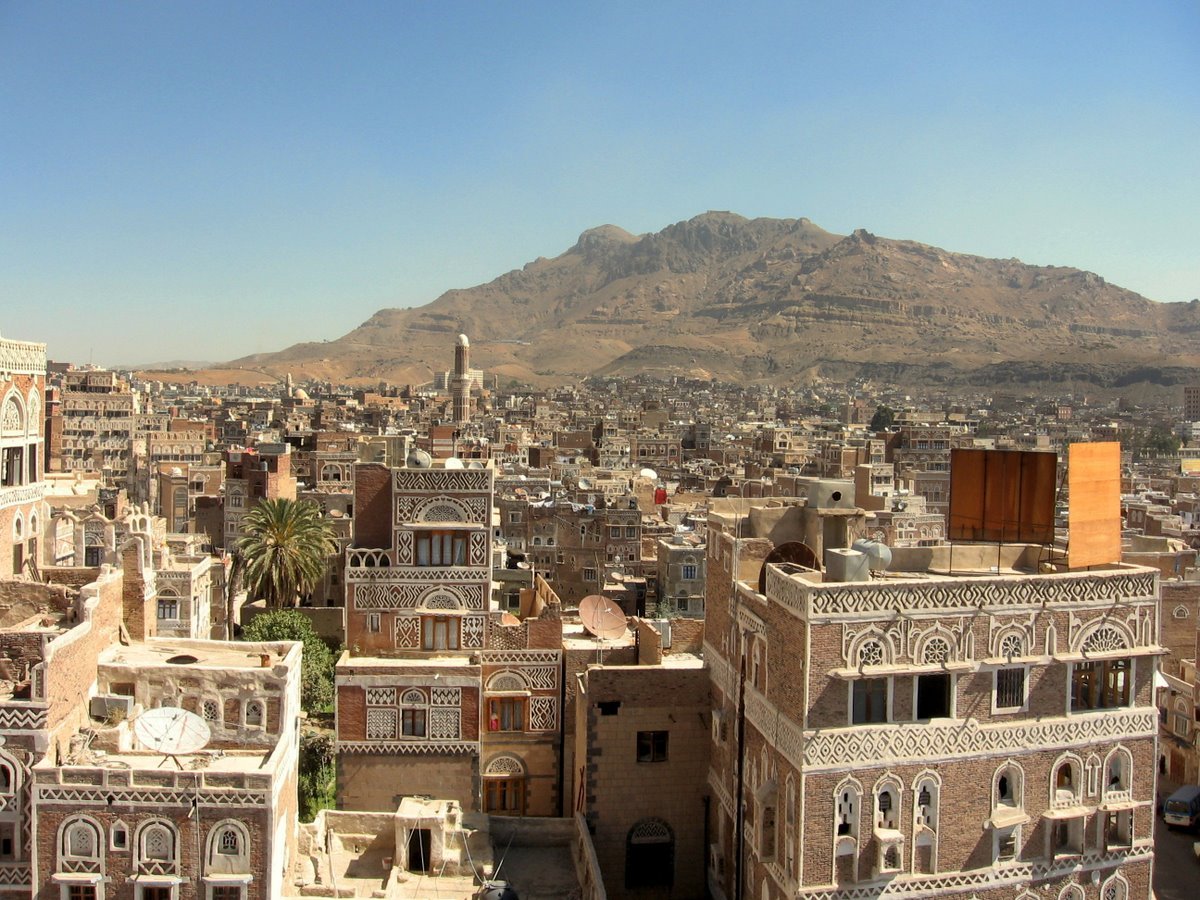
- Old City of Sana’a (1986) — a highland capital with more than a hundred mosques, dozens of hammams, and a residential vernacular of decorated “gingerbread” tower houses built from rammed earth and baked brick.
Both inscriptions were driven by the same concern: that economic development and the substitution of traditional materials with concrete threatened building stock that had evolved over many centuries without modern interruption. The early dates placed Yemen among the first Arab states to use the World Heritage Convention as a conservation instrument.
The most visited — and the alternatives
Sana’a has historically been the point of entry for most visitors to Yemen’s heritage, its multi-storey tower houses and the Great Mosque — reputedly among the earliest mosques built outside the Arabian Peninsula — concentrated within a walled area still used for daily commerce and residence. Shibam, reached via the Hadhramaut valley, draws comparisons with Manhattan not for scale but for the sheer vertical ambition of mud construction.
Less prominently discussed in international coverage are two sites that reward attention. The Historic Town of Zabid (inscribed 1993), on the Tihama coastal plain, served as Yemen’s capital during the thirteenth to fifteenth centuries and developed a distinctive courtyard-house tradition using local coral and limestone — a style quite different from the highland vernacular. The Landmarks of the Ancient Kingdom of Saba, Marib (2023) encompasses the Awam Temple complex and the remains of a city that commanded the frankincense and myrrh trade routes for over a millennium, providing one of the most direct material connections to the pre-Islamic Sabaean civilisation mentioned in ancient South Arabian inscriptions and Biblical sources alike.
Natural and shared sites
Yemen’s sole natural World Heritage Site stands apart from every other entry on the country’s list. The Socotra Archipelago, inscribed in 2008, comprises four islands and two rocky islets in the Arabian Sea, roughly 240 kilometres east of the Horn of Africa. Its prolonged geographic isolation produced an exceptional rate of endemism: more than a third of its plant species — including the visually striking dragon blood tree — exist nowhere else on Earth. The archipelago is also home to endemic bird species and some of the most intact coral reef ecosystems in the region.
None of Yemen’s inscriptions are formally transnational or serial in the UNESCO sense, though the Sabaean Kingdom’s reach extended across what is now southern Arabia, and scholarly calls for a broader serial nomination linking Sabaean-period sites across the region have been made in academic literature. For now, Marib stands as the single inscribed representative of that civilisation within Yemen’s borders.
How to find them
Yemen’s five World Heritage Sites are spread across geographically and climatically distinct zones: the high central plateau (Sana’a), the Hadhramaut interior valley (Shibam), the Tihama coastal lowlands (Zabid), the eastern plateau (Marib), and the Indian Ocean (Socotra). Practical access has been severely curtailed by the ongoing civil conflict, and travellers should consult current foreign-ministry advisories before making any plans.
Yemen’s World Heritage sites sit alongside thousands of other places on CHO’s interactive map, with GPS and sourced editorial history for each. See also our guides to Italy’s and France’s UNESCO sites, and our piece on cultural travel beyond mass tourism.
Frequently Asked Questions
How many UNESCO World Heritage Sites does Yemen have?
Yemen has five UNESCO World Heritage Sites as of 2023: four cultural and one natural. The cultural sites are the Old Walled City of Shibam, the Old City of Sana’a, the Historic Town of Zabid, and the Landmarks of the Ancient Kingdom of Saba, Marib. The natural site is the Socotra Archipelago.
What was Yemen’s first UNESCO World Heritage Site?
Yemen’s first UNESCO World Heritage Site was the Old Walled City of Shibam, inscribed in 1982. Located in the Hadhramaut valley, Shibam is renowned for its multi-storey mud-brick tower houses, some of which date to the sixteenth century. The Old City of Sana’a followed as the country’s second inscription in 1986.
Are Yemen’s World Heritage Sites on the endangered list?
All four of Yemen’s cultural World Heritage Sites are currently on UNESCO’s List of World Heritage in Danger, primarily due to the impact of the ongoing civil war that began in 2015. The most recent inscription, Marib in 2023, was added to the endangered list at the same time it was inscribed — a measure taken to mobilise international protective attention.
What makes the Socotra Archipelago a World Heritage Site?
The Socotra Archipelago was inscribed in 2008 for its outstanding natural values, particularly its extraordinary level of plant endemism: more than a third of its species are found nowhere else in the world. The dragon blood tree is the most visually distinctive of these endemic plants. The archipelago also supports endemic fauna and largely intact coral reef ecosystems.
Sources used in this article
- UNESCO — State Party Yemen — World Heritage list.
- UNESCO — Yemen: World Heritage Sites.
- CHO magazine — What is a World Heritage Site?
- CHO — Interactive map of heritage sites.
Sources
- S1 — Serjeant, R. B., and Ronald Lewcock, eds. San'a': An Arabian Islamic City. World of Islam Festival Publishing, 1983. ISBN 978-0-905035-04-8.
- S2 — Doe, Brian. Southern Arabia. Thames and Hudson, 1971. ISBN 978-0-500-02075-3.
Spotted an error? Write to editorial@culturalheritageonline.com and we correct it the same day.