Libya has five UNESCO World Heritage Sites, and all five were added to UNESCO’s List of World Heritage in Danger in 2016 as armed conflict and political fragmentation placed the country’s ancient monuments at severe risk. One site, the Old Town of Ghadamès, was removed from the danger list in 2025 after a period of relative stabilisation — a partial but meaningful recovery. The remaining four sites continue to face documented threats from looting, military activity, and the absence of coordinated state protection. From Cultural Heritage Online.
Libya’s ancient Mediterranean heritage
Libya sits at a crossroads where Phoenician traders, Greek colonists, and Roman emperors all left monumental traces. The coastal strip along the Mediterranean — ancient Tripolitania in the west, Cyrenaica in the east — preserves some of the largest and best-preserved Roman and Greek urban sites anywhere in the world. Inland, the Saharan massif of the Fezzan holds rock art reaching back thousands of years. Together these sites constitute a record of human activity across millennia that few countries can match in sheer scale.
UNESCO recognised this significance early. Four of Libya’s five sites received World Heritage status in 1982, just a decade after the 1972 World Heritage Convention opened for ratification. The fifth, Ghadamès, followed in 1986. For decades they were among the most cited examples of the Mediterranean’s classical legacy. The fall of Muammar Gaddafi’s government in 2011, and the civil conflict that followed, transformed that picture completely.
Five endangered sites: what is at stake
All five Libyan World Heritage Sites were added to the danger list at the same World Heritage Committee session in 2016, reflecting the scale and speed of deterioration across the country. The sites, with their original inscription dates, are:
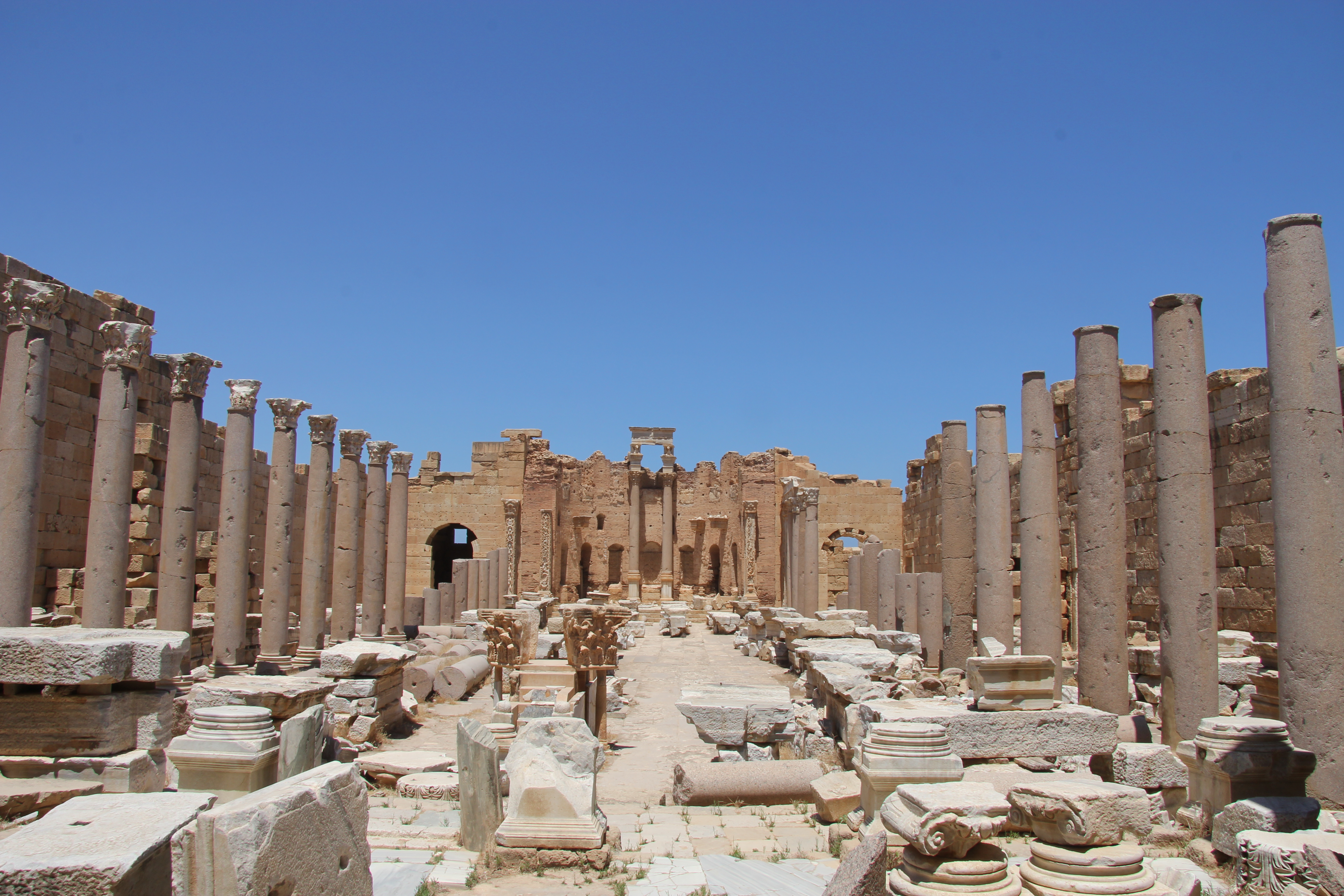
- Archaeological Site of Leptis Magna — inscribed 1982, added to danger list 2016. One of the largest and most intact Roman cities in existence, with a harbour, forum, basilica, circus, and amphitheatre.
- Archaeological Site of Sabratha — inscribed 1982, added to danger list 2016. A Phoenician trading post later developed by Rome, renowned for its theatres and coastal temples.
- Archaeological Site of Cyrene — inscribed 1982, added to danger list 2016. A major Greek colonial city, later Roman, whose necropolis and urban core face urban encroachment and flood damage.
- Rock-Art Sites of Tadrart Acacus — inscribed 1985, added to danger list 2016. Thousands of prehistoric engravings and paintings in the Saharan southwest, recording fauna, human figures, and ritual scenes across at least 12,000 years.
- Old Town of Ghadamès — inscribed 1986, added to danger list 2016, removed from the danger list in 2025. A pre-Saharan oasis settlement with a distinctive vernacular architecture of whitewashed mud-brick homes linked by covered passageways.
Leptis Magna alone covers roughly 400 hectares of excavated and unexcavated urban fabric. The scale of what is at risk — columns, mosaics, inscriptions, harbour infrastructure — is difficult to overstate. Sabratha’s theatre, one of the finest in North Africa, sits just metres from the sea. Cyrene’s Greek temples and Roman baths cover a hillside above the modern town of Shahat, where residential expansion has repeatedly encroached on the archaeological zone.
Political instability and its toll on monuments
The threats to Libya’s heritage are not primarily geological or environmental. They are political. The 2011 revolution and the prolonged armed conflict that followed created conditions in which no central authority exercised effective control over archaeological sites. Armed groups occupied ancient structures, used them as defensive positions, or extracted materials. Looting at all five sites was documented by satellite monitoring as early as 2012 and intensified through subsequent years of fighting.
At Cyrene, urban expansion into the necropolis accelerated after 2013, with bulldozers clearing tomb areas for new construction. At Tadrart Acacus, the remoteness that once protected the rock art became a liability: with no state presence in the Fezzan, illegal digging and vandalism went unchecked. The Libya case illustrates a pattern repeated across the Arab States region, which accounts for 22 of the 53 sites currently on UNESCO’s danger list — the highest of any region, driven by conflicts in Syria, Iraq, Yemen, and Gaza as well as Libya.
Efforts to protect Libya’s heritage
International attention to Libya’s sites has been sustained, if constrained. UNESCO’s danger list designation in 2016 unlocked emergency funding and triggered diplomatic pressure on all parties to the conflict to respect cultural property. The 1954 Hague Convention, ratified by Libya, formally prohibits military use of heritage sites — though enforcement in active conflict zones remains difficult. The organisation also coordinated satellite monitoring through its World Heritage Emergency Fund to track damage without requiring physical access.
The removal of Ghadamès from the danger list in 2025 demonstrates that recovery is possible. The old town’s traditional community of Berber inhabitants had largely maintained its built fabric even during the worst years, and a period of relative calm in the Fezzan allowed conservation work to resume. UNESCO’s danger list functions precisely as this kind of tool: not a permanent condemnation, but a mechanism for mobilising resources and political will. Three other sites were also removed from the global danger list in 2025 (Abu Mena in Egypt and the Rainforests of the Atsinanana in Madagascar), a sign that the list can work as intended when conditions allow.
How to find Libya’s sites on the map
Leptis Magna lies roughly 130 kilometres east of Tripoli, near the modern town of Al Khums. Sabratha is about 70 kilometres west of the capital. Cyrene sits in the Green Mountain (Jebel Akhdar) region of northeastern Libya, near the town of Shahat. The rock-art sites of Tadrart Acacus occupy the southwestern corner of the country, bordering Algeria, in terrain that is visually dramatic and logistically demanding even in peaceful times. Ghadamès, the oasis town now off the danger list, lies near the Algerian and Tunisian borders in the northwestern Sahara.
These sites sit alongside thousands of others on CHO’s interactive heritage map, with GPS coordinates and sourced editorial history. See our complete guide to UNESCO Sites in Danger and our explainer on UNESCO criteria.
Frequently Asked Questions
How many UNESCO World Heritage Sites does Libya have in danger?
Libya has five UNESCO World Heritage Sites in total, all of which were added to UNESCO’s List of World Heritage in Danger in 2016. As of 2025, one site — the Old Town of Ghadamès — has been removed from the danger list after conservation conditions improved. The remaining four sites (Leptis Magna, Sabratha, Cyrene, and the Rock-Art Sites of Tadrart Acacus) remain endangered.
What are Libya’s most important ancient sites?
Leptis Magna is widely regarded as one of the best-preserved Roman cities in the world, rivalling Pompeii and Ephesus in scale. Sabratha offers an exceptional Roman theatre facing the Mediterranean. Cyrene preserves the remains of a major Greek colonial city, including temples, an agora, and an extensive necropolis. Together they represent the depth of classical civilisation on Libya’s Mediterranean coast.
Why were all five Libyan sites added to the danger list at the same time?
The 2016 simultaneous inscription of all five Libyan sites reflected the country-wide nature of the crisis following the 2011 civil war. With no functioning central government able to protect archaeological zones, armed groups, looting, and uncontrolled urban expansion posed documented threats across every region. UNESCO acted on accumulated satellite evidence and on-the-ground reports from heritage professionals.
Has any Libyan heritage site been successfully recovered from the danger list?
Yes. The Old Town of Ghadamès was removed from the UNESCO danger list in 2025, representing a meaningful conservation success. The traditional mud-brick settlement had retained much of its architectural integrity thanks in part to the continued presence of its local Berber community. Its removal shows that the danger list is a practical tool for recovery, not a permanent designation.
Sources used in this article
- UNESCO — UNESCO World Heritage — Libya.
- UNESCO — List of World Heritage in Danger.
- CHO magazine — What is a World Heritage Site?
- CHO — Interactive map of heritage sites.
Sources
- S1 — Mattingly, David J. Tripolitania. University of Michigan Press, 1994. ISBN 978-0-472-10658-5.
- S2 — Ward, Philip. Sabratha: A Guide for Visitors. Oleander Press, 1970. ISBN 978-0-902675-05-6.
Spotted an error? Write to editorial@culturalheritageonline.com and we correct it the same day.