Vietnam has nine UNESCO World Heritage Sites, spanning ancient imperial citadels, Hindu temple complexes, Buddhist pilgrimage landscapes, limestone karst seascapes, and cave systems that rank among the largest on Earth — a list that cuts from the northern highlands to the Cham heartland of the central coast. From Cultural Heritage Online.
Why Vietnam’s list looks the way it does
Vietnam’s World Heritage list is, above all, a map of layered sovereignty. The country was shaped by three thousand years of Chinese cultural influence, several centuries of Cham civilization in the centre and south, a millennium of independent Viet dynasties, and a colonial period that left its own architectural sediment. UNESCO’s tally — six cultural sites, two natural, and one mixed — reflects all of this without reducing it to a single narrative thread.
The natural inscriptions are equally telling. Vietnam sits at the convergence of major biogeographic zones, and its karst geology — the same limestone formations that produce Hạ Long Bay’s famous silhouettes — extends underground into cave networks of extraordinary scale. That geological inheritance, rather than any single ecosystem, gives the natural sites their character.
The first inscriptions
Vietnam’s entry onto the World Heritage list came in 1993, at the 17th session of the World Heritage Committee held in Colombia. A single site received inscription that year:
- Complex of Huế Monuments (1993) — the former imperial capital of the Nguyễn dynasty, encompassing the Forbidden Purple City, royal tombs, temples, and the citadel walls along the Perfume River.
The pace quickened quickly. The following year Hạ Long Bay joined the list, and by 1999 two more sites — Hội An and Mỹ Sơn — were inscribed at the same session, establishing the pattern of clustered inscriptions that would continue into the 2000s and beyond. The most recent addition, the Yên Tử–Vinh Nghiêm–Côn Sơn, Kiếp Bạc Complex, was inscribed in 2025, bringing the total to nine.
The most visited — and the alternatives
Hạ Long Bay draws more international attention than any other site on the list, and Hội An Ancient Town — with its lantern-lit merchant quarter blending Chinese, Japanese, and European architectural traditions — runs a close second for visitor numbers. The Complex of Huế Monuments, as the first inscribed site, remains a pilgrimage point for Vietnamese cultural tourism. These three carry the bulk of the load.
Beyond them, the list holds sites that repay the effort of reaching them. Mỹ Sơn Sanctuary, a cluster of Hindu temples built between the 4th and 13th centuries as the religious centre of the Cham kingdom, stands in a forested valley in Quảng Nam province and remains one of the most significant examples of South and Southeast Asian temple architecture outside India. The Citadel of the Hồ Dynasty, constructed in 1397 from enormous stone blocks quarried and fitted without mortar, demonstrates a conception of royal power that blended Confucian statecraft with Buddhist spatial philosophy — and sees a fraction of the visitors that Huế attracts. The Central Sector of the Imperial Citadel of Thăng Long, in central Hanoi, marks a political axis that was continuously inhabited and rebuilt across thirteen centuries of Vietnamese history.
Natural and shared sites
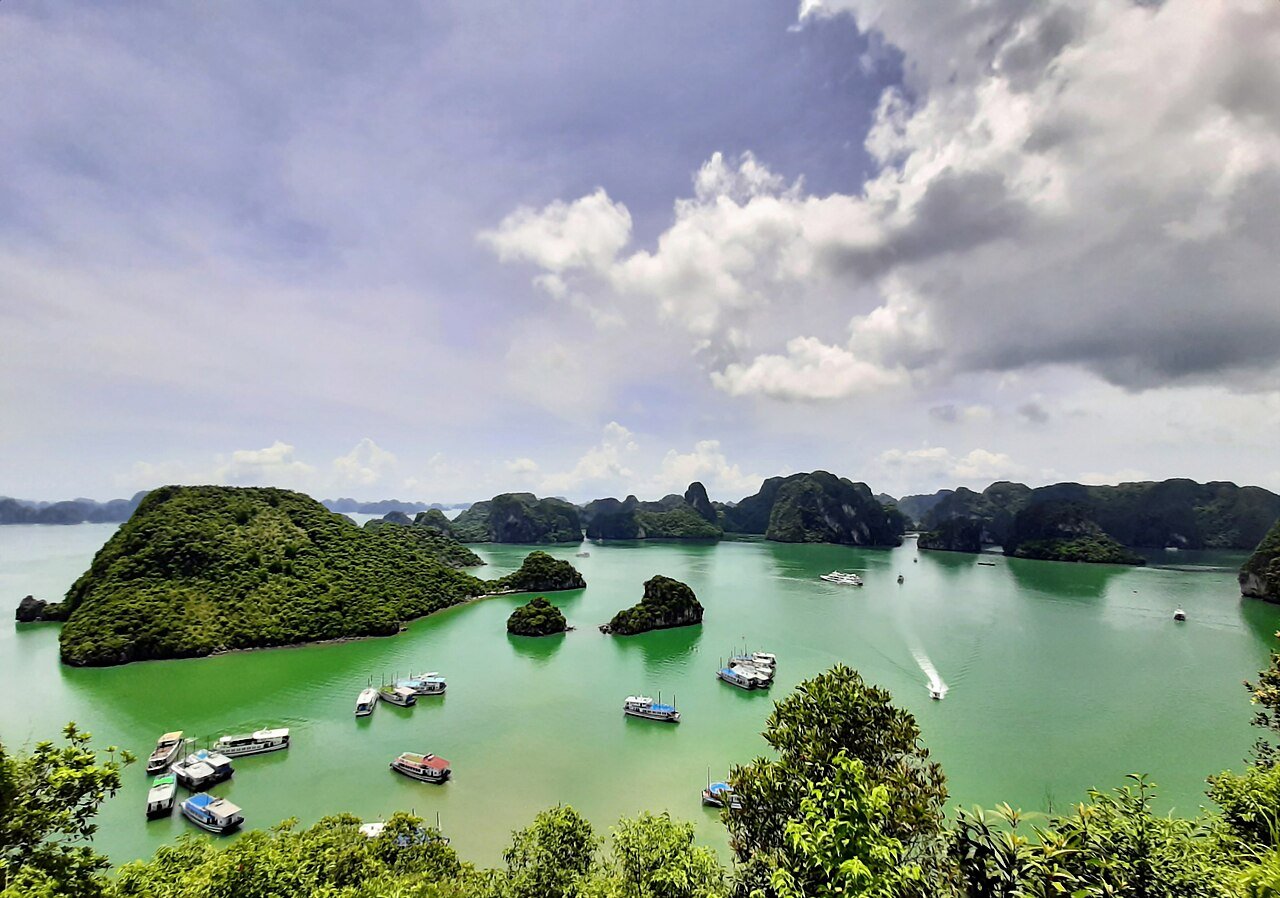
Vietnam’s two natural inscriptions sit at opposite scales. Hạ Long Bay–Cát Bà Archipelago — originally inscribed in 1994, extended in 2000 and again in 2023 to include the Cát Bà island group — covers more than 1,500 square kilometres of emerald water studded with limestone pillars, home to rare langurs found nowhere else. Phong Nha–Kẻ Bàng National Park, inscribed in 2003 and extended in 2015, protects one of the world’s oldest karst systems and contains Son Doong Cave, whose main passage is large enough to accommodate a Boeing 747.
The Tràng An Landscape Complex, inscribed in 2016, occupies a category of its own: it is a mixed site, carrying both natural and cultural criteria, and was the first mixed inscription in Southeast Asia. Its flooded limestone valleys in Ninh Bình province served as the capital of Vietnam in the 10th and 11th centuries and contain cave temples still in active religious use. On the transnational front, Phong Nha–Kẻ Bàng gained a serial extension in 2025 linking it with Hin Nam No National Park across the border in Laos, reflecting the shared karst system that the two parks protect together.
How to find them
Vietnam’s World Heritage sites sit alongside thousands of other places on CHO’s interactive map, with GPS and sourced editorial history for each. See also our guides to Italy’s and France’s UNESCO sites, and our piece on cultural travel beyond mass tourism.
Frequently Asked Questions
How many UNESCO World Heritage Sites does Vietnam have?
Vietnam has nine UNESCO World Heritage Sites as of 2025, comprising six cultural sites, two natural sites, and one mixed site. The most recent inscription, the Yên Tử–Vinh Nghiêm–Côn Sơn, Kiếp Bạc Complex, was added to the list in 2025.
What was Vietnam’s first UNESCO World Heritage Site?
The Complex of Huế Monuments was Vietnam’s first UNESCO World Heritage Site, inscribed in 1993 at the 17th session of the World Heritage Committee. It encompasses the former imperial capital of the Nguyễn dynasty, including the walled citadel, royal tombs, and temples along the Perfume River in central Vietnam.
Does Vietnam have any mixed UNESCO World Heritage Sites?
Yes — the Tràng An Landscape Complex in Ninh Bình province, inscribed in 2016, is Vietnam’s only mixed site, recognised for both its natural karst geology and its outstanding cultural significance. It was also the first mixed World Heritage Site to be inscribed anywhere in Southeast Asia.
Which of Vietnam’s UNESCO sites are natural rather than cultural?
Two sites are inscribed under natural criteria: Hạ Long Bay–Cát Bà Archipelago, renowned for its limestone karst formations and endemic wildlife, and Phong Nha–Kẻ Bàng National Park, which protects one of the world’s oldest karst systems and includes Son Doong, one of the largest caves ever surveyed. Phong Nha–Kẻ Bàng also became part of a transnational serial inscription with Laos in 2025.
Sources used in this article
- UNESCO — State Party Vietnam — World Heritage list.
- UNESCO — Vietnam: World Heritage Sites.
- CHO magazine — What is a World Heritage Site?
- CHO — Interactive map of heritage sites.
Sources
- S1 — Taylor, K. W. A History of the Vietnamese. Cambridge University Press, 2013. ISBN 978-0-521-87586-8.
- S2 — Sterling, Eleanor J., et al. Vietnam: A Natural History. Yale University Press, 2006. ISBN 978-0-300-10608-4.
Spotted an error? Write to editorial@culturalheritageonline.com and we correct it the same day.