Barbados has 1 UNESCO World Heritage Site — a figure that understates the island’s layered colonial, agricultural, and geological history. A single inscription anchors the official list as of 2025, yet the country’s tentative entries point toward a richer designation picture still taking shape. From Cultural Heritage Online.
Why Barbados’s list looks the way it does
Barbados ratified the UNESCO World Heritage Convention in April 2002, relatively late compared with many of its Caribbean neighbours. That timeline matters: nominations require years of documentation, site management plans, and state capacity, so a small island nation joining in the early 2000s could reasonably be expected to have only one or two inscriptions by the mid-2020s. The single site on record reflects careful rather than rushed engagement with the process.
The island’s heritage landscape is also unusually dense for its size. Barbados was continuously under British colonial administration from 1625 until independence in 1966 — one of the longest unbroken stretches in the Caribbean — which produced an intact urban fabric and an industrial sugar economy whose physical remains survive in remarkable quantities. That density, paradoxically, makes prioritising a single nomination more consequential.
The first inscription
Barbados earned its first and, to date, only World Heritage inscription in 2011. The designated property is:
- Historic Bridgetown and its Garrison (2011) — inscribed under criteria ii, iii, and iv as an outstanding example of British colonial town planning and architecture from the seventeenth through nineteenth centuries.
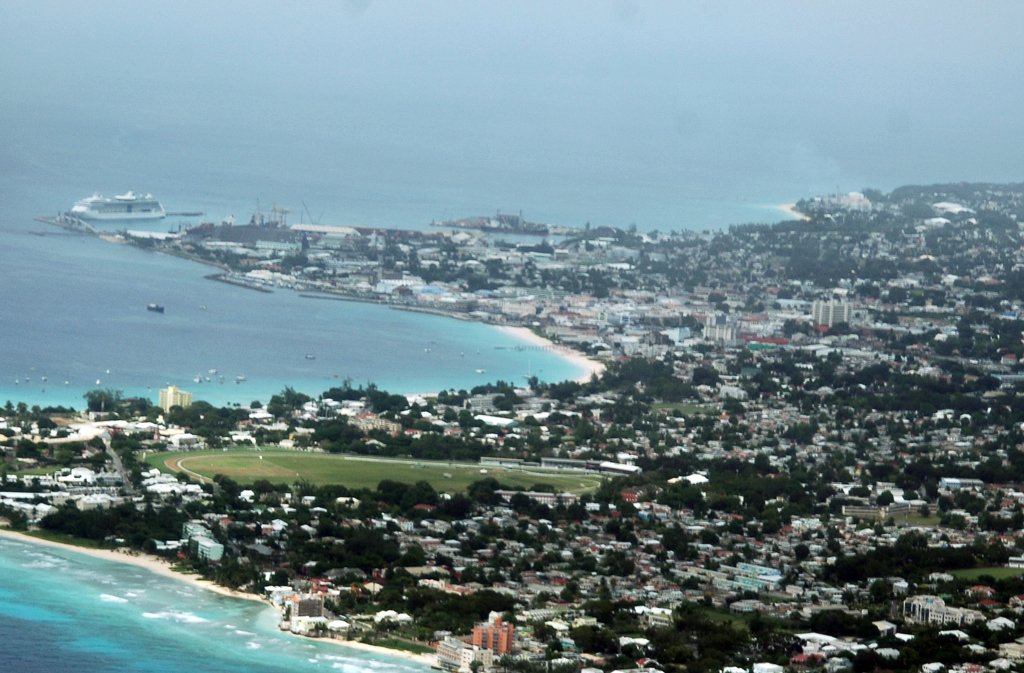
The inscription recognised Bridgetown’s distinctive departure from the grid-plan layouts used by Spanish and Dutch colonisers elsewhere in the region. The town grew organically along a tidal waterway, producing a street pattern and building stock that reads as legibly British rather than continental European. The adjacent Garrison — a military complex of barracks, parade ground, and fortifications — reinforces the property’s value as a document of imperial defensive strategy in the Atlantic.
The most visited — and the alternatives
Historic Bridgetown and its Garrison draws the majority of heritage-focused visitors to the island, and the sites repay close attention. The Garrison Savannah, a former military parade ground, is now a racecourse surrounded by eighteenth-century brick buildings that house the Barbados Museum and Historical Society. The Parliament Buildings on National Heroes Square date to the 1870s and form one of the oldest parliamentary assemblies in the Western Hemisphere.
Beyond the inscribed area, two tentative sites give a sense of what the official list may eventually include. The Scotland District in the island’s northeast is a striking geological outlier — a section of exposed oceanic sedimentary rock that predates the coral limestone covering most of Barbados, with active erosion features rarely seen elsewhere in the Lesser Antilles. The Industrial Heritage of Barbados: The Story of Sugar and Rum, placed on the tentative list in 2014, encompasses windmill towers, great houses, boiling houses, and rum distilleries distributed across the island’s plantation landscape — a serial nomination that would document the full cycle of sugar production from field to barrel.
Natural and shared sites
Barbados currently has no inscribed natural or mixed World Heritage Sites. The Scotland District tentative nomination, submitted under natural criteria, is the closest the country has come to putting forward a landscape-focused property. Its geomorphological significance — as a window into the deep marine sediment layers beneath the island’s coral cap — is well documented in the scientific literature, and the site has been under tentative consideration since 2005.
Barbados does not currently participate in any transnational or serial UNESCO inscription shared with neighbouring states, though the sugar and rum industrial heritage nomination could, in principle, be widened into a Caribbean-wide serial property given the shared plantation history of islands such as Trinidad, St Kitts, and Antigua. No such expanded nomination has been formally announced as of 2025.
How to find them
Historic Bridgetown and its Garrison occupies the southwestern corner of the island in Saint Michael Parish. The inscribed area is walkable from the Bridgetown harbour and well served by public transport from all coastal resort strips. The Garrison Savannah is approximately fifteen minutes on foot from the Parliament Buildings, making a combined visit feasible in a half-day.
Barbados’s World Heritage sites sit alongside thousands of other places on CHO’s interactive map, with GPS and sourced editorial history for each. See also our guides to Italy’s and France’s UNESCO sites, and our piece on cultural travel beyond mass tourism.
Frequently Asked Questions
How many UNESCO World Heritage Sites does Barbados have?
Barbados has 1 inscribed UNESCO World Heritage Site as of 2025: Historic Bridgetown and its Garrison, designated in 2011. The country also holds 2 properties on UNESCO’s tentative list — the Scotland District and the Industrial Heritage of Barbados — which are under consideration for future nomination.
What was Barbados’s first UNESCO World Heritage Site?
Historic Bridgetown and its Garrison became Barbados’s first and only World Heritage Site when it was inscribed in 2011. The property was recognised for its well-preserved British colonial urban fabric, spanning the seventeenth to nineteenth centuries, and for the adjacent military Garrison complex that surrounded the town.
Does Barbados have any natural UNESCO World Heritage Sites?
No natural sites from Barbados are currently inscribed on the World Heritage List. The Scotland District, a geologically distinctive section of exposed marine sedimentary rock in the island’s northeast, has been on the tentative list since 2005 under natural criteria but has not yet been formally nominated.
What is the significance of the Barbados Garrison?
The Garrison forms the military component of the inscribed Bridgetown property and represents one of the most intact examples of British imperial defensive architecture in the Caribbean. Its eighteenth-century barracks, guardhouses, and parade ground — now home to the Barbados Museum — illustrate the strategic role the island played as a staging post for British Atlantic operations.
Sources used in this article
- UNESCO — State Party Barbados — World Heritage list.
- UNESCO — Barbados: World Heritage Sites.
- CHO magazine — What is a World Heritage Site?
- CHO — Interactive map of heritage sites.
Sources
- S1 — Beckles, Hilary McD. A History of Barbados: From Amerindian Settlement to Nation-State. Cambridge University Press, 1990. ISBN 978-0-521-35879-8.
- S2 — Carrington, Sean, et al. A-Z of Barbados Heritage. Macmillan Caribbean, 2003. ISBN 978-0-333-92068-8.
Spotted an error? Write to editorial@culturalheritageonline.com and we correct it the same day.