
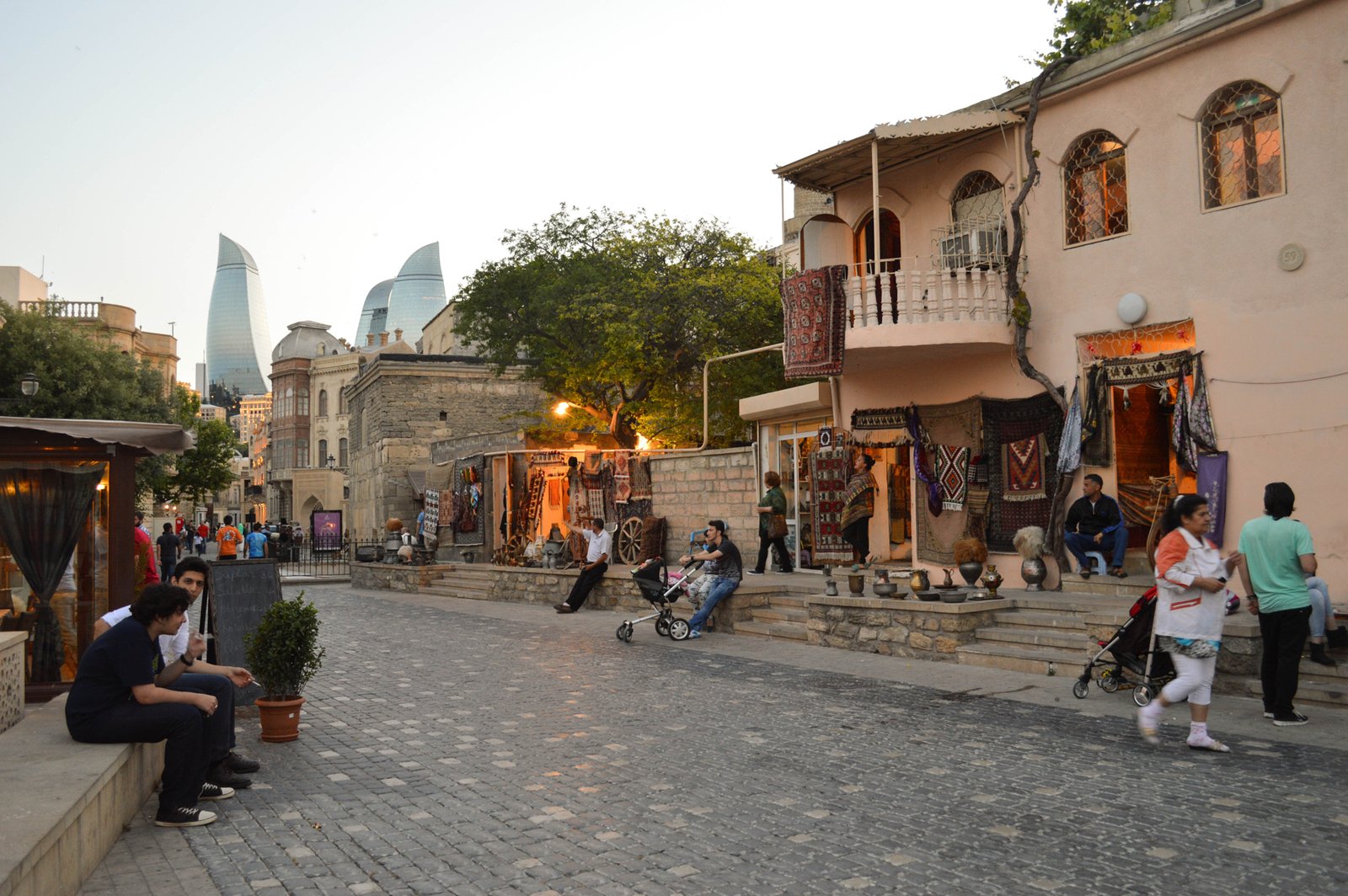
Azerbaijan holds two UNESCO World Heritage Sites — one wrapped around you the moment you step off the Baku boulevard, the other carved into a plateau 60 km outside the city. Together, the medieval Walled City of Baku and the Gobustan Rock Art Cultural Landscape span forty thousand years of human presence in the South Caucasus. From Cultural Heritage Online.
Walled City of Baku with the Shirvanshah’s Palace and Maiden Tower Walking distance from central Baku — 0 km
Ichari Shahar — the Inner City — sits behind a double ring of limestone walls that date from the 11th and 12th centuries, though settlement here goes back considerably further. UNESCO inscribed the Walled City in 2000, recognising the density of layered history compressed into roughly 22 hectares: Zoroastrian fire temples beneath mosque floors, caravanserai archways converted to carpet workshops, carved khachkar stones from the Christian period embedded in later Islamic masonry. You walk through it on foot, the lanes too narrow for anything else, the stone underfoot worn smooth by centuries of traffic.
The Shirvanshah’s Palace complex, built in stages through the 15th century, is the largest surviving monument of Azerbaijani medieval architecture. Its courtyard holds a mosque, a bathhouse, a royal mausoleum, and a small divan-khane — a ceremonial pavilion whose carved portal stonework rivals anything in the Islamic world. The stone is pale and warm; at midday it almost glows. Builders from Shirvan — the medieval kingdom centred on this region — worked in a tradition that fused Persian, local Caucasian, and early Ottoman influences into something recognisably their own.
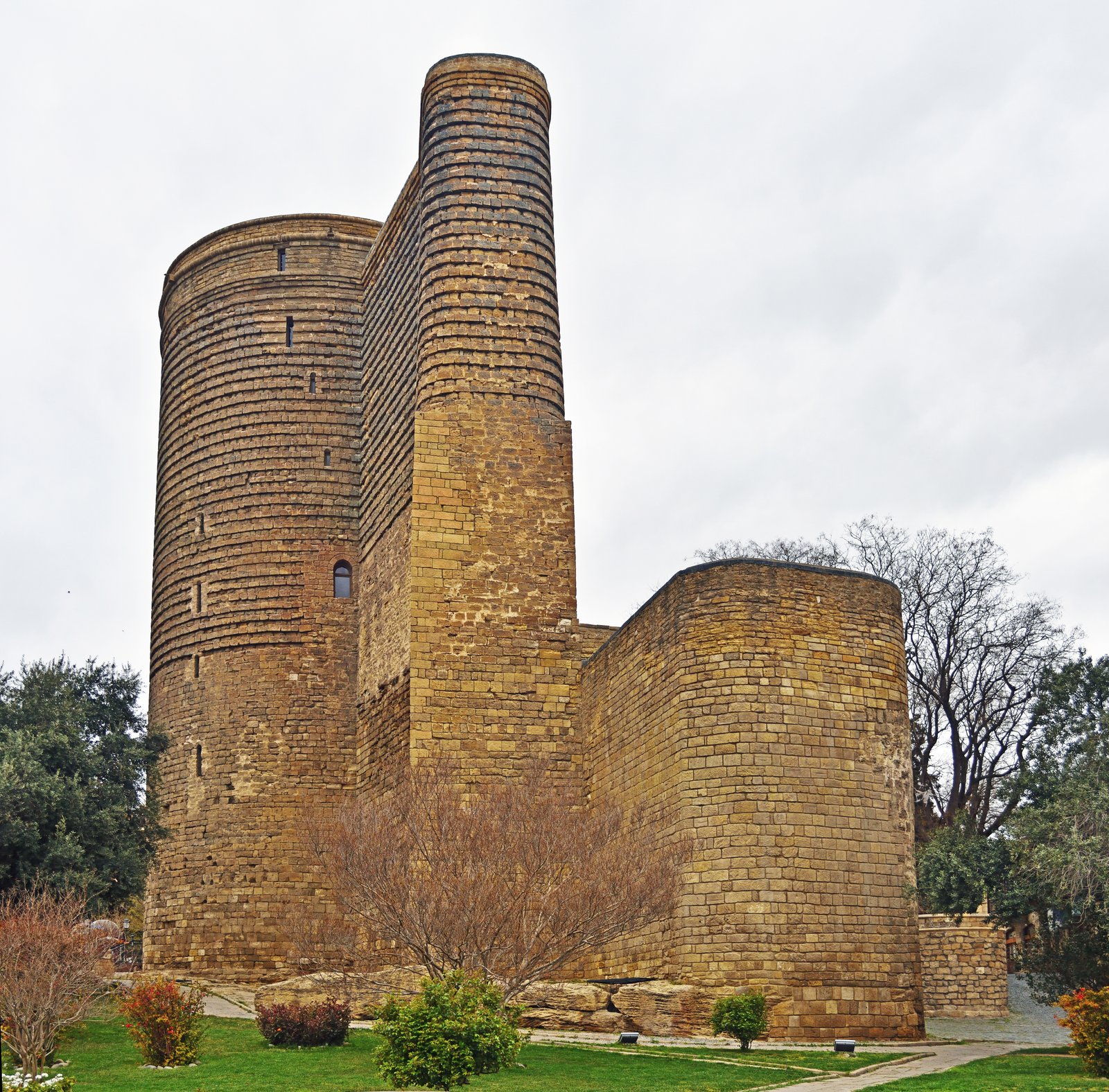
The Maiden Tower (Qız Qalası) stands at the southeastern edge of the walls, cylindrical, roughly 29 metres high, with a projecting buttress that no one has fully explained. Its original function is disputed — scholarly proposals range from defensive tower to Zoroastrian fire temple to astronomical observatory. The earliest structural phases are dated to between the 7th and 12th centuries AD, though some researchers argue for an even earlier core. From the roof terrace, the Caspian opens out to the east, flat and silver in the afternoon light, with the new city’s towers rising behind.
Getting there: The walled city is within walking distance of central Baku; the nearest metro station is Icheri Sheher (İçəri Şəhər), which deposits you directly at the fortress gate. Allow: Half a day minimum — the Shirvanshah’s Palace alone warrants two hours. The Museum of History of Azerbaijan, just outside the walls, is worth adding. Best for: Travellers with an interest in Islamic architecture, medieval urbanism, or Azerbaijani history.
Gobustan Rock Art Cultural Landscape 60 km southwest of Baku — approximately 1 hour by car
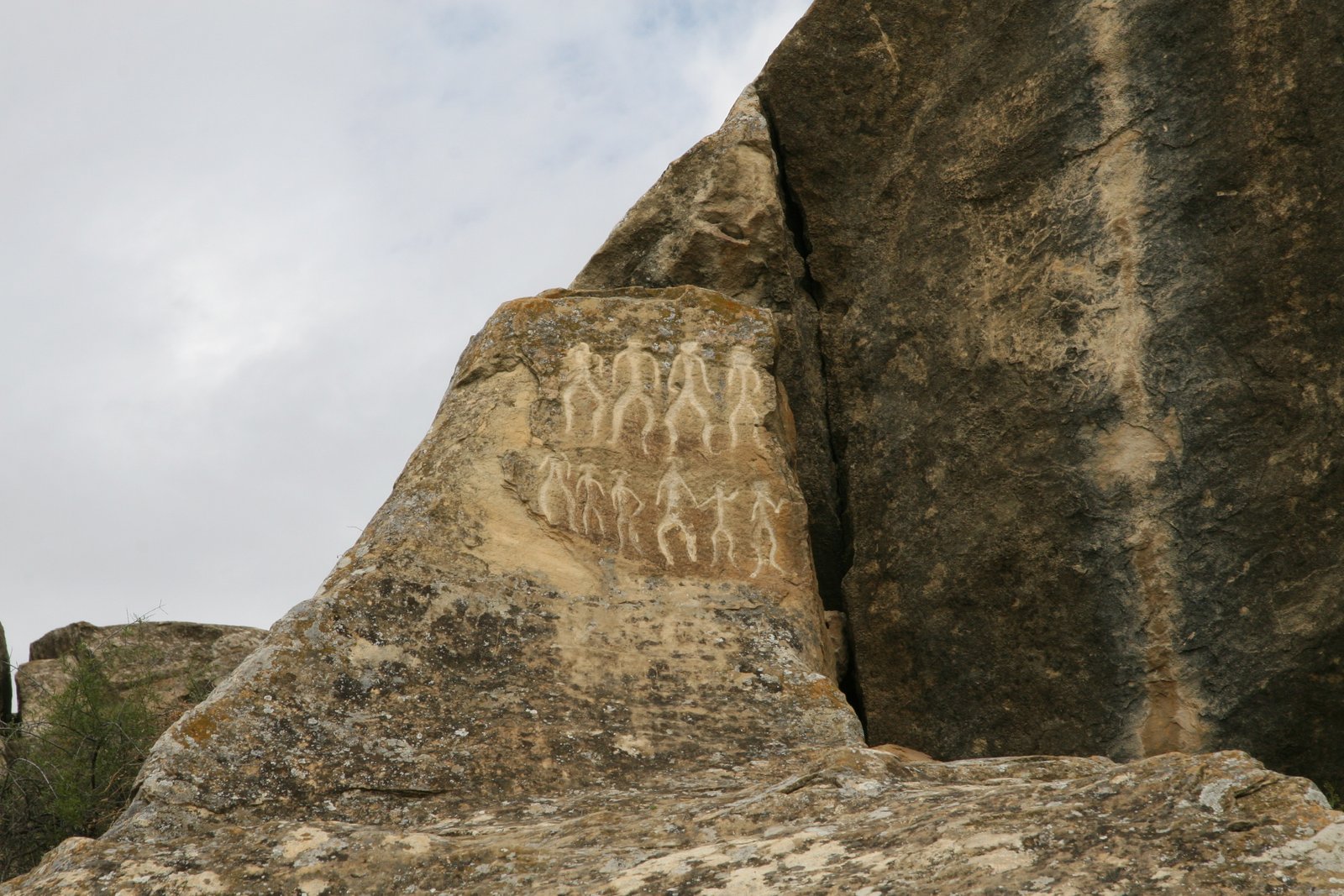
The Gobustan plateau is a landscape of dark, layered sandstone ridges rising from semi-arid scrubland south of Baku. UNESCO inscribed the rock art cultural landscape in 2007. More than 6,000 engravings are distributed across the site — bulls with exaggerated horns, human figures in motion, boats, reed instruments, hunting scenes — carved at different periods from the Upper Palaeolithic through to the Middle Ages. The oldest images were made when the Caspian shoreline ran close to the site and the climate supported dense woodland; the landscape the engravers inhabited looked nothing like what surrounds the rocks today.
One of the more startling finds at Gobustan is a Latin inscription carved into a boulder near the site’s southern end. It records the presence of a cohort of the XII Fulminata legion under the Emperor Domitian — dated to around 84–96 AD — establishing that Roman soldiers passed through or were garrisoned here during the first century. That a Roman military unit reached the western Caspian shore and left a standard-issue inscription in the same stone face as Palaeolithic hunters is the kind of coincidence that stops you mid-stride on the path. The inscription is authenticated and still legible.
The adjacent Gobustan mud volcanoes — about 10 km from the rock art site — are frequently added to the same day trip. Azerbaijan has roughly 400 of the world’s estimated 1,000 onshore mud volcanoes, and the Gobustan field is the most accessible cluster. They are small and low-pressure, producing slow grey bubbles of methane-rich mud rather than anything dramatic. The landscape around them is pale grey and bare, contrasting sharply with the dark stone of the engraving site a few kilometres away.
Getting there: By car from Baku, approximately one hour via the M6 highway south. Guided day tours from Baku typically combine the rock art museum with the mud volcanoes (full circuit around 3–4 hours including stops). Public transport options exist but require a connection at Gobustan village and a taxi for the final stretch to the reserve entrance. Allow: 3–4 hours for the rock art site alone; 5–6 hours if adding mud volcanoes. Best for: Archaeology enthusiasts, travellers interested in prehistoric art, or anyone wanting a full-day excursion away from the city.
Frequently Asked Questions
How many UNESCO World Heritage Sites are near Baku?
Azerbaijan has two UNESCO World Heritage Sites, both within easy reach of Baku. The Walled City of Baku with the Shirvanshah’s Palace and Maiden Tower was inscribed in 2000 and is located within the city itself. The Gobustan Rock Art Cultural Landscape, inscribed in 2007, lies approximately 60 km southwest and takes around one hour to reach by car.
What can you see inside the Walled City of Baku, and how long does a visit take?
The Walled City (Ichari Shahar) contains the Shirvanshah’s Palace complex — a 15th-century ensemble of mosque, mausoleum, bathhouse, and ceremonial pavilion — as well as the Maiden Tower, medieval caravanserai, hammams, and dozens of smaller mosques and historic houses. Carving out at least half a day allows enough time to explore both major monuments without rushing. The Shirvanshah’s Palace alone warrants two hours; the Maiden Tower has a museum inside and a roof terrace with Caspian views. Entry to both sites requires separate tickets.
Can you visit Gobustan and the Walled City of Baku on the same day?
Yes, though it makes for a full day. The most practical sequence is to spend the morning in the Walled City — which opens early and is cooler before noon — then drive to Gobustan in the early afternoon. Allow time for the Gobustan National Historical-Artistic Reserve museum before walking the open-air rock art paths. If mud volcanoes are on the agenda, leave the Walled City no later than 12:00 to avoid finishing the Gobustan circuit after dark. Summer temperatures on the exposed plateau can be high; bring water and sun cover.
What is the Roman inscription at Gobustan, and why is it significant?
A boulder near the southern section of the Gobustan site bears a Latin inscription identifying soldiers of the Legio XII Fulminata, a Roman legion active in the eastern provinces, dated to the reign of Emperor Domitian (81–96 AD). It is one of the easternmost confirmed Roman military inscriptions ever found, and it establishes that Roman legionaries reached the western Caspian shore during the first century. The inscription was discovered in 1948 and has been authenticated by epigraphers; it sits among prehistoric engravings made tens of thousands of years earlier on the same stone face.
Sources
- S1 — Farhadova, Malahat. Gobustan: Rock Art Cultural Landscape. Elm, 2008. ISBN 978-9952-453-01-0.
- S2 — Altstadt, Audrey L. The Azerbaijani Turks: Power and Identity Under Russian Rule. Hoover Institution Press, 1992. ISBN 978-0-8179-9182-1.
Spotted an error? Write to editorial@culturalheritageonline.com and we correct it the same day.

.jpeg)

