Madagascar has three UNESCO World Heritage Sites, a number that reflects both the island’s extraordinary ecological isolation and the scale of the conservation challenges it still faces. A country whose wildlife evolved separately from the African mainland for roughly 88 million years, Madagascar holds landscapes — cathedral limestone pinnacles, intact eastern rainforests, vast western dry forests — that exist nowhere else on Earth. This is an editorial overview of those inscriptions, their significance, and what sits alongside them. From Cultural Heritage Online.
Why Madagascar’s list looks the way it does
Madagascar ratified the UNESCO World Heritage Convention on 19 July 1983, yet four decades later only three sites carry the inscription. That restraint is less a sign of a thin cultural or natural heritage than of the practical and institutional difficulty of sustaining nominations and management plans for a country ranked among the world’s lowest-income economies. Of the three inscriptions, two are natural and one is cultural — a ratio that mirrors international recognition of the island as a global biodiversity hotspot rather than a centre of built heritage.
Seven sites currently sit on Madagascar’s tentative list, ranging from additional forest systems to sites of Austronesian and Arab settlement. Whether any of those progress to nomination depends partly on the political stability the country has struggled to maintain since 2009 — the same instability that triggered an “in Danger” classification for one of its existing inscriptions and slowed the conservation work that successful nominations require.
The first inscriptions
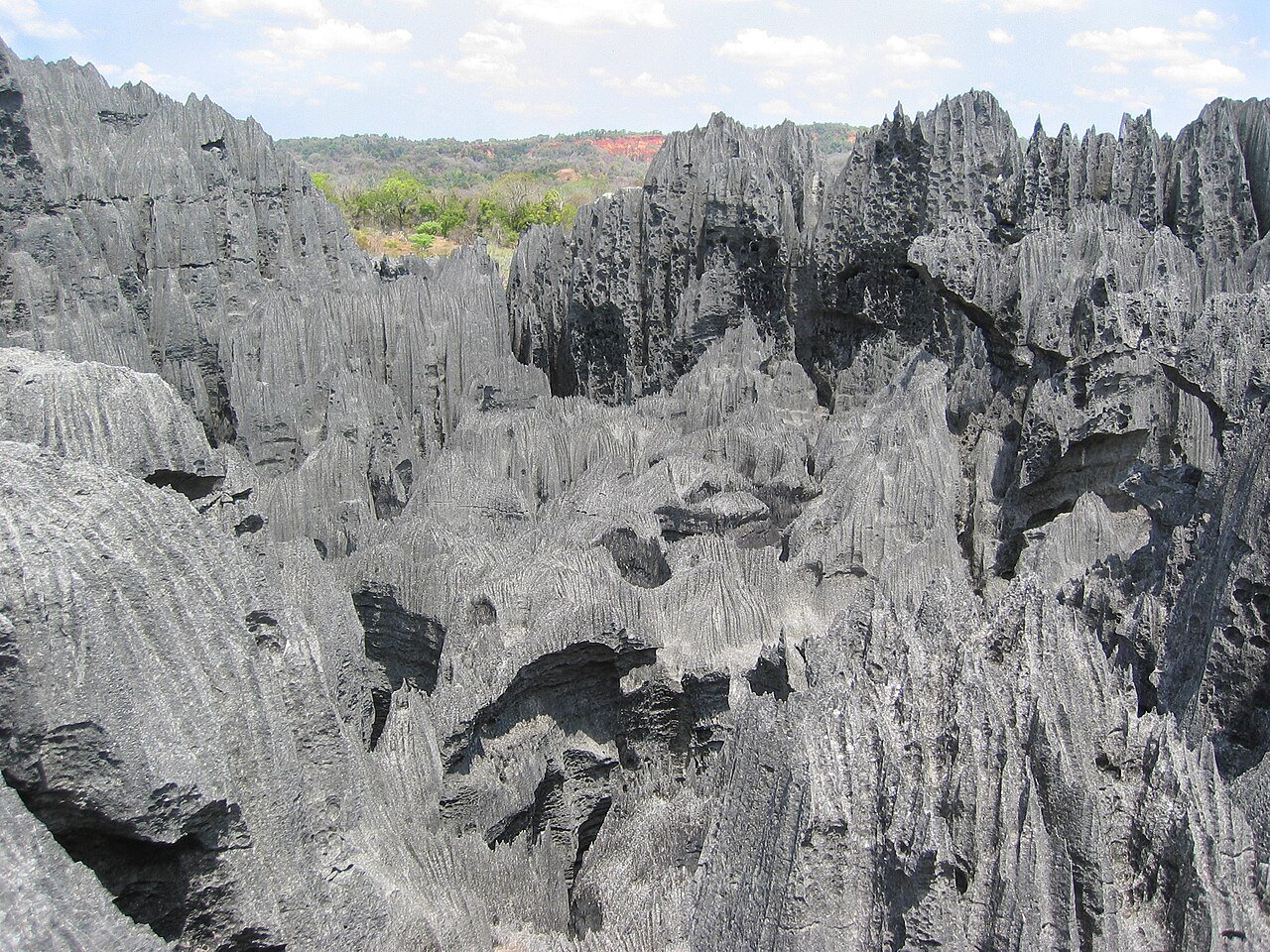
Madagascar’s World Heritage history begins in 1990, when the Tsingy de Bemaraha Strict Nature Reserve became the country’s inaugural inscription at the 14th session of the World Heritage Committee in Banff, Canada. The site was recognised immediately for its dramatic karst limestone formations — the tsingy, a Malagasy word approximating “where one cannot walk barefoot” — and for the near-intact dry deciduous forests surrounding them. It stood alone on the list for over a decade before a second inscription followed.
- Tsingy de Bemaraha Strict Nature Reserve (1990, Natural) — first inscription; western Madagascar limestone karst
- Royal Hill of Ambohimanga (2001, Cultural) — first and only cultural inscription
- Rainforests of the Atsinanana (2007, Natural) — six national parks along the eastern escarpment
- Andrefana Dry Forests (2023, Natural) — expanded extension of the 1990 Tsingy site, comprising six conservation areas across western Madagascar
The most visited — and the alternatives
The Tsingy de Bemaraha formation is the site most likely to appear in travel coverage of Madagascar. Its razor-edged limestone needles rise up to 120 metres in the Melaky region of western Madagascar and shelter species found nowhere else, including several lemur populations and endemic reptiles. The 2023 expansion into the broader Andrefana Dry Forests designation added five further conservation areas to the same property, recognising that the ecological integrity of the karst landscape cannot be separated from the surrounding forest system.
Less prominent in international coverage is the Royal Hill of Ambohimanga, roughly 24 kilometres north of Antananarivo. Inscribed in 2001 as Madagascar’s sole cultural World Heritage Site, Ambohimanga is a royal compound and spiritual centre of the Merina kingdom, continuously occupied since the sixteenth century and considered sacred by the Malagasy people. Nineteenth-century palaces survive on the hilltop alongside the defensive gates of the original fortified village. The Rainforests of the Atsinanana, inscribed in 2007 across six national parks on the eastern escarpment, have been on the Danger list since 2010 due to illegal rosewood and ebony extraction that accelerated following the political crisis of 2009 — making them one of the more closely watched inscriptions on the African continent.
Natural and shared sites
All three of Madagascar’s natural inscriptions protect ecosystems that evolved in near-complete isolation. The eastern rainforests of the Atsinanana encompass Masoala, Ranomafana, Andringitra and three further national parks, together sheltering more than 80 percent of Madagascar’s plant species and the majority of its remaining lemur diversity. The Andrefana Dry Forests property, which now incorporates and expands the original Tsingy inscription, covers six conservation units across the Melaky and Menabe regions, protecting habitat types — succulent shrubland, dry forest, wetland — that have no parallel on the African mainland.
Madagascar has no transnational or serial inscriptions shared with other states. All three properties are purely national designations, which means the country bears sole responsibility for their management — a significant institutional burden given the funding gaps that conservation agencies in Madagascar have documented repeatedly. The Danger listing for the Atsinanana rainforests since 2010 is a direct consequence of that gap widening during periods of governmental instability.
How to find them
The three inscribed properties span a large island: Ambohimanga is accessible from the capital Antananarivo in under an hour by road; the Tsingy de Bemaraha and Andrefana Dry Forests require travel to western Madagascar, typically via Morondava; the Atsinanana parks are distributed along the eastern coast, with Masoala and Ranomafana the two most frequently visited entry points. Road conditions across much of Madagascar make internal distances longer in practice than on a map, and access to several of the Atsinanana parks requires coordination with park authorities given their endangered status.
Madagascar’s World Heritage sites sit alongside thousands of other places on CHO’s interactive map, with GPS and sourced editorial history for each. See also our guides to Italy’s and France’s UNESCO sites, and our piece on cultural travel beyond mass tourism.
Frequently Asked Questions
How many UNESCO World Heritage Sites does Madagascar have?
Madagascar has three UNESCO World Heritage Sites as of 2025: Tsingy de Bemaraha (now part of the Andrefana Dry Forests property), the Royal Hill of Ambohimanga, and the Rainforests of the Atsinanana. Two are natural inscriptions and one is cultural.
What was Madagascar’s first UNESCO World Heritage Site?
The Tsingy de Bemaraha Strict Nature Reserve was Madagascar’s first inscription, recognised by UNESCO in 1990 at the World Heritage Committee session held in Banff, Canada. It was later incorporated into the expanded Andrefana Dry Forests designation in 2023.
Why are the Rainforests of the Atsinanana on the UNESCO Danger list?
The Rainforests of the Atsinanana were added to the List of World Heritage in Danger in 2010, following a surge in illegal logging of rosewood and ebony that began after Madagascar’s political crisis in 2009. The site remains endangered, with conservation bodies monitoring the situation closely.
What is the most recent UNESCO World Heritage inscription in Madagascar?
The Andrefana Dry Forests were inscribed in 2023, representing a significant extension of the original 1990 Tsingy de Bemaraha property. The expanded designation covers six conservation areas across western Madagascar, protecting dry forests, wetlands, and succulent shrubland alongside the original karst landscape.
Sources used in this article
- UNESCO — State Party Madagascar — World Heritage list.
- UNESCO — Madagascar: World Heritage Sites.
- CHO magazine — What is a World Heritage Site?
- CHO — Interactive map of heritage sites.
Sources
- S1 — Goodman, Steven M., and Jonathan P. Benstead, eds. The Natural History of Madagascar. University of Chicago Press, 2003. ISBN 978-0-226-30306-2.
- S2 — Brown, Mervyn. A History of Madagascar. Markus Wiener Publishers, 2000. ISBN 978-1-55876-292-3.
Spotted an error? Write to editorial@culturalheritageonline.com and we correct it the same day.