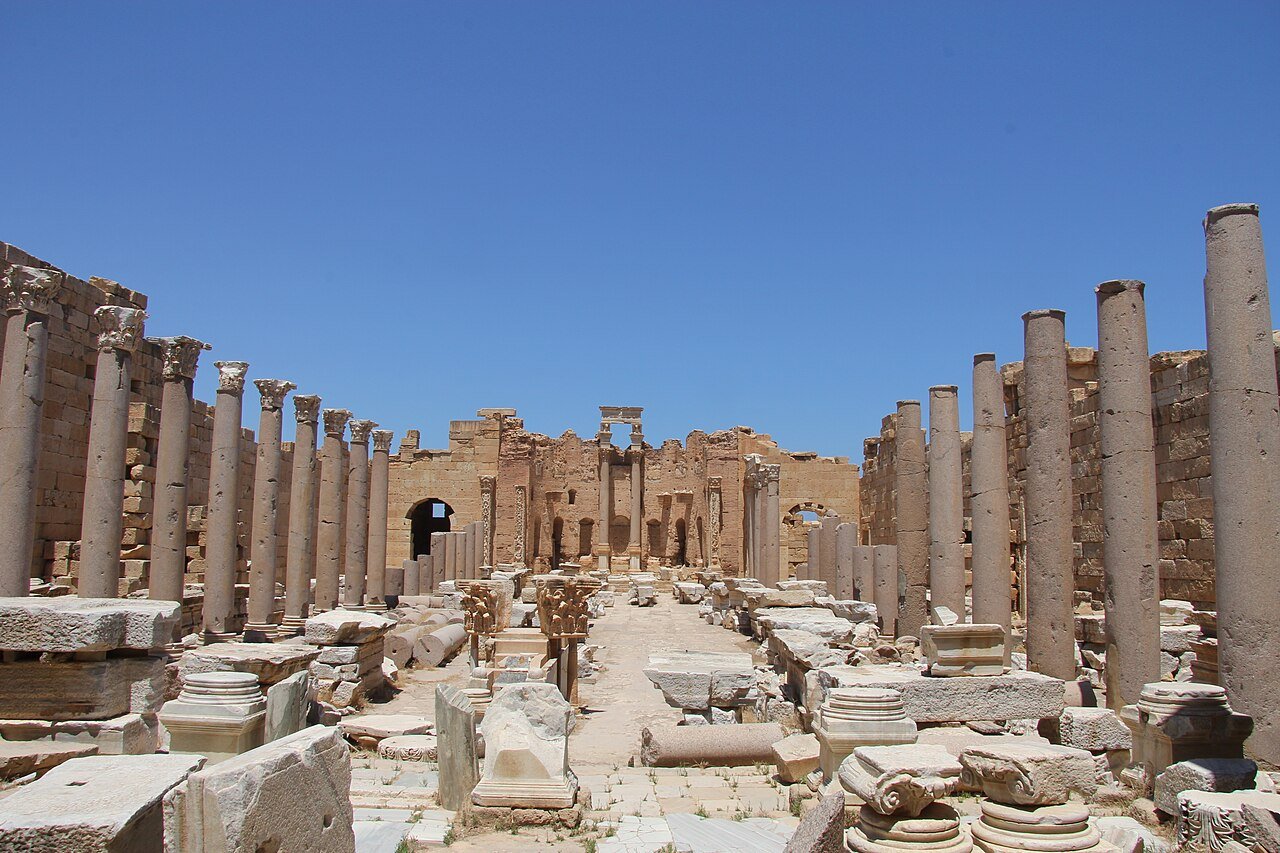
Libya has five UNESCO World Heritage Sites, all of them cultural designations, spanning Roman cities of extraordinary scale, a prehistoric rock-art landscape, and a Saharan trading town whose urban fabric has survived largely intact for centuries. Taken together, they trace North Africa’s role as a crossroads of Mediterranean civilisation, trans-Saharan commerce, and deep human prehistory — all concentrated along a narrow coastal strip and deep into the desert interior. From Cultural Heritage Online.
Why Libya’s list looks the way it does
Every one of Libya’s five inscribed sites carries a cultural designation: there are no natural or mixed entries on the country’s UNESCO list. This reflects the evaluation priorities of the early inscription period — three of the five sites entered the list in 1982, at the very beginning of the World Heritage Convention’s active phase — as well as Libya’s particular geography, which concentrates its outstanding universal value in archaeology and living urban heritage rather than in protected wilderness.
The absence of more recent inscriptions is also notable. Libya’s last addition dates to 1986, meaning the list has remained unchanged for nearly four decades. The country does maintain tentative-list entries, including the rock shelter of Haua Fteah and the desert settlement of Ghirza, but political disruption since 2011 has significantly slowed any nomination process. The five existing sites represent a durable if incomplete account of what this territory holds.
The first inscriptions
In 1982, Libya placed three sites on the World Heritage List simultaneously — a rare concentration of inaugural nominations that signalled both the richness of its Roman-era archaeology and the state’s intention to anchor its heritage identity in the classical period. All three are coastal urban sites of exceptional scale.
- Archaeological Site of Leptis Magna (1982) — one of the best-preserved Roman cities in the world, expanded massively under the emperor Septimius Severus, who was born there.
- Archaeological Site of Sabratha (1982) — a Phoenician trading post that became a Roman city, featuring a celebrated theatre whose reconstruction reveals a three-storey scaenae frons.
- Archaeological Site of Cyrene (1982) — a Greek colony founded in the seventh century BCE, later absorbed into Roman administration, with extensive sanctuaries, necropolises, and a large agora.
The most visited — and the alternatives
Leptis Magna draws the most scholarly and tourist attention, and for clear reasons: its forum, basilica, harbour, and amphitheatre survive to an unusual degree, and the Severan building programme gave the city a monumental ambition that few Roman provincial centres can match. Sabratha’s theatre is the other site most likely to appear in any overview of North African antiquity, its stage wall reconstructed to show the rhythm of columns and niches that framed performances two thousand years ago.
Cyrene, the least-visited of the three Roman sites partly because of its eastern location, rewards careful attention: it was the capital of the ancient region of Cyrenaica and home to a sanctuary of Apollo that was significant across the Greek world. The Rock-Art Sites of Tadrart Acacus, inscribed in 1985, push the timeline back dramatically — engravings and paintings there document human presence and environmental change from roughly 12,000 BCE to around 100 CE, recording animals now absent from the Sahara and shifting patterns of settlement across millennia. The Old Town of Ghadamès, the fifth and final inscribed site, is a pre-Saharan trading city whose labyrinthine covered streets and distinctive white earthen architecture represent a coherent urban response to extreme desert conditions.
Natural and shared sites
Libya currently holds no natural or mixed World Heritage designations. The country’s Saharan interior contains landscapes of considerable ecological and geological significance — the Tadrart Acacus massif alone spans terrain of dramatic visual and scientific interest — but these have not been brought forward under the natural criteria of the World Heritage Convention. Libya is also not party to any transnational or serial inscription on the current list.
The tentative entries for Haua Fteah Cave and the Ghirza settlement suggest that future nominations could extend the list in new directions. Haua Fteah holds a sediment record spanning more than 150,000 years, making it one of the longest continuous archaeological sequences in North Africa. Ghirza, a fortified settlement on the edge of the ancient Limes Tripolitanus, demonstrates how Roman frontier architecture was adapted and reinterpreted by local populations over generations.
How to find them
All five inscribed sites are accessible in principle, though travel conditions in Libya require careful planning and up-to-date security assessment. Leptis Magna and Sabratha lie west of Tripoli, within a few hours by road. Cyrene is in the far northeast, near the city of Shahhat. The Tadrart Acacus sites are deep in the southwestern desert, reached from Ghat, and require a guide and desert-capable transport. Ghadamès sits near the Algerian and Tunisian borders and serves as a useful base for exploring the southwestern region.
Libya’s World Heritage sites sit alongside thousands of other places on CHO’s interactive map, with GPS and sourced editorial history for each. See also our guides to Italy’s and France’s UNESCO sites, and our piece on cultural travel beyond mass tourism.
Frequently Asked Questions
How many UNESCO World Heritage Sites does Libya have?
Libya has five UNESCO World Heritage Sites, all of them cultural designations. Three were inscribed in 1982, one in 1985, and the fifth and most recent in 1986. The list has not changed since.
What was Libya’s first UNESCO World Heritage Site?
Libya’s first inscriptions came in 1982, when three sites entered the list together: the Archaeological Sites of Leptis Magna, Sabratha, and Cyrene. All three are Roman-era urban sites along the North African coast.
What is the oldest human occupation documented at a Libyan World Heritage Site?
The Rock-Art Sites of Tadrart Acacus, inscribed in 1985, contain paintings and engravings dating back to around 12,000 BCE. They record changes in climate, fauna, and human lifestyle across more than twelve thousand years in what is now the Libyan Sahara.
Does Libya have any natural UNESCO World Heritage Sites?
No. All five of Libya’s World Heritage Sites carry a cultural designation. The country holds no natural or mixed inscriptions, and is not part of any transnational or serial World Heritage property on the current list.
Sources used in this article
- UNESCO — State Party Libya — World Heritage list.
- UNESCO — Libya: World Heritage Sites.
- CHO magazine — What is a World Heritage Site?
- CHO — Interactive map of heritage sites.
Sources
- S1 — Mattingly, David J. Tripolitania. University of Michigan Press, 1994. ISBN 978-0-472-10658-5.
- S2 — Wright, John. Libya: A Modern History. C. Hurst & Co., 1982. ISBN 978-0-905838-42-7.
Spotted an error? Write to editorial@culturalheritageonline.com and we correct it the same day.