Côte d’Ivoire has 5 UNESCO World Heritage Sites, ranging from some of West Africa’s last intact primary rainforests to a French colonial capital shaped by the tensions between European ambition and tropical reality, and a group of earthen mosques that encode centuries of trans-Saharan culture in mud-brick and timber. The list is compact, but each entry carries a weight that rewards careful attention. From Cultural Heritage Online.
Why Côte d’Ivoire’s list looks the way it does
Five sites across four decades of inscription tells a story about priorities as much as about places. Côte d’Ivoire’s engagement with the World Heritage Convention began in 1982, the year the country ratified the treaty, with two natural nominations submitted simultaneously. That early emphasis on ecology was not unusual for West African states in the 1980s, when biodiversity was the dominant lens through which international conservation bodies viewed the region. The cultural side of the list grew more slowly: Grand-Bassam came only in 2012, and the eight Sudano-Sahelian mosques in the north were added in 2021.
The breakdown today stands at three natural sites and two cultural sites, with no mixed inscriptions. One of the natural sites, Mount Nimba Strict Nature Reserve, is shared with Guinea — and potentially Liberia — making it one of the few genuinely transnational ecological designations in the region. The rest are solely Ivoirian, though Taï National Park sits within a broader landscape of West African forest that conservation organisations monitor as a connected system.
The first inscriptions
The year 1982 brought Côte d’Ivoire’s first two World Heritage inscriptions in a single cycle:
- Mount Nimba Strict Nature Reserve (1982) — a transnational massif rising to 1,752 metres, shared with Guinea, and home to the Nimba otter shrew and populations of chimpanzees observed using stone tools.
- Taï National Park (1982) — the largest surviving block of primary tropical rainforest in West Africa, sheltering over 150 endemic plant species and a chimpanzee population whose tool-use behaviour has been the subject of decades of primate research.
Both sites entered the list under natural criteria for their outstanding ecological value and biodiversity. The speed of these twin inscriptions reflected an international moment when West African forest cover was already understood to be declining rapidly, and the Convention was being used as a protective instrument in near-real time.
The most visited — and the alternatives
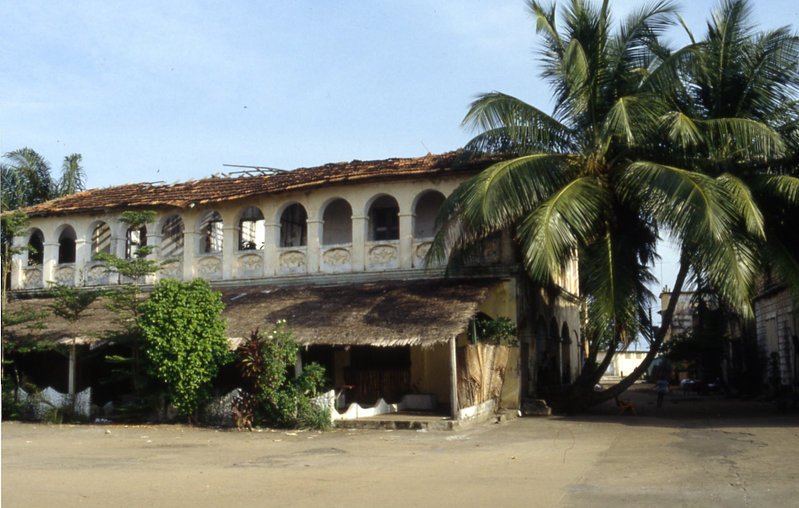
Grand-Bassam, inscribed in 2012, draws the most consistent international attention. The historic town sits east of Abidjan on a narrow peninsula, and its surviving colonial-era streetscapes document the 1880s experiment of building a French administrative capital in a place the climate ultimately made untenable. Yellow-fever epidemics drove the colonial government inland to Bingerville by 1900, leaving the Quarter France and the Quarter Résidentiel in a state of arrested development that is now their chief historic value.
Less discussed but equally specific in character are the other sites on the list. Comoé National Park, inscribed in 1983, is one of the largest protected areas in West Africa, extending along the Komoé River and supporting African wild dogs, chimpanzees, and approximately 500 recorded bird species — a range that reflects the park’s unusual position at the meeting point of savanna and transitional forest zones. The eight mosques inscribed in 2021 as “Sudanese style mosques in northern Côte d’Ivoire” were built mainly between the seventeenth and nineteenth centuries; their Sudano-Sahelian construction technique, using banco (earthen mortar) over wooden armatures, requires continuous community maintenance and represents a living tradition rather than a frozen monument.
Natural and shared sites
Three of Côte d’Ivoire’s five sites are natural inscriptions. Taï National Park and Comoé National Park both appear on the List of World Heritage in Danger — Comoé was placed on that list in 2003 due to poaching pressure and political instability, and was removed in 2017 after conservation measures were strengthened. Taï has faced sustained pressure from agricultural encroachment along its borders. Mount Nimba Strict Nature Reserve remains on the Danger List, partly because iron-ore extraction concessions within the Guinean portion of the massif have never been fully resolved.
The transnational dimension of Mount Nimba is worth noting for travellers: the site straddles the border between Côte d’Ivoire and Guinea, and access logistics differ significantly on each side. Liberia has also been involved in discussions about extending the inscription to include its portion of the Nimba range, though as of 2024 no formal extension had been completed. For natural heritage on a single-country basis, Taï National Park offers the most coherent and accessible entry point, with established research stations that have operated continuously since the 1970s.
How to find them
The five sites are spread across very different geographic and climatic zones: the coastal colonial town, the dense southwestern forests, the eastern savanna parkland, and the northern Sahel-influenced mosque towns. No single itinerary connects them efficiently, and for most visitors one or two sites anchor a trip rather than all five. Grand-Bassam is reached in under two hours from Abidjan by road. Taï requires a flight or long drive to the southwest. The northern mosques — in towns including Kong, Tengréla, and Sorobango — are best approached from Korhogo.
Côte d’Ivoire’s World Heritage sites sit alongside thousands of other places on CHO’s interactive map, with GPS and sourced editorial history for each. See also our guides to Italy’s and France’s UNESCO sites, and our piece on cultural travel beyond mass tourism.
Frequently Asked Questions
How many UNESCO World Heritage Sites does Côte d’Ivoire have?
Côte d’Ivoire has 5 UNESCO World Heritage Sites: three natural and two cultural. The list spans tropical rainforest reserves, a savanna national park, a French colonial town, and a group of Sudano-Sahelian earthen mosques in the country’s north.
What was Côte d’Ivoire’s first UNESCO World Heritage Site?
Côte d’Ivoire received its first two inscriptions simultaneously in 1982: Mount Nimba Strict Nature Reserve and Taï National Park. Both were recognised under natural criteria, reflecting the country’s early commitment to protecting its remaining forest and mountain ecosystems.
Which of Côte d’Ivoire’s World Heritage Sites are on the Danger List?
As of 2024, Mount Nimba Strict Nature Reserve remains on the UNESCO List of World Heritage in Danger, primarily due to unresolved mining concession pressures on the Guinean side of the transnational site. Comoé National Park was on the Danger List from 2003 to 2017 and was removed after conservation conditions improved.
What are the Sudanese style mosques inscribed in 2021?
The site inscribed in 2021 comprises eight mosques in northern Côte d’Ivoire built mainly between the seventeenth and nineteenth centuries in the Sudano-Sahelian architectural tradition. Constructed from banco — an earthen mortar applied over wooden armatures — they represent a living building practice maintained by local communities, not a static monument.
Sources used in this article
- UNESCO — State Party Côte d’Ivoire — World Heritage list.
- UNESCO — Côte d’Ivoire: World Heritage Sites.
- CHO magazine — What is a World Heritage Site?
- CHO — Interactive map of heritage sites.
Sources
- S1 — Mundt, Robert J. Historical Dictionary of Cote d'Ivoire (The Ivory Coast). Scarecrow Press, 1995. ISBN 978-0-8108-3015-8.
- S2 — Poorter, Lourens, et al., eds. Biodiversity of West African Forests: An Ecological Atlas of Woody Plant Species. CABI Publishing, 2004. ISBN 978-0-85199-734-6.
Spotted an error? Write to editorial@culturalheritageonline.com and we correct it the same day.