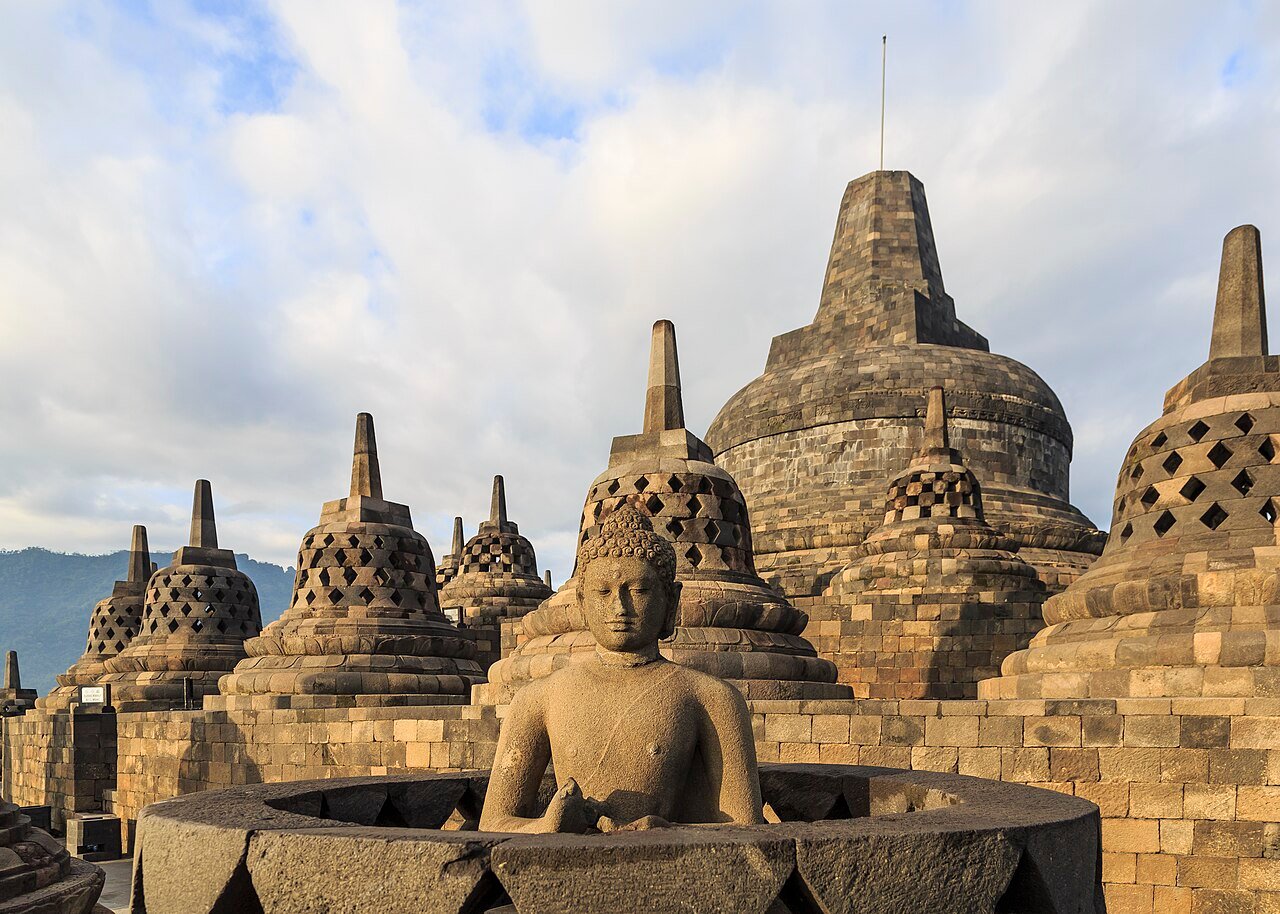
Indonesia has ten UNESCO World Heritage Sites, spanning ninth-century Buddhist stupas and Hindu temple complexes on Java, colonial coal-mining infrastructure in Sumatra, ancient hominid excavation grounds, living rice-terrace landscapes governed by century-old irrigation philosophy, and some of the most biodiverse rainforest and marine habitat on earth. From Cultural Heritage Online.
Why Indonesia’s list looks the way it does
Indonesia’s ten inscriptions reflect the layered complexity of an archipelago stretching across more than 17,000 islands. The list divides into six cultural and four natural sites — a ratio that captures both the depth of Java’s civilisational legacy and the extraordinary ecological wealth concentrated across Sumatra, Kalimantan, and the Lesser Sunda Islands. No other Southeast Asian country on the World Heritage list combines such contrasting inscription types: a medieval royal cosmology overlapping a living city, and a rainforest holding the last viable wild populations of three great ape species.
The uneven geographic spread is deliberate rather than accidental. Java’s dense archaeological record made it an early focus for international heritage bodies, while the natural sites tend to cluster in the outer islands where terrestrial and marine biodiversity remains exceptional. That concentration of both cultural and natural value in one national list is unusual and worth understanding before planning any itinerary.
The first inscriptions
Indonesia entered the World Heritage list in 1991 with four inscriptions at once, an unusually strong debut that immediately established the country as a major heritage nation. Those four sites were:
- Borobudur Temple Compounds
- Prambanan Temple Compounds
- Ujung Kulon National Park
- Komodo National Park
The simultaneous inscription of two of Java’s greatest religious monuments alongside two nationally significant protected areas set a pattern for the list as a whole: cultural and natural heritage advancing together. Borobudur and Prambanan remain the most internationally recognised entries, but the 1991 cohort is best understood as a single statement about the breadth of what Indonesia was bringing to the Convention.
The most visited — and the alternatives
Borobudur draws hundreds of thousands of visitors annually and Prambanan’s silhouette is one of the defining images of Southeast Asian architecture. Komodo National Park is similarly well-trafficked, largely because of its Komodo dragons. These three sites absorb most of the international heritage tourism that reaches Indonesia, which makes the remaining seven inscriptions comparatively quiet even when they are equally significant.
Three sites in particular reward the effort to reach them. The Sangiran Early Man Site in Central Java, inscribed in 1996, has yielded roughly half of all known early hominid fossils discovered worldwide — a scientific concentration that has made it one of the most important palaeontological sites on earth. The Cultural Landscape of Bali (2012) encompasses traditional rice terraces whose subak cooperative irrigation system is grounded in the Tri Hita Karana philosophy, a Balinese concept of harmony that dates to at least the ninth century. The Ombilin Coal Mining Heritage of Sawahlunto (2019) documents a complete colonial industrial system built by Dutch authorities in the late nineteenth and early twentieth centuries: mine, railway, coal storage, and workers’ settlements still largely intact in West Sumatra.
Natural and shared sites
Indonesia’s four natural World Heritage Sites cover very different ecosystems. Ujung Kulon, on the westernmost tip of Java, protects the last significant lowland rainforest on the island and the critically endangered Javan rhinoceros. Komodo National Park in East Nusa Tenggara is as much a marine site as a terrestrial one, with coral reefs and manta ray feeding grounds of global importance surrounding the islands where the dragons live. Lorentz National Park in Papua is one of the largest protected areas in the Asia-Pacific, encompassing a gradient from snowfields to tropical coastline. The Tropical Rainforest Heritage of Sumatra groups three non-contiguous national parks — Gunung Leuser, Kerinci Seblat, and Bukit Barisan Selatan — as a serial inscription, together forming one of the last refuges for Sumatran orangutans, tigers, rhinoceroses, and elephants.
Indonesia does not currently share any inscribed transnational World Heritage Site with a neighbouring country, though Betung Kerihun National Park in Kalimantan has featured in discussions around a potential cross-border nomination with Malaysia. The Tropical Rainforest Heritage of Sumatra, as a serial inscription across three separate park units, is itself a form of extended nomination designed to capture habitat connectivity that no single park could represent alone.
How to find them
Indonesia’s World Heritage sites sit alongside thousands of other places on CHO’s interactive map, with GPS and sourced editorial history for each. See also our guides to Italy’s and France’s UNESCO sites, and our piece on cultural travel beyond mass tourism.
Frequently Asked Questions
How many UNESCO World Heritage Sites does Indonesia have?
As of 2023, Indonesia has ten UNESCO World Heritage Sites. The list comprises six cultural sites and four natural sites, spread across the islands of Java, Sumatra, Bali, Komodo, and Papua.
What was Indonesia’s first UNESCO World Heritage Site?
Indonesia received four inscriptions simultaneously in 1991: Borobudur Temple Compounds, Prambanan Temple Compounds, Ujung Kulon National Park, and Komodo National Park. No single site preceded the others; all four were inscribed in the same year and session.
What is Indonesia’s most recently inscribed World Heritage Site?
The Cosmological Axis of Yogyakarta and its Historic Landmarks was inscribed in 2023, making it the most recent addition to Indonesia’s World Heritage list. The site encompasses the philosophical and spatial framework underlying the layout of the Sultanate of Yogyakarta’s historic urban core.
Which of Indonesia’s World Heritage Sites is most significant for science?
The Sangiran Early Man Site in Central Java, inscribed in 1996, has produced approximately half of all known early hominid fossils discovered worldwide. It is considered one of the most important sites in the study of human evolution and continues to be a major focus of palaeontological research.
Sources used in this article
- UNESCO — State Party Indonesia — World Heritage list.
- UNESCO — Indonesia: World Heritage Sites.
- CHO magazine — What is a World Heritage Site?
- CHO — Interactive map of heritage sites.
Sources
- S1 — Ricklefs, M. C. A History of Modern Indonesia Since c. 1200. Stanford University Press, 2001. ISBN 978-0-8047-4480-5.
- S2 — Miksic, John N. Borobudur: Golden Tales of the Buddhas. Periplus Editions, 1990. ISBN 978-0-945971-90-0.
Spotted an error? Write to editorial@culturalheritageonline.com and we correct it the same day.