

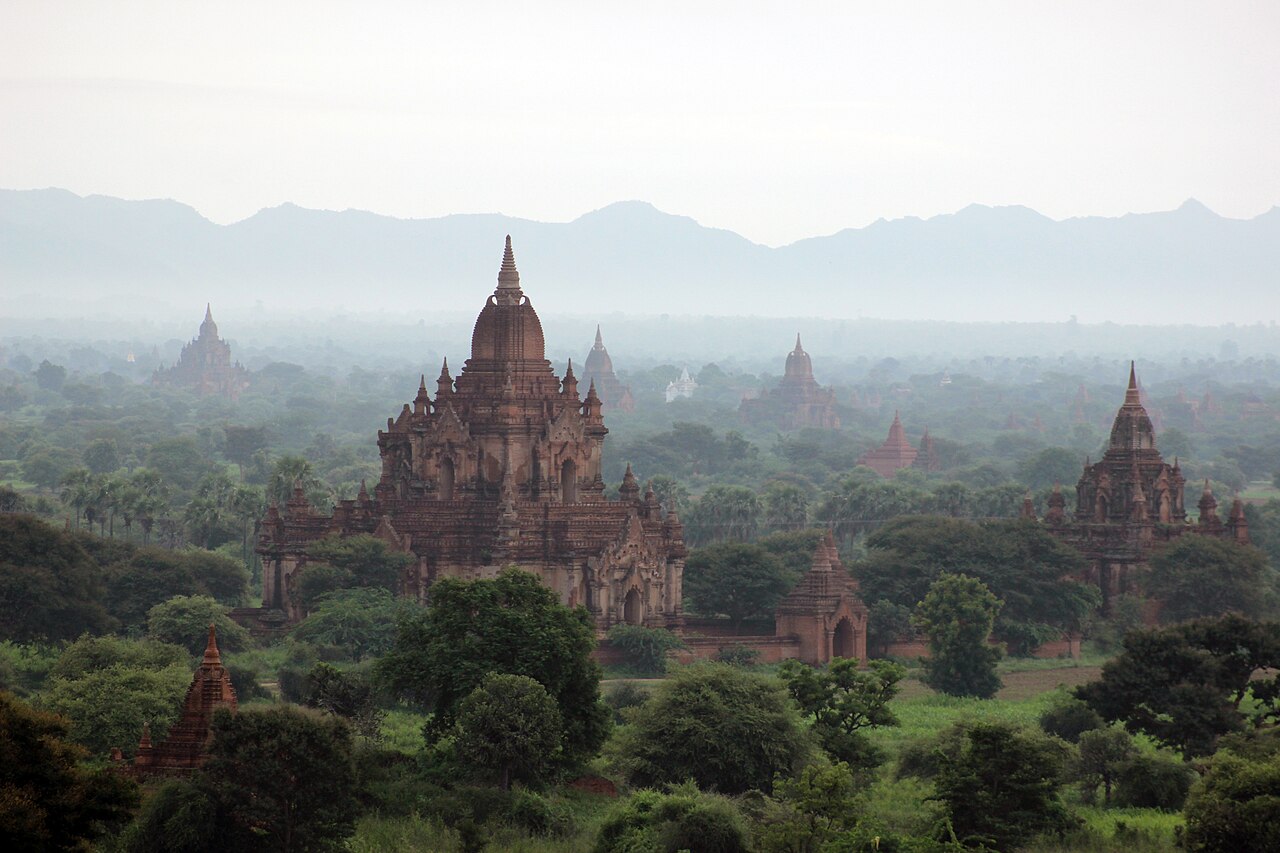
Mandalay sits within reach of Myanmar’s two UNESCO World Heritage Sites: Bagan, one of the greatest concentrations of Buddhist monuments on earth, and the Pyu Ancient Cities, three walled urban centres that predate the Bamar kingdom by a thousand years. Both reward the detour — and together they form one of Southeast Asia’s most substantial heritage itineraries. From Cultural Heritage Online.
Pyu Ancient Cities — Halin 115 km northwest · 2 hr by road
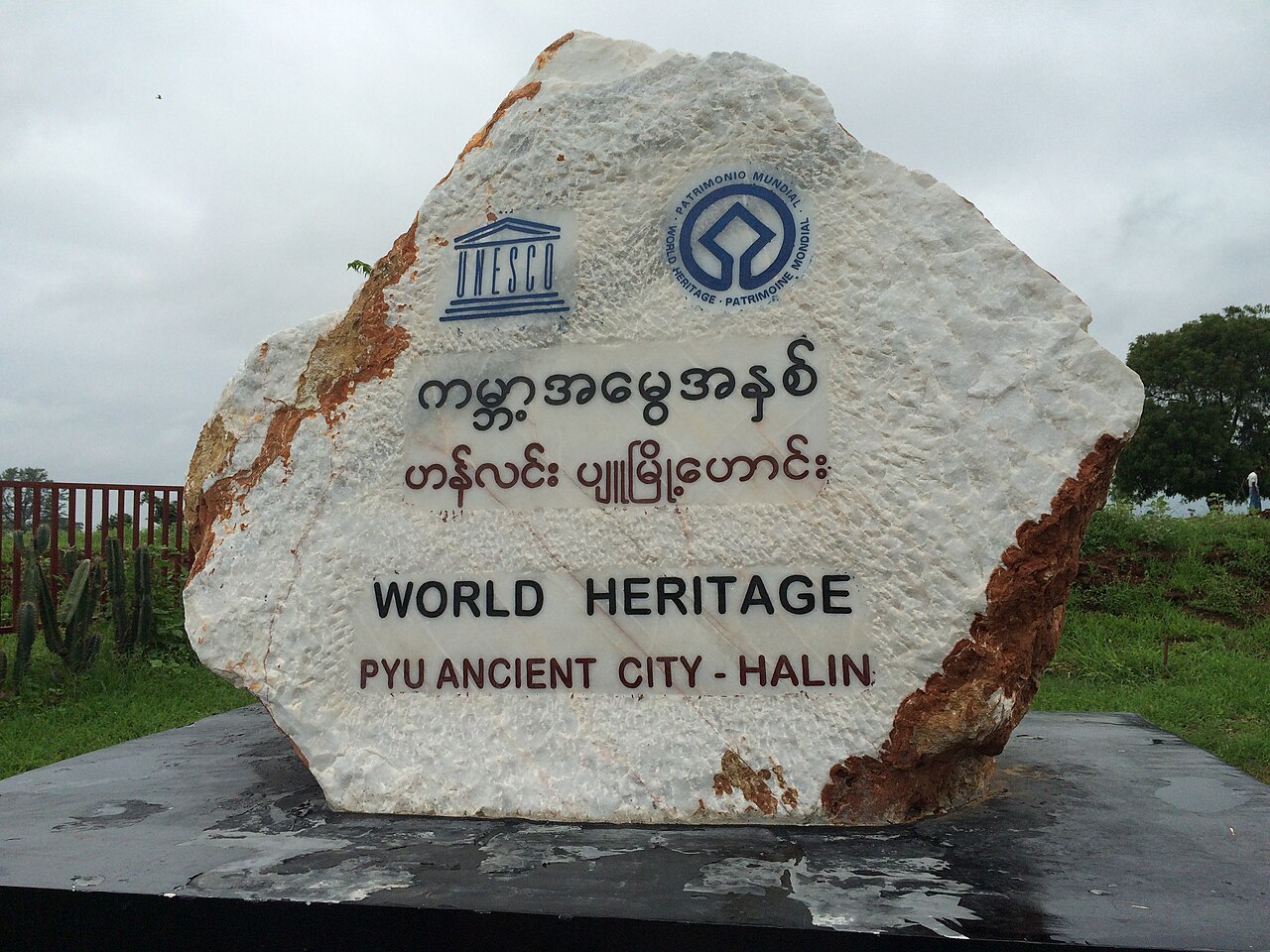
The Pyu Ancient Cities (inscribed 2014) comprise three walled settlements — Halin, Beikthano, and Sri Ksetra — built by the Pyu civilisation between roughly 200 BC and 900 AD. Of the three, Halin is the closest to Mandalay: about 115 km to the northwest, near Shwebo, and reachable in two hours on a reasonable road. The other two sites are further south: Beikthano sits around 250 km away near Magwe, and Sri Ksetra (the largest) is 430 km southwest near Pyay, accessible by domestic flight or a full day by road.
The Pyu built with kiln-fired brick at a time when much of mainland Southeast Asia relied on perishable materials. Their cities were planned around ceremonial axes, enclosed by massive walls and moats, and oriented according to a Theravada Buddhist cosmology. Halin’s excavations have yielded palace platforms, stupas, and evidence of a sophisticated drainage system. Active digs continue, and the site retains the quiet, slightly provisional character of ongoing archaeology — unrestored monuments, scattered sherds, open trenches.
What the Pyu left behind shaped everything that followed. Their script, their Buddhism, and their urban grammar passed to the Bamar people who succeeded them. Without the Pyu, there is no Bagan.
Getting there: Halin is 2 hr by road from Mandalay via Shwebo; hire a car or join an organised day trip. Beikthano and Sri Ksetra require overnight stays or domestic flights. Allow: Half a day for Halin; 2 days minimum to include Sri Ksetra. Best for: Travellers with a strong interest in pre-Bamar history who want a site almost entirely to themselves.
Bagan 200 km south · 4.5 hr by road · 1 hr by plane · 11 hr by river boat
Bagan (inscribed 2019) covers roughly 50 square kilometres of flat, semi-arid plain along the Irrawaddy River and holds over 3,500 religious structures — temples, pagodas, and monasteries built during the Pagan Empire between the 9th and 13th centuries. The scale is difficult to process at ground level: you turn a corner expecting a field and find a 12th-century corridor temple half-buried in scrub. At sunrise, the spires emerge from river mist in layers.
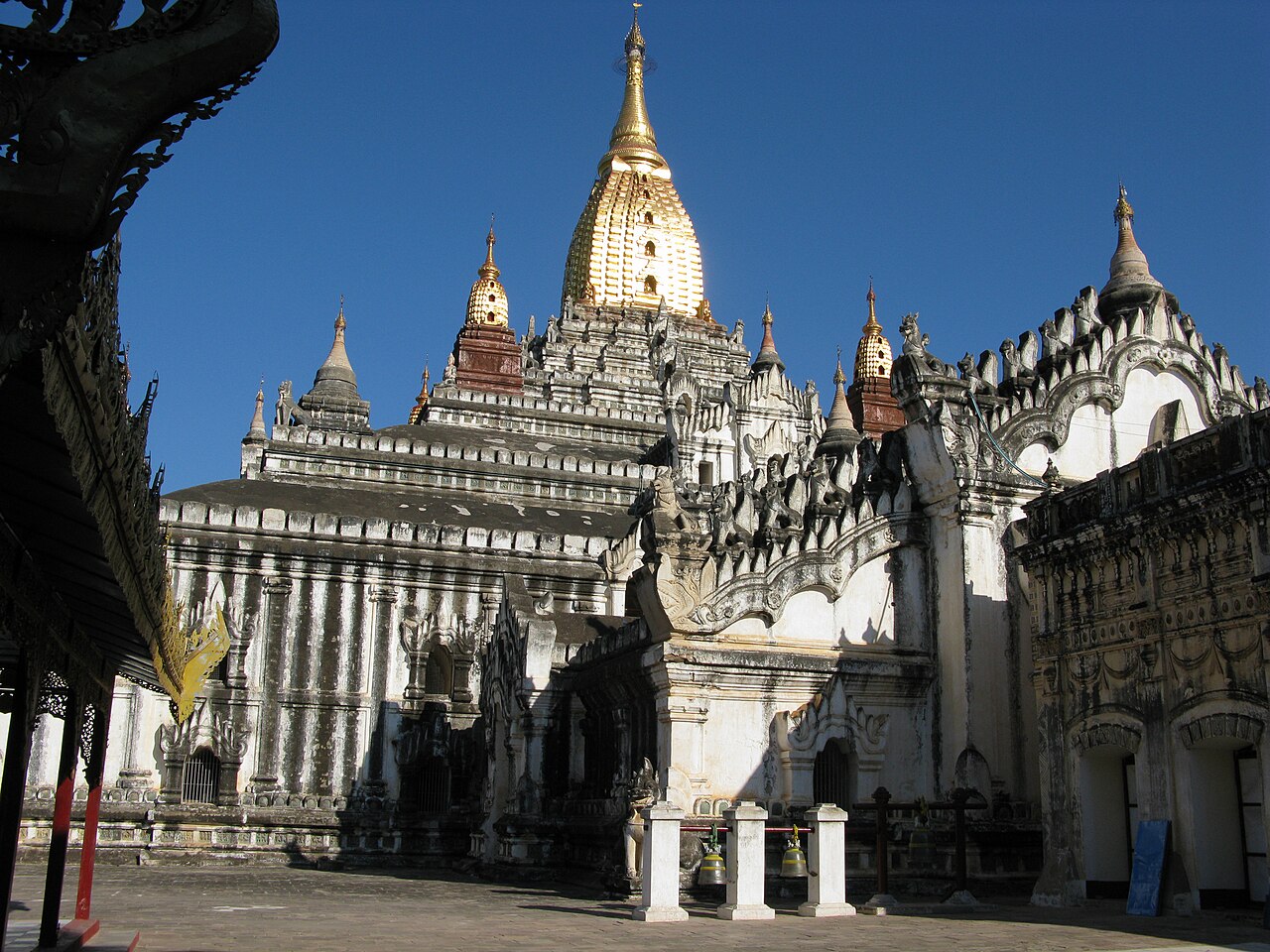
The standout monuments are distinct in character. Ananda Temple (1105 AD) is the best-preserved: a whitewashed, symmetrical structure with four gilded spires and corridors lined by standing Buddhas, their expressions shifting between serenity and severity depending on the angle and the light. Dhammayangyi Temple, built in the 12th century, is the largest — a stepped pyramid of dark laterite whose interior was never finished, reportedly sealed by the king who ordered it after his murder of a rival. Thatbyinnyu Temple reaches 61 metres, the tallest monument on the plain, visible from kilometres away. Shwezigon Pagoda, begun under King Anawrahta in the 11th century, set the template for Burmese stupa design that persists to the present day.
Between October and March, hot air balloons rise at dawn over the plain. It remains one of the more reliable ways to understand the sheer density of the site — from the ground, the monuments hide each other; from the air, the plain reveals itself as an unbroken carpet of brick and gilded finials.
Mandalay is actually closer to Bagan than Yangon is. The fastest option is a 1-hour domestic flight to Nyaung-U airport, from which the temples are a 10-minute drive. The road south via Kyaukpadaung takes around 4.5 hours and crosses pleasant countryside. The classic slow option is the overnight ferry on the Irrawaddy — 11 hours, mostly nocturnal, arriving at dawn — a journey more about the river than the destination, but worth it once.
Getting there: Domestic flight Mandalay–Nyaung-U, 1 hr (Air KBZ, Myanmar Airways); road via Kyaukpadaung, 4.5 hr by private car; overnight Irrawaddy river ferry, 11 hr. Allow: Minimum 2 full days; 3 days to cover major temples at a measured pace. Best for: First-time visitors to Myanmar, photographers, and anyone drawn to large-scale Buddhist archaeology.
Frequently Asked Questions
How many UNESCO World Heritage Sites are near Mandalay?
Myanmar has two UNESCO World Heritage Sites, and both are reachable from Mandalay. Bagan was inscribed in 2019; the Pyu Ancient Cities (comprising Halin, Beikthano, and Sri Ksetra) were inscribed in 2014.
How do you get from Mandalay to Bagan?
The quickest route is a domestic flight from Mandalay to Nyaung-U airport, which takes about one hour. By road via Kyaukpadaung the journey is roughly 4.5 hours; a private car hire is the most practical option. The overnight Irrawaddy river ferry takes around 11 hours and arrives in the early morning — a scenic but slow choice suited to travellers who want to experience the river.
Can you visit Bagan and the Pyu Ancient Cities on the same trip?
Yes, though it requires planning around the geography. Halin — the Pyu site closest to Mandalay — can be visited as a day trip before heading south to Bagan. Sri Ksetra near Pyay is furthest and works best as a separate leg, either with a domestic flight or an overnight stop. Allow at least five to six days from Mandalay to cover both UNESCO sites properly, including Bagan’s main temple circuit.
What is the significance of the Pyu Ancient Cities?
The Pyu civilisation occupied the Irrawaddy valley from roughly 200 BC to 900 AD — centuries before the Bamar people established the Pagan Empire at Bagan. Their cities were among the earliest urban centres in mainland Southeast Asia, built to a sophisticated plan with fired brick, elaborate hydraulic systems, and Theravada Buddhist sanctuaries. The Pyu’s script, religious practices, and urban forms directly shaped the culture that produced Bagan. The UNESCO inscription in 2014 recognised the three walled cities — Halin, Beikthano, and Sri Ksetra — as exceptional examples of early urban development and cultural exchange across South and Southeast Asia.
Sources
- S1 — Stadtner, Donald M. Sacred Sites of Burma: Myth and Folklore in an Evolving Tradition. River Books, 2011. ISBN 978-974-9863-60-2.
- S2 — Strachan, Paul. Pagan: Art & Architecture of Old Burma. Kiscadale Publications, 1989. ISBN 978-1-870838-00-9.
Spotted an error? Write to editorial@culturalheritageonline.com and we correct it the same day.



.jpg)

