Denmark has 12 UNESCO World Heritage Sites, spanning Viking burial mounds and runic stones in the Jutland heartland, baroque hunting forests on Zealand, glacial chalk cliffs rising from the Baltic, and vast Arctic landscapes in Greenland that carry 4,000 years of human presence. From Cultural Heritage Online.
Why Denmark’s list looks the way it does
Denmark’s twelve inscribed properties reflect the country’s geographic breadth as much as its historical depth. Metropolitan Denmark contributes several cultural sites tied to royal power, ecclesiastical heritage, and the Viking age, while Greenland — an autonomous territory within the Kingdom of Denmark — accounts for four inscriptions, three of them natural. That ratio makes Denmark’s list unusual among Northern European nations: four of the twelve sites are classified as natural, a share that few countries of comparable size can match.
The list also reveals a consistent interest in serial and transnational nominations. Denmark has joined Germany and the Netherlands in the Wadden Sea inscription, and Greenlandic sites have been grouped with Arctic and sub-Arctic landscapes that cross political borders. This collaborative approach has allowed properties that would be difficult to justify individually to secure recognition as part of a wider outstanding universal value.
The first inscriptions
Denmark’s World Heritage history begins in 1994, when the UNESCO World Heritage Committee, meeting in Phuket, inscribed the country’s inaugural site. The first inscription was:
- Jelling Mounds, Runic Stones and Church (1994) — the royal complex in central Jutland regarded as the symbolic birthplace of Denmark, containing two large burial mounds, the runic stones of King Gorm and Harald Bluetooth, and a twelfth-century church built over earlier wooden predecessors.
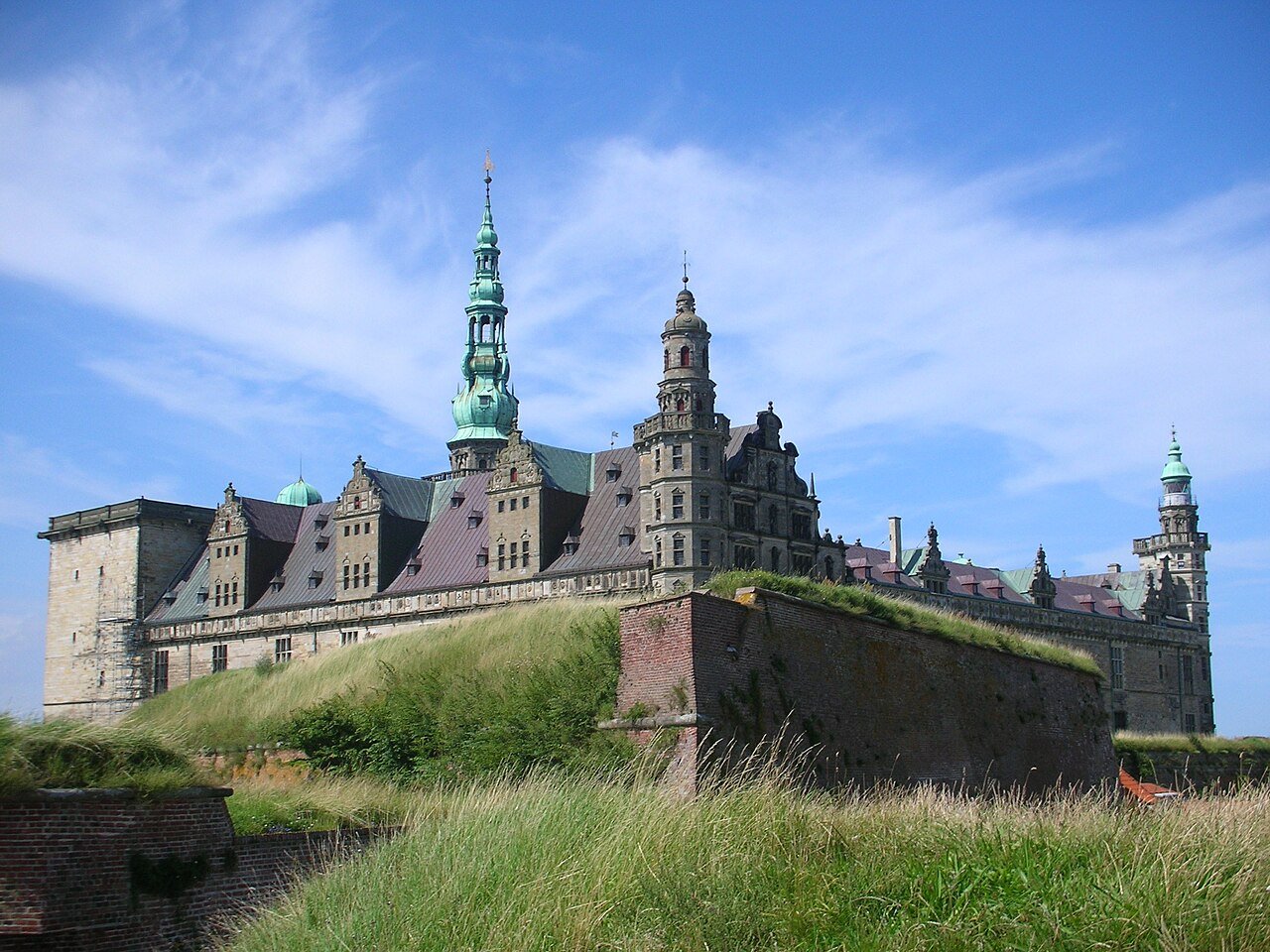
Two more inscriptions followed quickly. Roskilde Cathedral was listed in 1995 as the dynastic burial church of Danish monarchs since the fifteenth century, its architecture tracing the evolution of Gothic brick building across Northern Europe. Kronborg Castle in Helsingør was inscribed in 2000, recognised for its role as one of the most important Renaissance castles in the region and as the inspiration behind Shakespeare’s Elsinore in Hamlet.
The most visited — and the alternatives
Kronborg Castle and Roskilde Cathedral draw the largest visitor numbers among Denmark’s mainland sites. Both are accessible by rail from Copenhagen and sit within well-established tourist circuits. Kronborg in particular occupies a narrow headland at the narrowest point of the Øresund strait, its copper-green spires visible from Sweden, and the site benefits from considerable name recognition even among travellers unfamiliar with its history.
Quieter but equally compelling options reward those who look further. The Par Force Hunting Landscape in North Zealand (inscribed 2015) preserves two royal forests whose hunting allées were laid out in a Baroque star system designed for equestrian hunts; the geometric pattern, still legible from above, had no functional successor in European landscape design. Christiansfeld, a Moravian Church Settlement (2015), is a planned town in southern Jutland whose eighteenth-century grid, yellow-brick architecture, and communal egalitarian layout remain remarkably intact. In Greenland, Kujataa (2017) preserves a farming landscape that Norse settlers established from the tenth century and Inuit communities later shaped, creating one of the few places on Earth where two entirely separate agricultural traditions overlapped in the same terrain.
Natural and shared sites
Denmark’s four natural sites are all associated with Greenland or the North Sea coastline. Ilulissat Icefjord (2004), on Greenland’s west coast, is one of the world’s most productive glaciers outside Antarctica; the volume of ice calving annually from the Sermeq Kujalleq glacier makes the fjord a site of primary scientific importance for understanding glacial dynamics and climate change. Aasivissuit – Nipisat (2018) documents more than 4,200 years of Inuit hunting culture through an unbroken sequence of archaeological remains. Møns Klint, the chalk cliffs on the Danish island of Møn, became the most recent addition to the list when it was inscribed in 2025.
The Wadden Sea, shared with Germany and the Netherlands, covers the world’s largest unbroken system of intertidal sand and mud flats and is critical habitat for millions of migratory birds on the East Atlantic Flyway. Its serial transnational structure, expanded several times since the initial 2009 inscription, reflects an understanding that ecological integrity does not follow national borders. Denmark’s portion covers the tidal flats off the Jutland coast and was integrated into the property when the site was extended in 2014.
How to find them
Denmark’s mainland World Heritage sites are served by an efficient rail network, with Kronborg, Roskilde, and the Jelling monuments each reachable from a major city without a car. The North Zealand hunting landscape and Christiansfeld require shorter regional connections but are well signposted once reached. Greenlandic sites, by contrast, demand dedicated travel — Ilulissat is served by domestic flights from Nuuk — and reward those journeys with landscapes that have no equivalent elsewhere in the kingdom.
Denmark’s World Heritage sites sit alongside thousands of other places on CHO’s interactive map, with GPS and sourced editorial history for each. See also our guides to Italy’s and France’s UNESCO sites, and our piece on cultural travel beyond mass tourism.
Frequently Asked Questions
How many UNESCO World Heritage Sites does Denmark have?
Denmark has 12 UNESCO World Heritage Sites as of 2025. The list includes eight cultural properties and four natural sites, with a significant portion — including all four natural sites — located in Greenland, an autonomous territory within the Kingdom of Denmark.
What was Denmark’s first UNESCO World Heritage Site?
Denmark’s first inscription was Jelling Mounds, Runic Stones and Church, listed in 1994. The complex in central Jutland holds two Viking-age burial mounds, two runic stones raised by King Gorm and his son Harald Bluetooth, and a twelfth-century stone church built over earlier wooden structures on the same sacred ground.
Does Denmark share any UNESCO sites with other countries?
Yes. The Wadden Sea is a transnational natural site shared with Germany and the Netherlands, covering the world’s largest system of intertidal flats along the North Sea coast. Denmark’s portion was incorporated when the property was extended in 2014.
What was the most recently inscribed UNESCO site in Denmark?
Møns Klint, the chalk cliffs on the island of Møn in the Baltic Sea, was inscribed in 2025, making it Denmark’s most recent World Heritage Site. The Viking Age Ring Fortresses were inscribed in 2023, the year before Møns Klint’s designation.
Sources used in this article
- UNESCO — State Party Denmark — World Heritage list.
- UNESCO — Denmark: World Heritage Sites.
- CHO magazine — What is a World Heritage Site?
- CHO — Interactive map of heritage sites.
Sources
- S1 — Roesdahl, Else. The Vikings. Penguin Books, 1998. ISBN 978-0-14-025282-8.
- S2 — Jespersen, Knud J. V. A History of Denmark. Palgrave Macmillan, 2004. ISBN 978-0-333-65908-3.
Spotted an error? Write to editorial@culturalheritageonline.com and we correct it the same day.