Bosnia and Herzegovina has five UNESCO World Heritage Sites — three cultural and two natural — inscribed across two decades of international recognition that reflect the country’s layered Ottoman heritage, its medieval funerary traditions, and landscapes shaped by deep geological time. A country whose size belies its density of significant places, it draws visitors to a reconstructed sixteenth-century bridge in a Herzegovinian valley and, increasingly, to a cave system and primeval forest that tell stories far older than any human settlement. From Cultural Heritage Online.
Why Bosnia and Herzegovina’s list looks the way it does
With five inscribed sites, Bosnia and Herzegovina’s UNESCO portfolio is compact but structurally coherent. The three cultural designations cluster around two distinct periods: the Ottoman centuries, which left monumental bridge architecture across the western Balkans, and the medieval era of the Stećci tombstones, whose geographic spread predates modern national borders. The two natural sites — one a transnational forest ecosystem, the other a karst cave — reflect the country’s position within the Dinaric Alps, one of Europe’s most biologically significant mountain chains.
The list has grown steadily since 2005, with each addition opening a different lens on the country’s heritage. Bosnia and Herzegovina also maintains an active tentative list of nine further sites, suggesting the pace of nominations may accelerate through the late 2020s. The pattern across inscribed and tentative sites points toward a strategy that values both standalone monuments and serial, cross-border designations that distribute significance across the region.
The first inscriptions
Bosnia and Herzegovina received its first UNESCO recognition in 2005, with a site that had been destroyed less than a decade earlier and rebuilt with international support:
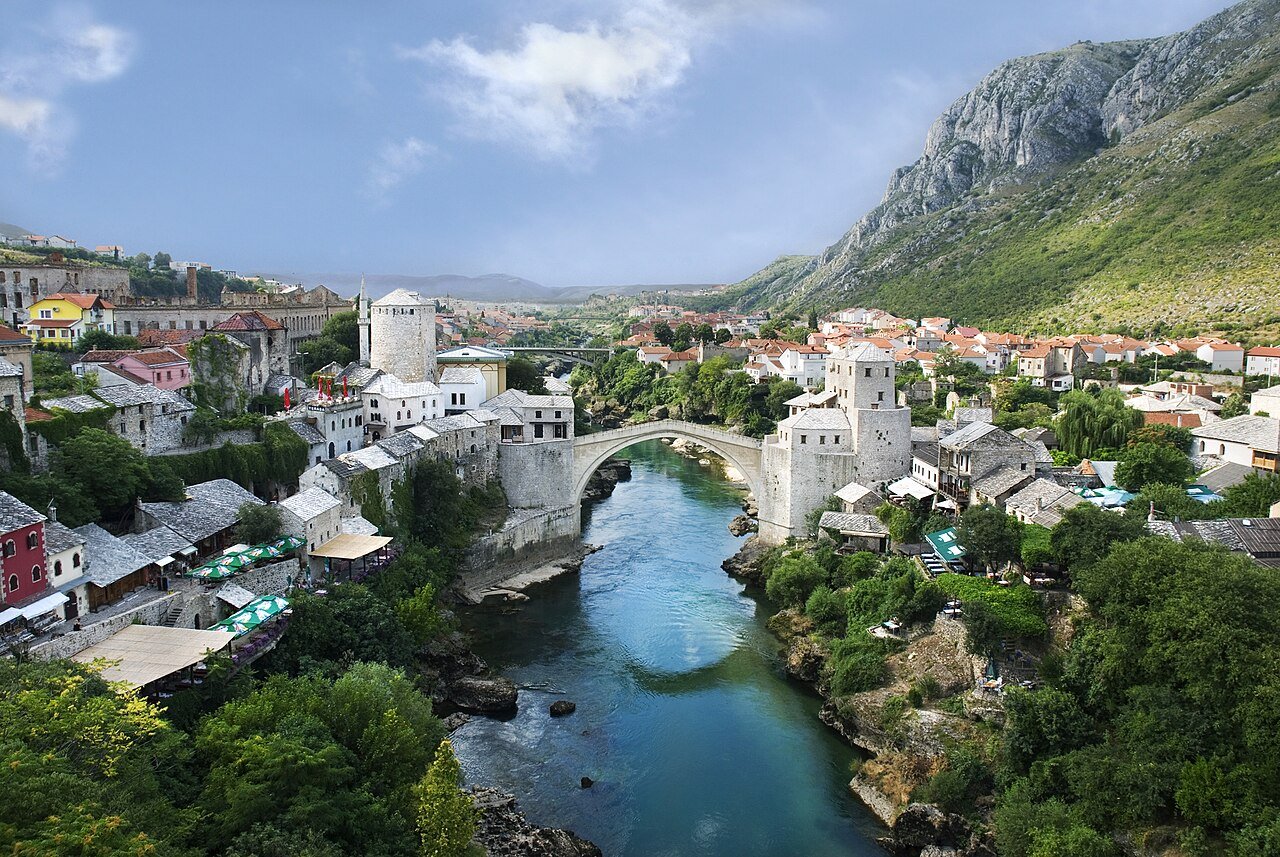
- Old Bridge Area of the Old City of Mostar (2005) — the sixteenth-century Ottoman bridge across the Neretva River, known as Stari Most, was demolished during the 1993 siege and reconstructed by 2004 using salvaged original stone. UNESCO recognised not only the bridge itself but the surrounding historic urban fabric.
- Old Bridge Area of the Old City of Mostar was followed in 2007 by the Mehmed Paša Sokolović Bridge in Višegrad — a single-span Ottoman bridge completed in 1577, attributed to the imperial architect Mimar Sinan, spanning the Drina River in eastern Bosnia.
Both inscriptions are classified as cultural sites under UNESCO criteria, and both reflect the Ottoman administration’s investment in Balkan infrastructure during the sixteenth century. The Višegrad bridge remains in continuous use, carrying road traffic across the same arches that Sinan’s engineers raised nearly four hundred and fifty years ago.
The most visited — and the alternatives
Stari Most in Mostar draws the largest share of international visitors to Bosnia and Herzegovina’s UNESCO sites. Its silhouette over the green Neretva, framed by historic towers and waterside Ottoman-era buildings, has become one of the defining images of the western Balkans. The bridge is a genuinely powerful piece of engineering, and the surrounding old city district — coppersmith workshops, hans, and a sixteenth-century bazaar — gives the inscription its urban coherence.
Visitors who look beyond Mostar encounter a very different register of significance. The Stećci Medieval Tombstones, inscribed in 2016 as a serial transnational site shared with Croatia, Serbia, and Montenegro, consist of monolithic carved stone markers that first appeared in the twelfth century and reached their peak between the fourteenth and fifteenth centuries. Several thousand examples survive across Bosnia and Herzegovina alone, scattered across hillside necropolises with geometric and figural carvings whose iconographic sources are still debated by scholars. Vjetrenica Cave in the Popovo Polje karst field, the country’s largest cave system, offers a third kind of encounter: a subterranean world containing fossils of prehistoric carnivores and one of Europe’s richest cave-dwelling fauna lists, recognised by UNESCO only in 2024.
Natural and shared sites
Bosnia and Herzegovina’s two natural inscriptions are both part of larger international designations. The Janj virgin beech forest in central Bosnia joined the transnational Ancient and Primeval Beech Forests of the Carpathians and Other Regions of Europe in 2021, a serial site now spanning eighteen countries. Janj represents one of the most intact stands of old-growth beech woodland in the Balkans and contributes evidence to the scientific understanding of how European beech expanded northward and westward after the last glaciation.
Vjetrenica, inscribed in 2024 under natural criteria, adds a karst dimension to the list. The cave extends for roughly six kilometres of explored passages beneath the limestone plateau of the Popovo Polje and shelters an exceptional concentration of endemic cave-adapted species. Its inscription completes a picture of Bosnia and Herzegovina’s natural heritage that is genuinely complementary to the cultural sites: the same limestone geology that shaped Ottoman bridging challenges in the river valleys created, underground, one of the continent’s most ecologically significant cave systems.
How to find them
The five inscribed sites span the country’s main geographic zones: the Herzegovina valleys, the Drina corridor, the central Bosnian highlands, and the southern karst. Mostar and Višegrad are accessible by road from Sarajevo, and both towns have accommodation and onward connections. The Stećci tombstones are distributed across multiple rural locations, some of which require a vehicle and local guidance. Janj forest is most practicably approached from Šipovo in central Bosnia; Vjetrenica Cave, near Zavala in Herzegovina, is open to visitors on guided tours.
Bosnia and Herzegovina’s World Heritage sites sit alongside thousands of other places on CHO’s interactive map, with GPS and sourced editorial history for each. See also our guides to Italy’s and France’s UNESCO sites, and our piece on cultural travel beyond mass tourism.
Frequently Asked Questions
How many UNESCO World Heritage Sites does Bosnia and Herzegovina have?
Bosnia and Herzegovina has five UNESCO World Heritage Sites — three cultural and two natural. The list spans from 2005 to 2024, with the most recent addition, Vjetrenica Cave, inscribed in 2024. The country also maintains a tentative list of nine further candidates under active consideration.
What was Bosnia and Herzegovina’s first UNESCO World Heritage Site?
The Old Bridge Area of the Old City of Mostar was Bosnia and Herzegovina’s first UNESCO inscription, recognised in 2005. The sixteenth-century Ottoman bridge had been destroyed in 1993 and rebuilt by 2004 using salvaged original stone; UNESCO’s designation covers both the bridge and the surrounding historic urban district. It remains the country’s most internationally recognised heritage site.
Are any of Bosnia and Herzegovina’s UNESCO sites transnational?
Two of the five inscribed sites are transnational. The Stećci Medieval Tombstones (2016) are a serial designation shared with Croatia, Serbia, and Montenegro, covering necropolises distributed across the region. The Ancient and Primeval Beech Forests serial site, which includes Bosnia and Herzegovina’s Janj forest, spans eighteen countries across Europe.
What natural UNESCO World Heritage Sites does Bosnia and Herzegovina have?
Bosnia and Herzegovina has two natural UNESCO sites. Janj virgin beech forest, part of the transnational Ancient and Primeval Beech Forests serial inscription, joined the designation in 2021 and documents postglacial beech expansion across the Dinaric Alps. Vjetrenica Cave, inscribed in 2024, is the country’s largest cave system and shelters an exceptional concentration of endemic cave fauna alongside fossils of prehistoric carnivores.
Sources used in this article
- UNESCO — State Party Bosnia and Herzegovina — World Heritage list.
- UNESCO — Bosnia and Herzegovina: World Heritage Sites.
- CHO magazine — What is a World Heritage Site?
- CHO — Interactive map of heritage sites.
Sources
- S1 — Malcolm, Noel. Bosnia: A Short History. New York University Press, 1994. ISBN 978-0-8147-5520-4.
- S2 — Fine, John V. A. The Late Medieval Balkans. University of Michigan Press, 1994. ISBN 978-0-472-08260-5.
Spotted an error? Write to editorial@culturalheritageonline.com and we correct it the same day.