Belarus has four UNESCO World Heritage Sites — a compact list that spans primeval forest, aristocratic architecture, and one of the most ambitious scientific undertakings of the nineteenth century. The country’s inscriptions are few in number but remarkable in range: a natural wilderness shared with Poland, two castle complexes from the Grand Duchy of Lithuania era, and a chain of survey points stretching across a continent. From Cultural Heritage Online.
Why Belarus’s list looks the way it does
Belarus emerged as an independent state in 1991, and its engagement with the World Heritage Convention reflects both the density of historic layering in the region and the complexities of cross-border nomination. Much of what made the territory culturally significant — the Radziwiłł dynasty’s network of estates, the frontier forests of Eastern Europe, the geodetic infrastructure of the Russian Empire — had roots that reached well beyond modern borders. That transnational quality shaped how Belarus’s sites were nominated and how they are still best understood.
Three of the four inscriptions are cultural, one is natural. Two involve multiple countries. The result is a list that rewards closer reading: the individual sites are far more interconnected with broader European history than the headline numbers might suggest.
The first inscriptions
Belarus’s entry into the World Heritage list came through an extension rather than a standalone nomination. When Poland’s Białowieża Forest had been inscribed in 1979, only the Polish portion of the forest was included. In 1992, the Belarusian side was added, making Białowieża the first — and for over a decade, the only — World Heritage property associated with the country.
- Białowieża Forest (extended to Belarus 1992) — natural site shared with Poland, covering one of Europe’s last and largest primeval lowland forests.
The next wave of inscriptions did not arrive until 2005, when three properties were added simultaneously: Mir Castle Complex, Nesvizh Castle, and Belarus’s portion of the Struve Geodetic Arc.
- Mir Castle Complex (2005) — cultural
- Nesvizh Castle (2005) — cultural
- Struve Geodetic Arc (2005) — cultural, transnational
The most visited — and the alternatives
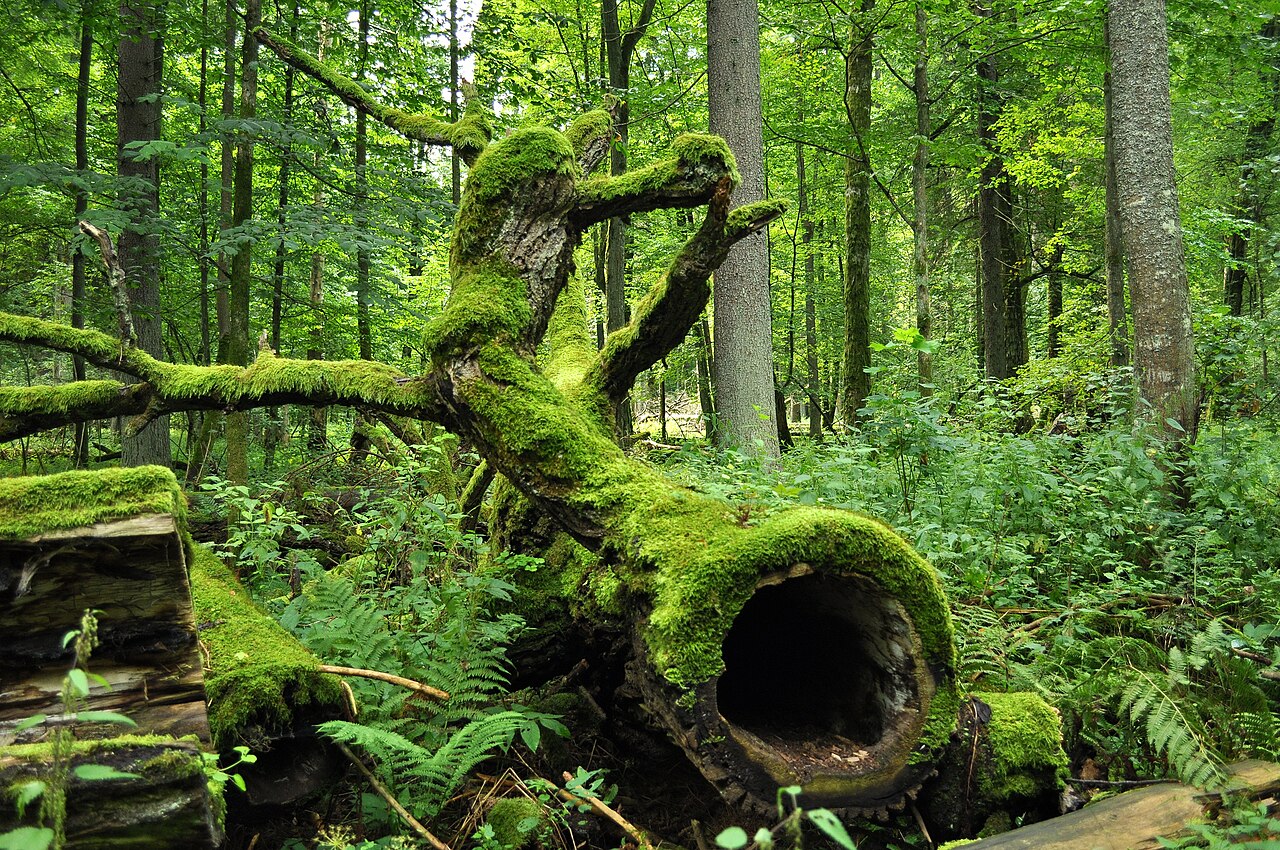
Białowieża Forest draws the largest international audience, partly because of its shared status with Poland and the infrastructure that exists on the Polish side. The Belarusian sector, managed as a strict nature reserve, is in some respects more intact — access is controlled, and guided entry into the core zone is required. The forest’s old-growth stands, some of the trees several hundred years old, represent the closest surviving analogue to the lowland forest that once covered much of the North European Plain.
For visitors oriented toward architectural heritage, Mir Castle Complex in the Grodno Region offers something genuinely layered. Construction began in the late fifteenth century in a Gothic mode, and the building passed through Renaissance and Baroque phases as ownership changed — a physical record of shifting dynastic and cultural currents. Nesvizh Castle, associated with the Radziwiłł family across several centuries, incorporates a Corpus Christi church that served as a dynastic mausoleum and carried Italian Baroque influence deep into Central and Eastern Europe. The Struve Geodetic Arc is the least visually spectacular of the four but arguably the most intellectually striking: the Belarusian points in this 2,820-kilometre chain of triangulation stations were part of Friedrich Georg Wilhelm von Struve’s nineteenth-century project to measure the exact size and shape of the Earth.
Natural and shared sites
Białowieża Forest is Belarus’s sole natural World Heritage Site, and it functions quite differently from the country’s three cultural inscriptions. The property is a living ecosystem — home to the European bison, the continent’s heaviest land animal, which was reintroduced here after becoming extinct in the wild in the early twentieth century. The forest straddles a national border, and joint management between Belarus and Poland is an ongoing dimension of the site’s stewardship.
The Struve Geodetic Arc, while classified as a cultural site, also crosses borders on a scale unusual for any World Heritage property. The full arc runs through ten countries — Norway, Sweden, Finland, Russia, Estonia, Latvia, Lithuania, Belarus, Moldova, and Ukraine — with the Belarusian segment contributing several of the original triangulation points. What survives are physical markers: stone pillars, drilled holes in rock, iron crosses set into the ground — modest objects that represented a major leap in humanity’s understanding of its own planet.
How to find them
Belarus’s four World Heritage properties are distributed across the country: Białowieża Forest lies on the western border with Poland; Mir and Nesvizh are in the Grodno and Minsk regions respectively, roughly 80 kilometres apart and often visited in sequence; the Struve Arc points are scattered more widely. Practical access to the forest reserve requires advance arrangement; the castle complexes are accessible independently and both have been substantially restored in recent decades.
Belarus’s World Heritage sites sit alongside thousands of other places on CHO’s interactive map, with GPS and sourced editorial history for each. See also our guides to Italy’s and France’s UNESCO sites, and our piece on cultural travel beyond mass tourism.
Frequently Asked Questions
How many UNESCO World Heritage Sites does Belarus have?
Belarus has four UNESCO World Heritage Sites, as of 2021. Three are cultural properties — Mir Castle Complex, Nesvizh Castle, and Belarus’s section of the Struve Geodetic Arc — and one, Białowieża Forest, is a natural site shared with Poland.
What was Belarus’s first UNESCO World Heritage Site?
Białowieża Forest became associated with Belarus in 1992, when the Belarusian portion of the forest was added as an extension to Poland’s original 1979 inscription. It remains the country’s only natural World Heritage property.
What is the Struve Geodetic Arc and why is it a World Heritage Site?
The Struve Geodetic Arc is a 2,820-kilometre chain of triangulation survey points used in the nineteenth century by astronomer Friedrich Georg Wilhelm von Struve to calculate the precise size and shape of the Earth. It is recognised as a World Heritage Site for its outstanding contribution to the earth sciences and spans ten countries, including Belarus. The inscription dates to 2005.
Are Mir Castle and Nesvizh Castle close to each other?
The two castles are approximately 80 kilometres apart in the western part of Belarus, and they are frequently visited as a pair. Both are connected to the Radziwiłł dynasty and were inscribed on the same year, 2005; Mir’s layered Gothic-Renaissance-Baroque architecture and Nesvizh’s role as a dynastic mausoleum complex make them complementary rather than repetitive stops.
Sources used in this article
- UNESCO — State Party Belarus — World Heritage list.
- UNESCO — Belarus: World Heritage Sites.
- CHO magazine — What is a World Heritage Site?
- CHO — Interactive map of heritage sites.