Bahrain has 3 UNESCO World Heritage Sites — a compact roster that punches well above its weight, spanning Bronze Age harbours, coral-harvesting economies, and one of the largest prehistoric burial landscapes on earth. For an archipelago of 780 square kilometres in the Arabian Gulf, that is a remarkable density of layered significance. From Cultural Heritage Online.
Why Bahrain’s list looks the way it does
All three of Bahrain’s inscribed properties are classified as cultural heritage. The absence of natural sites from the inscribed list does not reflect a lack of ecological value — Hawar Islands Reserve, with its migrating birds, coral reefs, and marine mammals, sits on the tentative list — but it does reflect the sheer depth of human activity that defines this archipelago. Bahrain stands at a crossroads that has been exploited by traders, pearl divers, and empire builders for roughly four millennia.
The UNESCO criteria applied across Bahrain’s three inscriptions share a consistent thread: evidence of long-distance exchange and of civilisations that used the sea as a highway rather than a boundary. The Dilmun civilisation, centred here from around 2300 BCE, connects all three sites conceptually even where they are separated by geography and function.
The first inscriptions
Bahrain’s first UNESCO inscription came in 2005, with a single site that immediately established the islands’ profile on the world heritage map:
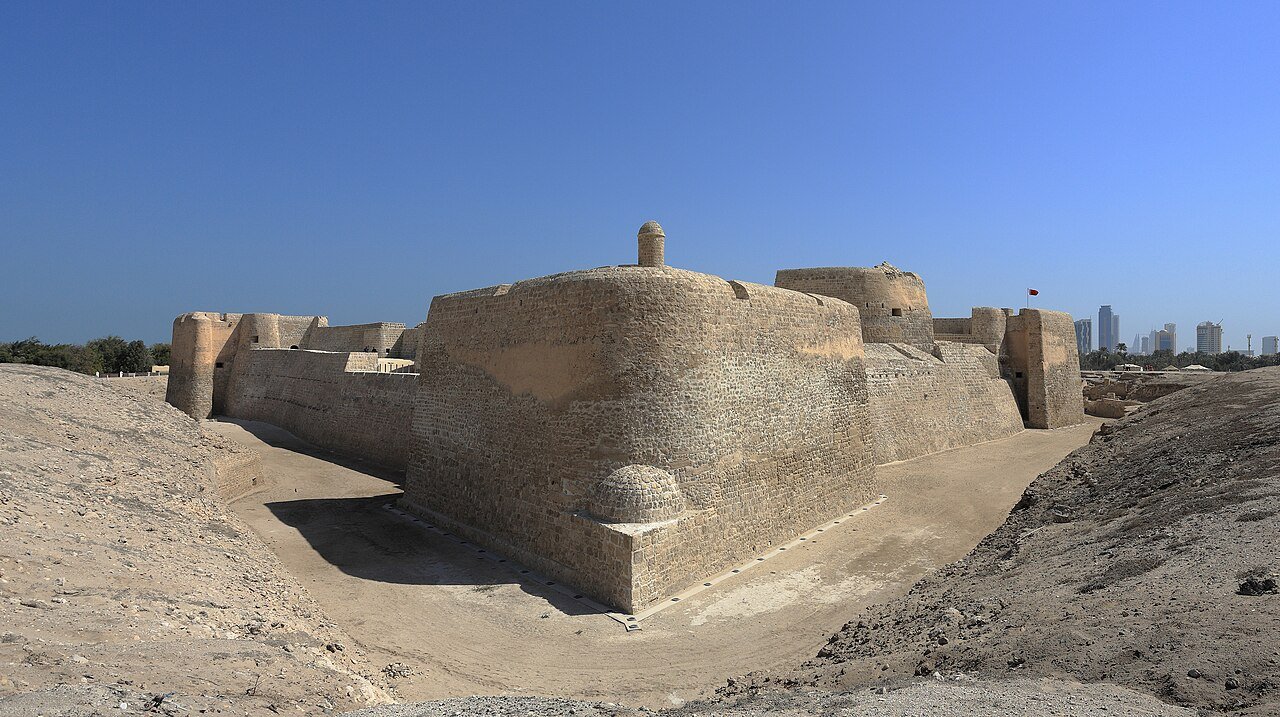
- Qal’at al-Bahrain — Ancient Harbour and Capital of Dilmun (2005): a tell built up over centuries of continuous occupation, preserving the remains of a harbour city that served as a transit point between Mesopotamia and the Indus Valley.
The choice of Qal’at al-Bahrain as the opening entry was logical. The site’s layered stratigraphy runs from the Dilmun period through Kassite, Assyrian, Greek, Parthian, and Portuguese phases, making it one of the most compressed records of Gulf history anywhere in the region. Its 2005 designation gave Bahrain an immediate anchor for cultural tourism and set the interpretive frame for the inscriptions that followed.
The most visited — and the alternatives
Qal’at al-Bahrain — better known informally as the Portuguese Fort, even though its occupation long predates Portuguese presence — remains the most internationally recognised of the three sites. The imposing sixteenth-century fort structure visible above ground is in fact only the uppermost layer of a tell that extends downward through millennia of settlement. Visitors who spend time at the site’s dedicated museum understand how much lies beneath the walls they can walk along.
Two less-examined inscriptions reward closer attention. The 2012 entry, Pearling, Testimony of an Island Economy, encompasses seventeen historic buildings in the town of Muharraq alongside offshore oyster beds — an integrated urban and marine landscape that documents the pearl trade that sustained Bahrain economically until the 1930s. It is one of the few UNESCO inscriptions worldwide to treat a vernacular merchant cityscape and its working sea as a single property. The 2019 inscription, Dilmun Burial Mounds, is a serial nomination of twenty-one archaeological sites across three governorates, containing more than 10,000 individual mounds dating from roughly 2200 to 1750 BCE. The scale is difficult to absorb from ground level; the site reads differently on aerial imagery, where the sheer density of the funerary landscape becomes apparent.
Natural and shared sites
As of 2024, Bahrain has no inscribed natural or mixed World Heritage Sites. The tentative list includes Hawar Islands Reserve, submitted in 2001, which encompasses coral reef systems, seagrass beds, and habitat for significant populations of migratory birds and marine mammals including dugong. Inscription would represent a meaningful addition to a list that currently reflects only the human dimension of Bahrain’s long relationship with the Gulf.
None of Bahrain’s current inscriptions are transnational in the sense of shared sovereignty, though the Dilmun Burial Mounds nomination functions as a domestic serial property distributed across multiple governorates. The Dilmun civilisation itself extended across what is now Kuwait, eastern Saudi Arabia, and the coasts of the UAE — a geographic scope that has occasionally prompted discussion of future cross-border serial nominations in Gulf archaeology, though nothing has been inscribed under that framework to date.
How to find them
All three inscribed sites are accessible from Manama within a manageable day, and Muharraq — the base for exploring the Pearling landscape — is connected to the main island by causeway. Qal’at al-Bahrain sits on the northern coast; the Dilmun Burial Mounds are distributed across the interior and west of the main island, with the most concentrated fields near A’ali. Opening hours and access conditions vary by site and season; checking with the Bahrain Authority for Culture and Antiquities before visiting is advisable, particularly for the burial mound sites where conservation work is ongoing.
Bahrain’s World Heritage sites sit alongside thousands of other places on CHO’s interactive map, with GPS and sourced editorial history for each. See also our guides to Italy’s and France’s UNESCO sites, and our piece on cultural travel beyond mass tourism.
Frequently Asked Questions
How many UNESCO World Heritage Sites does Bahrain have?
Bahrain has 3 inscribed UNESCO World Heritage Sites as of 2024, all classified as cultural properties. An additional six sites appear on the country’s tentative list, including the Hawar Islands Reserve, which would be Bahrain’s first natural inscription if approved.
What was Bahrain’s first UNESCO World Heritage Site?
Bahrain’s first inscription was Qal’at al-Bahrain — Ancient Harbour and Capital of Dilmun, designated in 2005. The site preserves a stratified tell documenting over four millennia of continuous occupation, from the Dilmun Bronze Age civilisation through to the early modern period.
What are the Dilmun Burial Mounds and why are they significant?
Inscribed in 2019, the Dilmun Burial Mounds comprise twenty-one archaeological sites across three of Bahrain’s governorates, containing more than 10,000 burial mounds dating from approximately 2200 to 1750 BCE. They represent one of the largest and best-preserved prehistoric funerary landscapes in the world, offering direct evidence of the Dilmun civilisation’s scale and its beliefs about death and the afterlife.
What does the Pearling inscription in Muharraq cover?
Inscribed in 2012, Pearling, Testimony of an Island Economy encompasses seventeen historic structures in the town of Muharraq alongside the associated offshore oyster beds. The inscription documents the full chain of the pearl trade — from harvesting at sea to merchant houses onshore — which was the economic foundation of Bahraini society until the global pearl market collapsed in the 1930s.
Sources used in this article
- UNESCO — State Party Bahrain — World Heritage list.
- UNESCO — Bahrain: World Heritage Sites.
- CHO magazine — What is a World Heritage Site?
- CHO — Interactive map of heritage sites.