
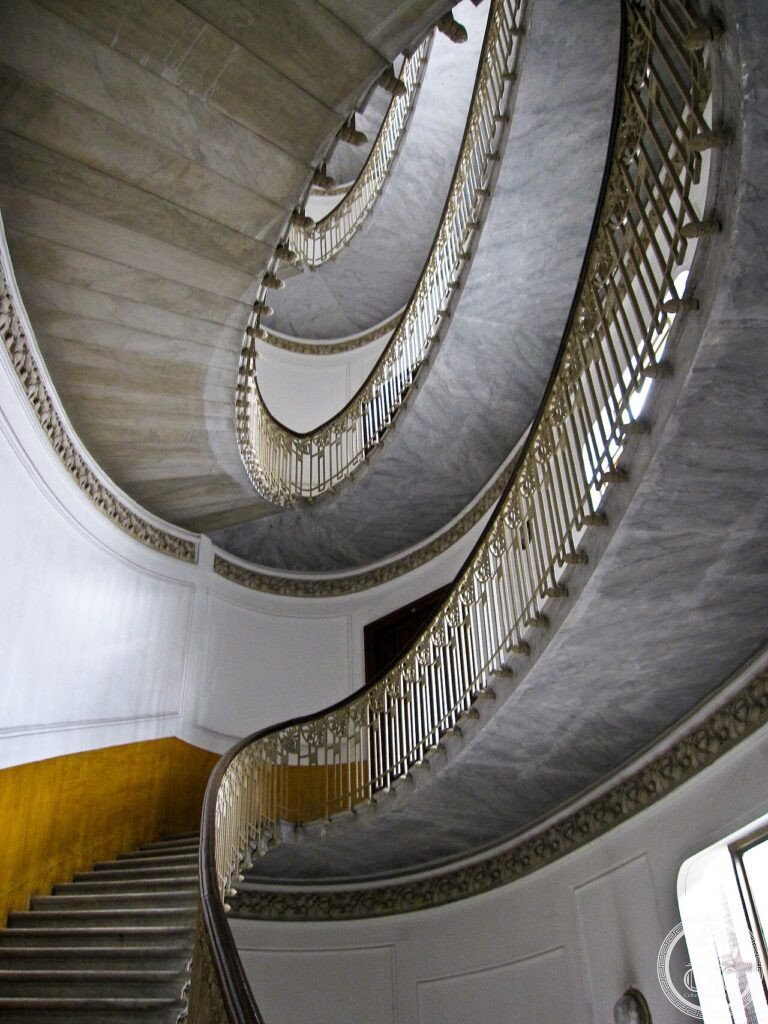
Step into the atrium of Palazzo Mannajuolo on Via Filangieri and look up. An oval staircase spirals through six storeys of wrought-iron vines and glass, the dome above it filtering daylight into a space that feels like the inside of a jewel box. It was completed in 1911 — a high-water mark of the Liberty style that swept through Naples at the turn of the century and left behind a handful of exquisitely ornate buildings before Italian architecture took a hard turn toward the stripped and the severe. The staircase is the walk’s opening argument: by the time you reach the Mostra d’Oltremare, three decades and a world war later, every surface will have been scrubbed of ornament, every curve straightened, every vine replaced by a column.
Between 1909 and 1940 Naples built a compressed version of the argument that ran through all of Italian architecture: how should a modern city look? The Liberty architects said: with flowers and curves and beautiful excess. The Rationalists of the 1920s said: with geometry and discipline and materials used honestly. The Fascist state said: with power and marble and an empire. All three are visible in this city, within walking distance of each other, and their conversation — often more like a fight — is what this walk is about.
Armando Mancini from Napoli, Italia · CC BY-SA 2.0 · Wikimedia Commons
The Liberty Prelude
Francesco Paolo Mannajuolo designed his family building at Via Filangieri 36 between 1909 and 1911, in a city where the bourgeoisie of the Chiaia quarter were spending the profits of the Giolittian economic boom on ornament. The Art Nouveau style — called Liberty in Italy, after the London store that popularised it — was exactly the right language for a class that wanted to look modern and prosperous and not quite like the baroque Naples of the Bourbons. The staircase is the building’s self-declaration: this is what a family of means, confident in the future, looks like when it builds itself a home.
It is also, with hindsight, a last hurrah. By the time the Mannajuolo building was three years old, the First World War had begun. By the time it was ten, the Fascist movement was marching. The ornament that seemed to announce progress in 1911 would be read as decadence by 1930. This is not the first time in European history that architecture has been caught on the wrong side of a turning point — and the buildings that survive those turns are often the most interesting ones to revisit.
The Port and the Street
Lalupa · CC BY-SA 4.0 · Wikimedia Commons
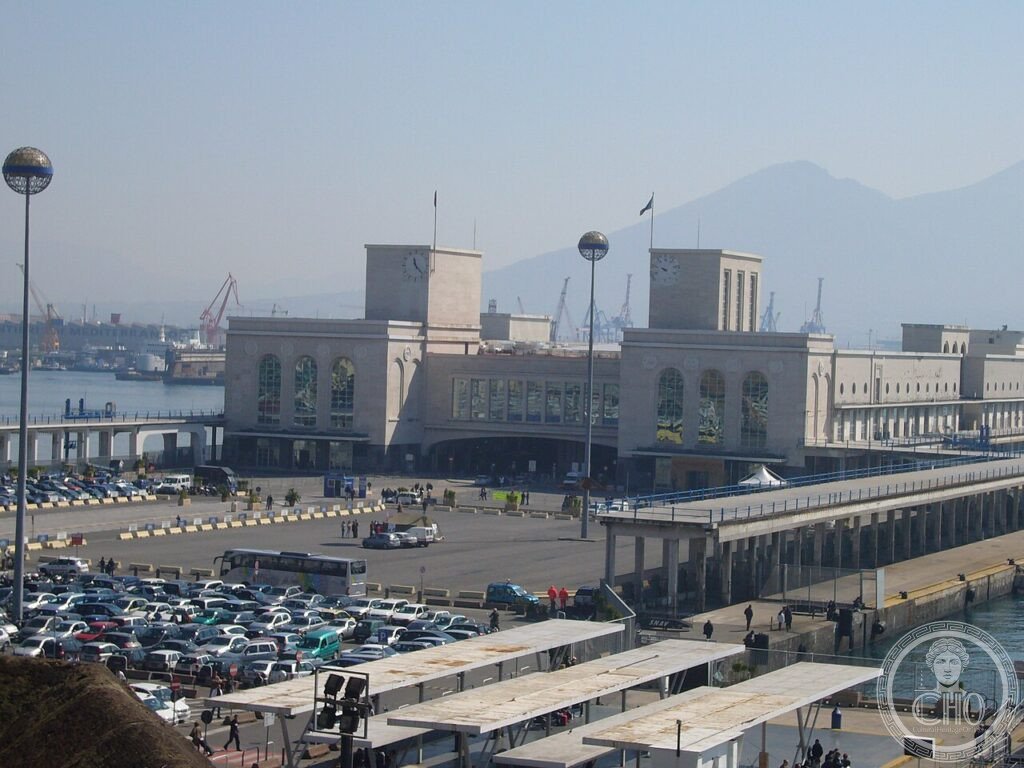
Cesare Bazzani completed the Maritime Station in 1936, giving Naples a rationalist face for the decade of mass emigration and luxury travel. The building sits at Molo Angioino, turning toward the sea: it was built to be arrived at, not to be lived beside. Bazzani stripped the classical vocabulary to rhythm and horizontal emphasis and pale rendered surfaces — the language that the regime was establishing as the official idiom of public architecture in southern Italy. The Maritime Station is the first building most Neapolitans built by the regime see, and its restraint, compared with what follows, is almost gentle.
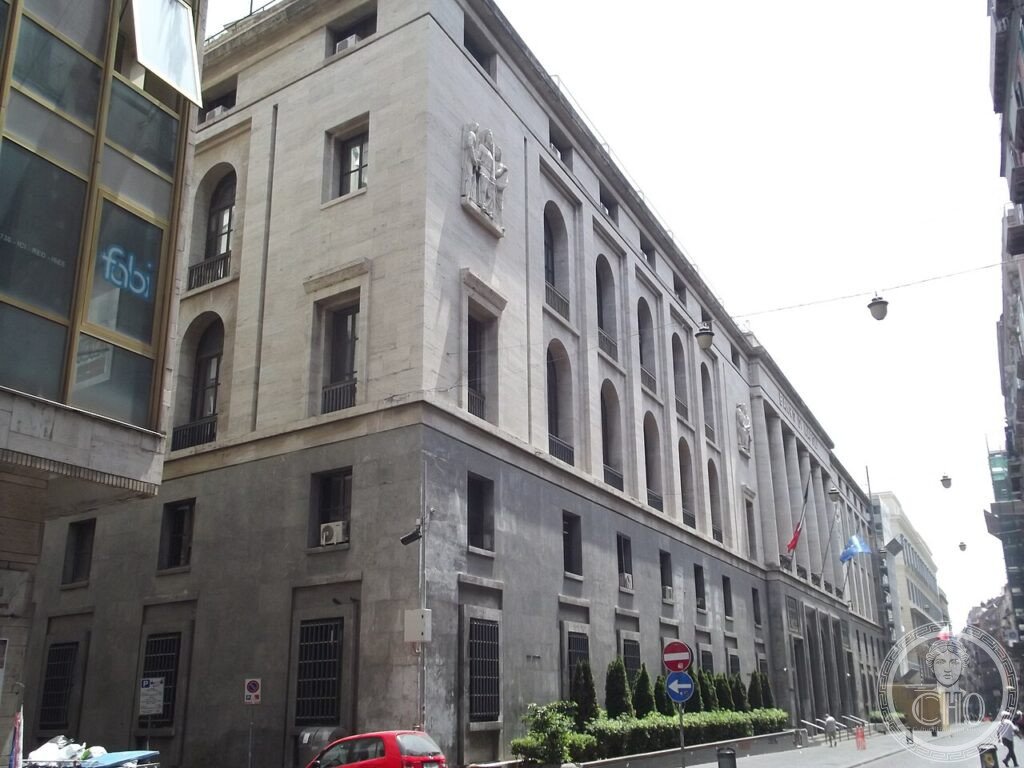
The transformation of Via Toledo — Naples’ main street, running north from Piazza del Plebiscito to the Quartieri Spagnoli — tells the story of the 1930s in a single long straight line. Piacentini’s Palazzo del Banco di Napoli, completed in 1940 at no. 177, is the set piece. A giant order of pale stone pilasters spans the length of the facade; the openings are regular, the proportions Roman, the ornament absent. Inside, the assembly hall is clad in marble brought from Ethiopia, which Italy had invaded and occupied in 1935. The building opened on 9 May 1940, the fourth anniversary of the proclamation of the Italian Empire in East Africa — the date was not accidental.
Elliott Brown · CC BY 2.0 · Wikimedia Commons
A few blocks away, the Palazzo delle Poste on Piazza Matteotti occupies a square that exists because Mussolini’s urban renewal programme demolished an older neighbourhood to make room for a monumental civic core. The post office — still operating — is the useful face of that clearance: a building designed to serve the city in the most everyday sense, which makes it, paradoxically, one of the most honest of the decade’s constructions. The Casa del Mutilato, a welfare centre for war veterans built in 1938, completes the civic cluster with the regime’s most loaded subject: the bodies of men whose sacrifice had made the empire possible, commemorated in the same stripped-classical language as the bank and the post office.
The Exhibition That War Closed
Johnnyrotten · Public domain · Wikimedia Commons
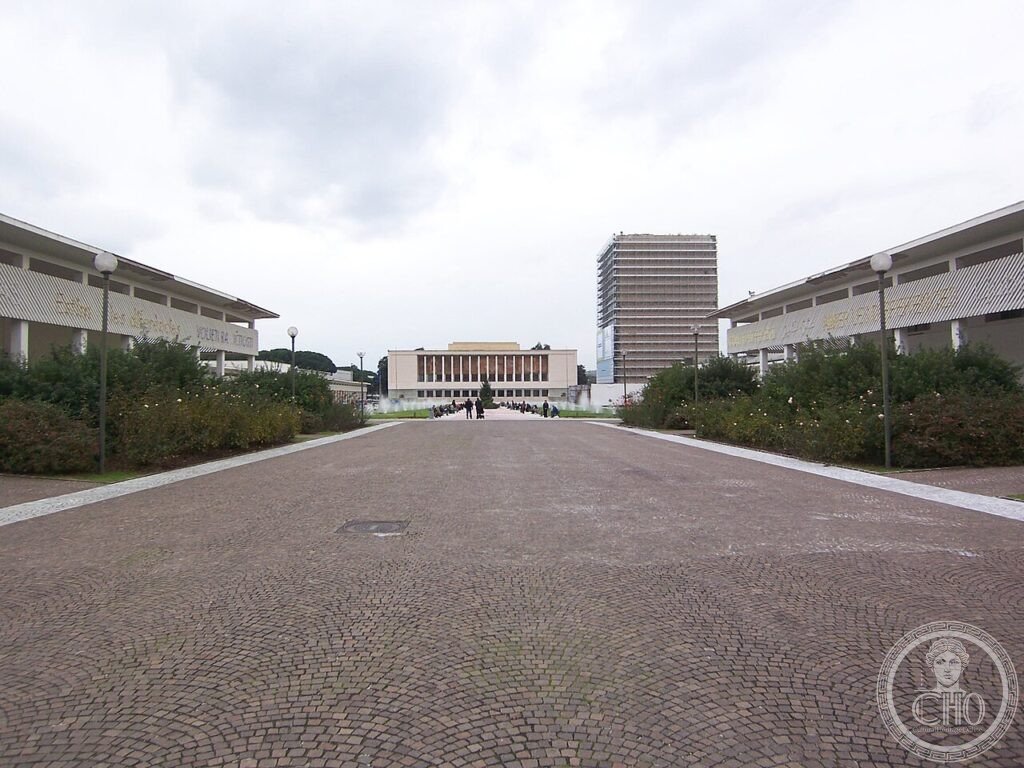
In 1937 the regime announced a Triennial Exhibition of Italian Overseas Lands, to be built on 72 hectares of the Conca Flegrea plateau in Fuorigrotta, west of the city centre. The deadline was 9 May 1940 — the fourth Empire anniversary — and sixteen months was all the architects, Luigi Cosenza, Stefania Filo Speziale, Marcello Canino and others, were given to build 36 pavilions, an arena, two theatres, a pool, restaurants and cafes and a wildlife park. They delivered on time. The exhibition opened as promised. It closed five weeks later, when Italy entered the Second World War.
The Mostra d’Oltremare was conceived as a celebration of Italian colonialism — “Overseas” meant Ethiopia, Libya, Eritrea, Somalia, Dodecanese — and its architecture reflected that programme. The pavilions used rationalist planning organised around a colonial content: exhibitions of Italian agriculture in Africa, Italian industry in the colonies, Italian naval power in the Mediterranean. The central Fontana dell’Esedra still stands. Allied bombing in 1943 destroyed 60 percent of the buildings. The complex reopened in 1952 as a venue for exhibitions of Italian labour and industry, its colonial programme quietly retired, its architecture repurposed as commercial infrastructure. Today it hosts trade fairs and concerts, and the original palm-lined Viale Augusto looks much as it did in the photographs of May 1940.
Walking the site now is an exercise in historical layering — the surviving rationalist pavilions, the postwar reconstruction, the current commercial occupation, the archaeological park underneath (the plateau sits above Roman remains) — that the original architects could not have predicted and that the regime would not have wanted. The empire for which the exhibition was built lasted three years. The pavilions are still standing.
Naples compressed a particular argument about architecture and politics into three decades: from the ornamental confidence of Liberty to the austere certainty of Rationalism to the imperial ambition of the Mostra, and then to the rubble of 1943. What survives — the staircase, the maritime station, the bank, the post office, the exhibition grounds — is a city reading its own history in its own walls.
Continue the inter-war architecture thread with the Rome Rationalism RoadBook (EUR, Foro Italico, Sapienza) and the Milan Rationalism RoadBook (Terragni, Muzio, Piacentini).
Walk this itinerary: Naples Architecture RoadBook — 6 stops, maps and insider notes.