
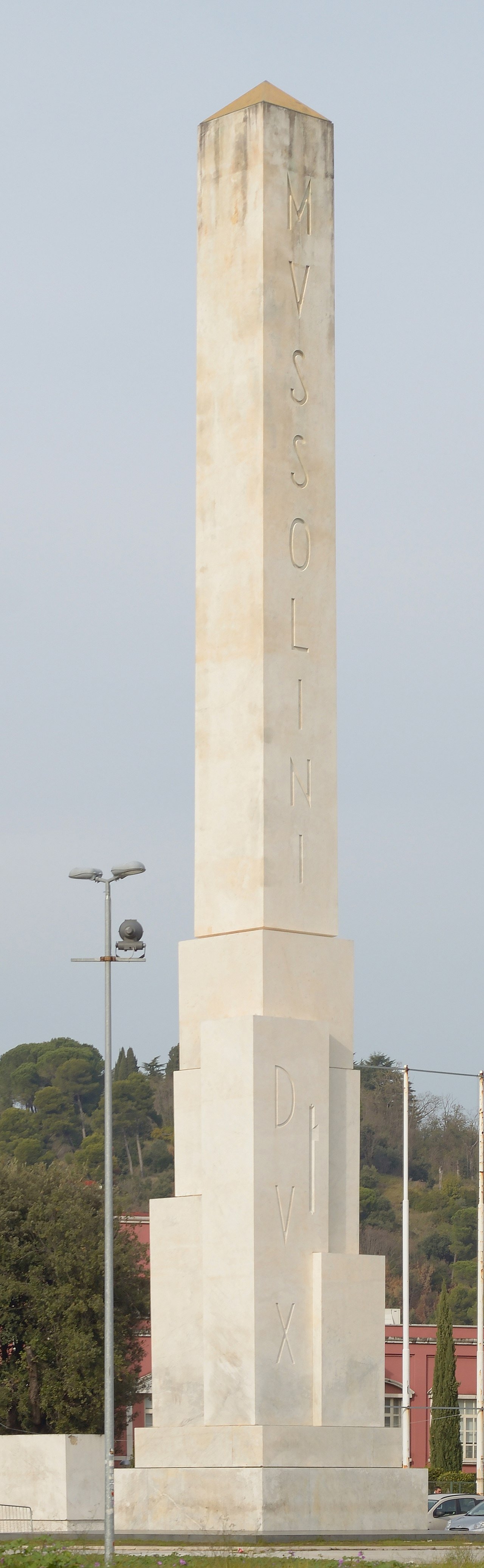
The entrance to the Foro Italico — once the Foro Mussolini — is marked by a monolith of Carrara marble seventeen metres tall. Carved into its base, in letters that the post-war government chose not to remove, are the words “MUSSOLINI DVX”. It is the first thing you see when you approach from the river, and a reasonable introduction to what follows: a tour of some of the most architecturally ambitious, morally complex and surprisingly little-known buildings in Rome.
Between 1927 and the mid-1950s, the Italian capital was rebuilt on a scale it had not seen since the Baroque. The government of Benito Mussolini — determined to fuse Roman antiquity with modern nationalism — commissioned a sports complex north of the city, a new university campus to the east, post offices in the working-class neighbourhoods, and an entire new district on the southern edge: EUR, the Esposizione Universale Roma, a planned city for an exhibition that the Second World War cancelled before it could open. Many of the architects who built these things were genuinely talented. Some were ideological true believers; some were opportunists; at least one — Giuseppe Pagano — died in a Nazi concentration camp after publicly breaking with the regime he had served. The buildings they left behind are a document of all of this, and they repay a long look.
Livioandronico2013 · CC BY-SA 4.0 · Wikimedia Commons
The Sports Citadel
Enrico Del Debbio received the commission for the Foro Mussolini in 1927 and spent the following decade building out a complete sports complex on a bend of the Tiber north of the city. The result — pools, tennis courts, training academies, a marble stadium, a fencing academy and a processional axis lined with mosaics — was one of the most ambitious architectural gestures of the Fascist period, and remains among the most coherent. The seventeen-metre obelisk at the entrance was inscribed “MUSSOLINI DVX” in 1932 and has never been touched since. You can read it as an oversight, a deliberate monument to a difficult history, or something between the two. Romans do not agree.
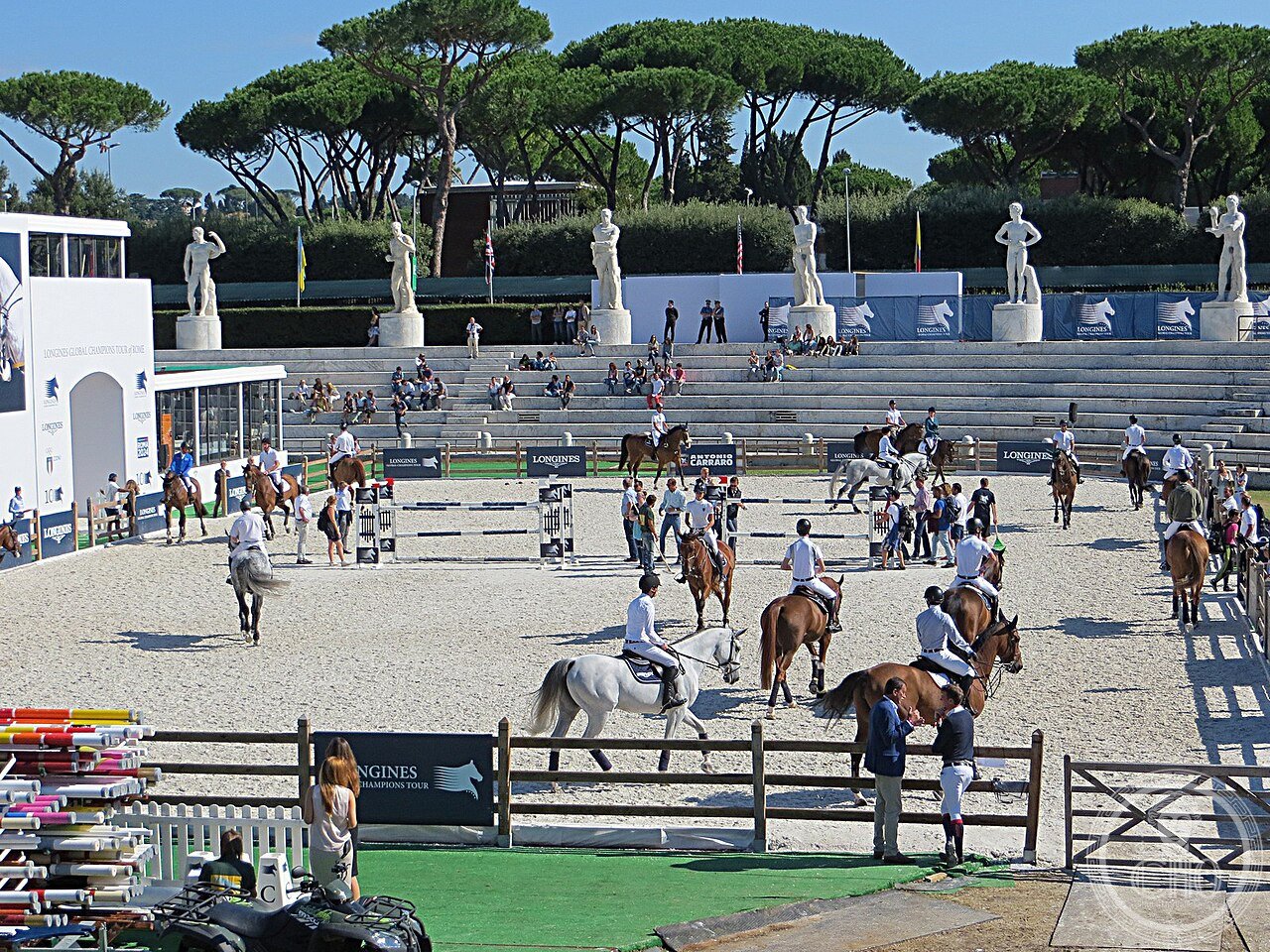
Immediately south of the main academy building, the Stadio dei Marmi was completed by Del Debbio in 1932. Sixty white Carrara statues ring the open athletics field — one commissioned from each province of Italy, each depicting a different sport. The provinces competed through their sculptors, which means the quality and style of the figures varies considerably. Walk the full circuit and you will find stylistic range from classical refinement to something more expressionist, all frozen in the same white marble. The stadium was built for athletics and ceremony rather than crowds: no covered stand, just the marble ring looking inward at the field.
Mister No · CC BY 3.0 · Wikimedia Commons
The most architecturally remarkable building in the complex is the Casa delle Armi, completed in 1936 by Luigi Moretti at the age of twenty-nine. This fencing academy is built almost entirely in glass and reinforced concrete: a single vast hall where natural light pours through a continuous glass wall of industrial scale, delivering the shadow-free, even illumination that fencing demands. The brief was purely technical; the result is one of the most spatially compelling interiors of Italian rationalist architecture. The same architect — who was subsequently imprisoned after 1945, rehabilitated and went on to design the Watergate complex in Washington DC — never built anything more purely itself.
Knowledge as Power
Góngora · CC BY-SA 4.0 · Wikimedia Commons
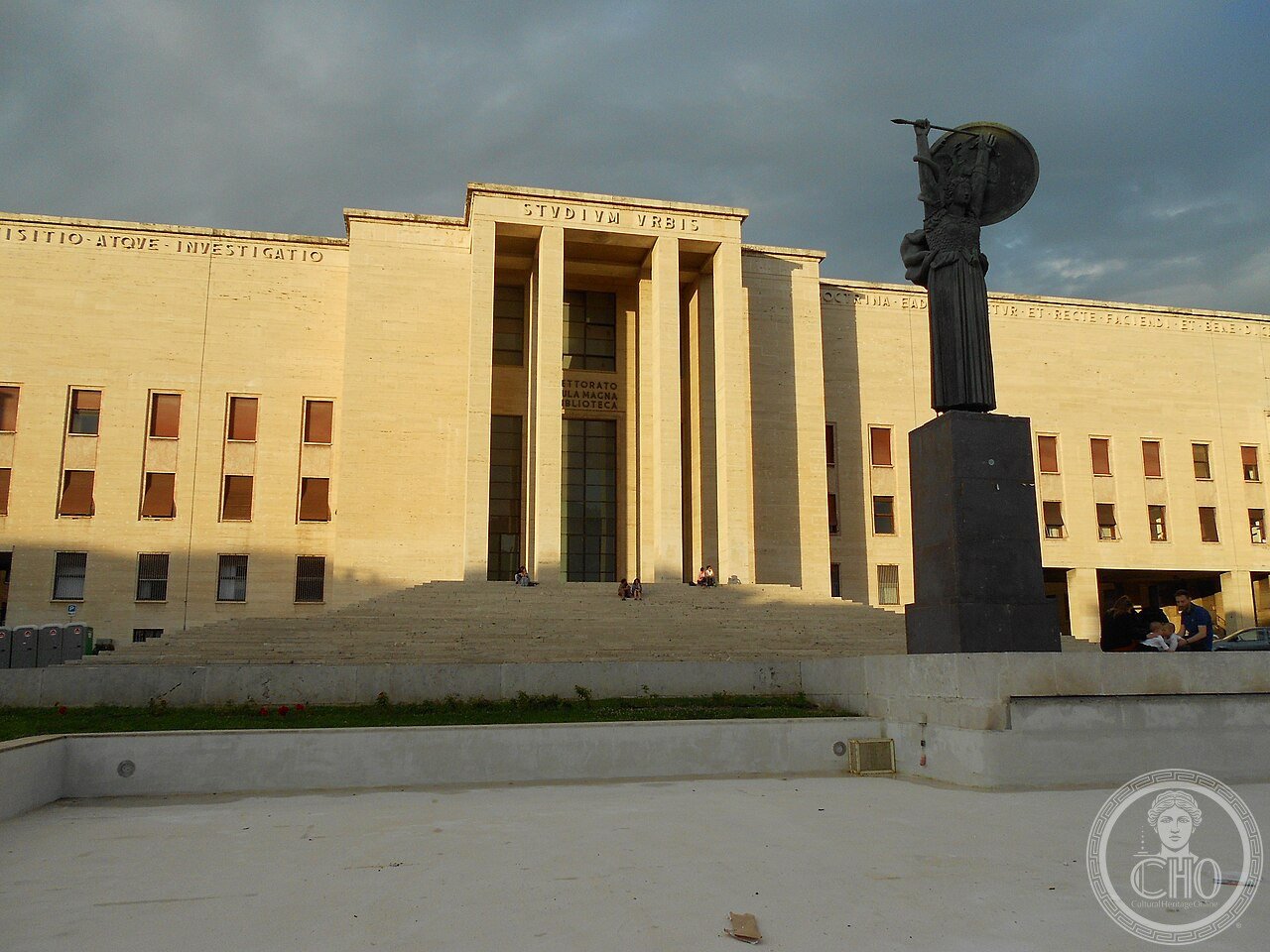
A bus and metro ride east brings you to the Sapienza campus, where Marcello Piacentini coordinated a collective project of unusual ambition: a new university for the ancient institution, built in three years between 1932 and 1935, with individual faculty buildings commissioned from a roster of Italy’s finest architects. The list is extraordinary: Gio Ponti, Giovanni Michelucci, Arnaldo Foschini, Pietro Aschieri and — most fatefully — Giuseppe Pagano.
Pagano contributed the Institute of Physics: the building where Enrico Fermi and his team conducted the early experiments that preceded nuclear fission. At the time, Pagano was an enthusiastic Fascist, editing the journal Casabella in a voice that aligned Rationalist architecture with the regime’s modernist ambitions. By the early 1940s he had broken with the movement, publicly and at considerable cost. He joined the Resistance, was arrested by the German SS in 1943, and died in Mauthausen concentration camp in April 1945. His Physics building stands thirty metres from Piacentini’s grandiloquent Rectorate — the most compromised building on the campus — as if history had not happened between them. The Sironi mosaic on the Rectorate facade, Minerva presiding over Rome in a language borrowed equally from antiquity and propaganda, is the campus’s most intense single image. Pagano’s quieter faculty buildings are better architecture.
A short detour via bus or metro to Testaccio adds Adalberto Libera and Mario De Renzi’s 1935 post office on Via Marmorata: a building that strips classical Roman architecture to its proportions — the symmetry, the rhythm of openings, the travertine cladding — and removes all ornament. The result is monumental without being heavy, modern without being cold. Still a working post office, it remains among Rome’s least-visited rationalist buildings and among its most satisfying.
The City That Never Was
In 1936 Mussolini announced a world exhibition for 1942 — the twentieth anniversary of the March on Rome — to be held on a plateau south of the city. Piacentini was given the master plan; Libera, Guerrini and others designed the major buildings. The exhibition was cancelled when Italy entered the war in 1940. Construction continued intermittently; the district was completed only in the 1950s under the Italian Republic, which finished what the regime had started and turned EUR into a functioning residential and commercial neighbourhood. The result is one of the strangest and most coherent planned urban environments in Italy: wide boulevards, formal plazas, rationalist monuments and a lakeside promenade where Romans walk dogs and eat gelato among buildings that were designed to celebrate an empire.
Alberti1492 · CC BY-SA 4.0 · Wikimedia Commons
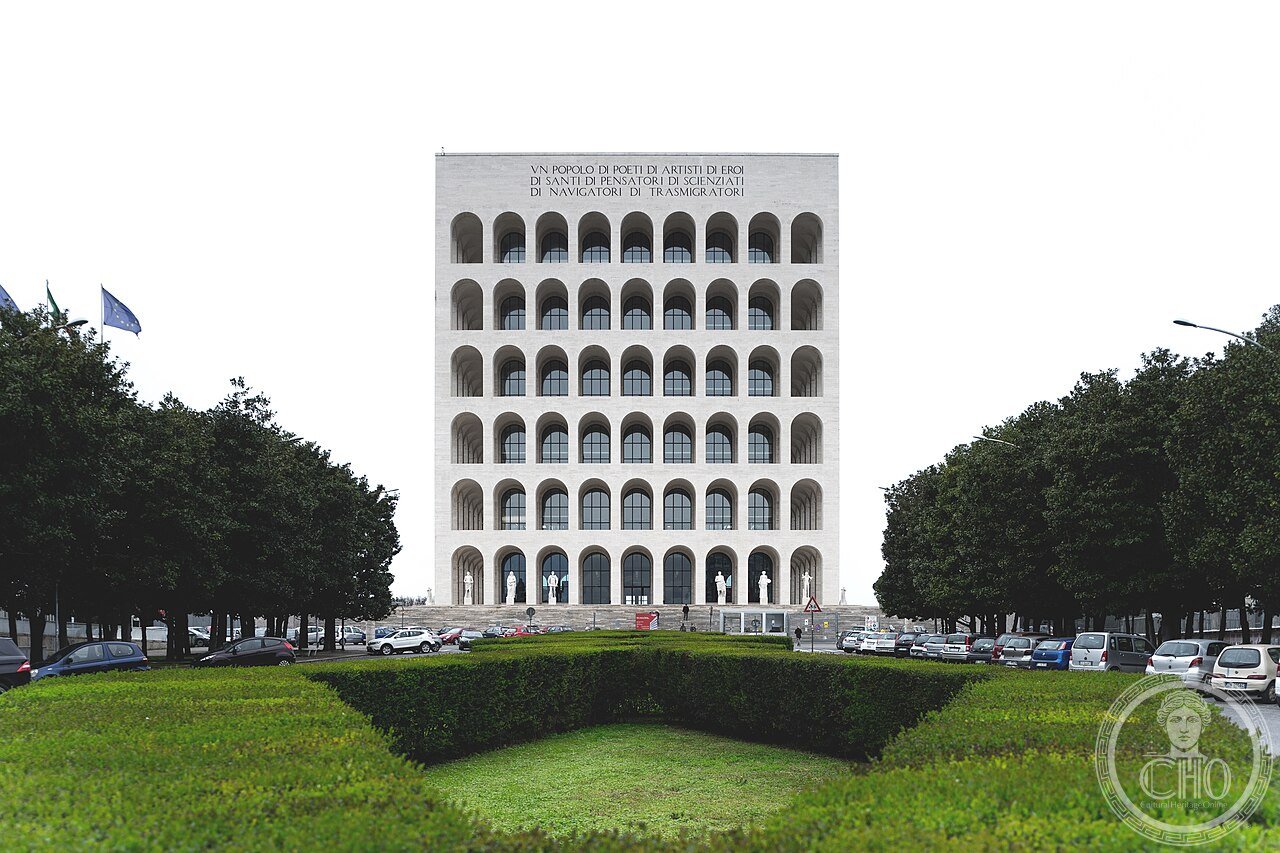
At the heart of EUR stands the Palazzo della Civiltà Italiana, completed in 1943 by Guerrini, La Padula and Romano. Six floors of arched travertine bays — 216 in total — create a building that appears circular from any angle despite being exactly square in plan: an optical illusion that still stops visitors mid-approach. The inscription on all four facades names the Italian people as poets, artists, heroes, saints, thinkers, scientists, navigators and emigrants. The building was never used for its original purpose. It stood empty for decades, served briefly as a television studio, and since 2015 has been the Rome headquarters of Fendi. It is simultaneously the most photographed building in EUR and the one whose meaning is hardest to fix.
A seven-minute walk brings you to the Palazzo dei Congressi, first designed by Adalberto Libera in 1937 and finally built in 1954 — seventeen years later, under a different government, after a world war and a change of regime. Libera spent those seventeen years revising the design; the enforced austerity of the post-war period stripped away the more grandiose elements of the original and left something purer. The great barrel-vaulted entrance hall — one of the largest single interior spaces in Rome, clad in travertine and marble — is both the product of the original Fascist commission and of the Republic that executed it. The building is still in active use as a congress centre, which is the best possible outcome: designed for assembly, used for assembly, fifty years after the government that commissioned it was dismantled.
The walk ends at the Museum of Roman Civilization, its long travertine wings closing the south side of a formal piazza. Built between 1939 and 1955 to house plaster casts of Roman monuments and the great Plastico di Roma — a 200-square-metre scale model of the city under Constantine — the museum was the civilisational arm of the same propaganda project that raised the Colosseo Quadrato next door. Both are still standing. Rome, as it tends to do, outlasted the people who tried to reshape it in their own image.
Continue the inter-war architecture thread with the Milan Rationalism RoadBook (Terragni, Muzio, Piacentini in the industrial capital) and the Turin Modernism RoadBook (Pagano’s Piedmontese years and the Lingotto).
Walk this itinerary: Rome Rationalism RoadBook — 8 stops, maps and insider notes.